Challenges such as poor walkways and unsafe crossings are discouraging some city residents from using nearby train stations.
Can building houses above train stations as well as providing direct access resolve such hardships?
In June, Prime Minister Datuk Seri Anwar Ibrahim said the government was collaborating with Kuala Lumpur City Hall (DBKL) to study a proposal on building housing above train stations to address traffic gridlock.
“This would involve building both public and private housing above train stations,” he said as reported by a local daily.
StarMetro spoke to experts in architecture, housing and public transport to assess the proposal’s feasibility and envision how such projects might take shape.
Above-ground stations

“Examples include Taman Tun Dr Ismail, Kajang, Cyberjaya, Sungai Buloh and Glenmarie stations, among others, which are all elevated train stations.
“Some other factors that make these stations suitable for housing-on-transit projects are the availability of adjacent land and their locations which are not in hyper-dense areas where land cost is prohibitive,” he said.
“Furthermore, these stations are located along corridors of planned urban expansion, where there is demand for new housing and other amenities such as schools.”
He added that the houses could also be built within an 800m stretch on either side of a station, and not necessarily directly above rail stops.
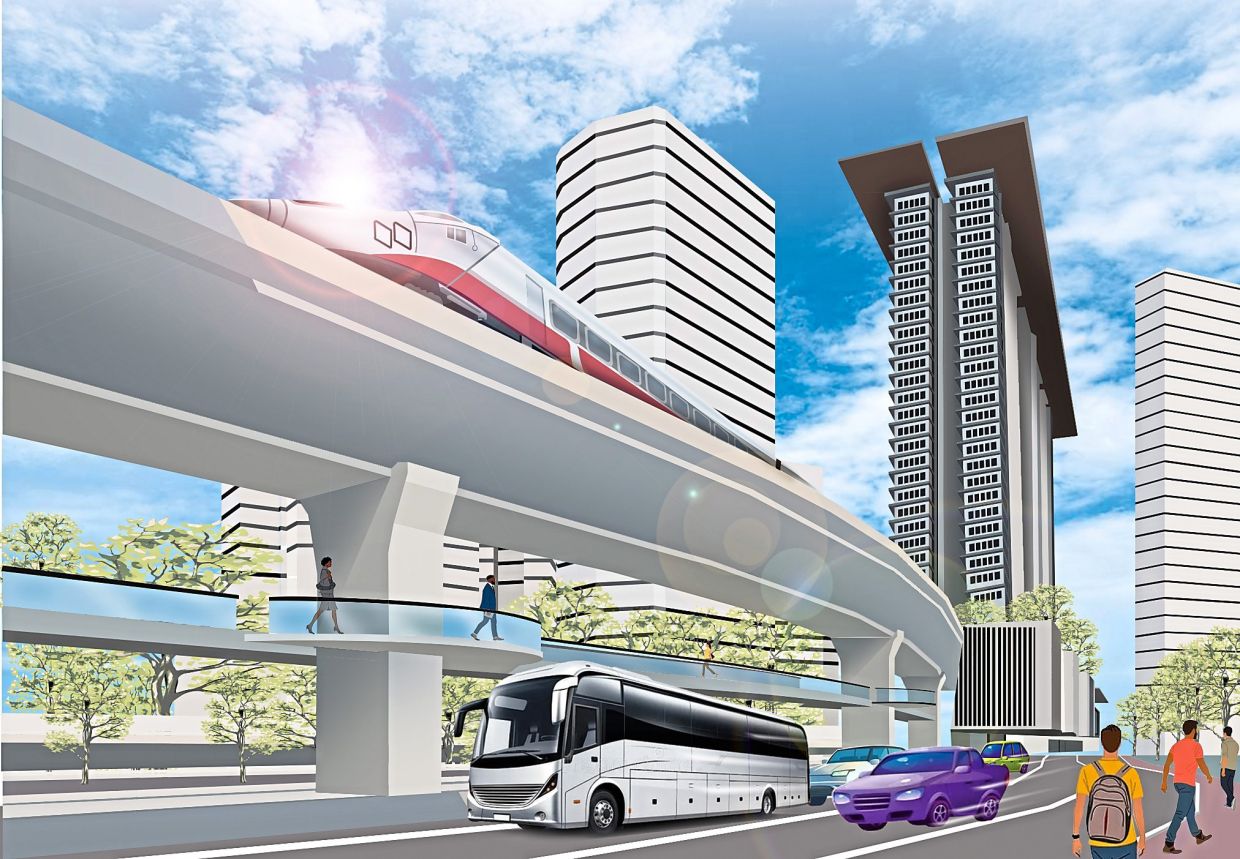
“The projects could feature elevated walkways linking housing units to the train stations.
“These walkways can be constructed along support beams of rail lines,” he said.
However, Azim said TOD projects required advanced structural design and architectural solutions to handle vibrations, noise and weight distribution issues.
“Building houses over rail infrastructure is more expensive.
“It requires detailed coordination and specialised construction methods. It would also cause temporary disruptions to rail lines involved,” he said.
“The projects must also comply with strict building codes and gain multi-agency approvals, including those related to fire safety, noise, vibration mitigation and structural loading.
“The people’s concerns about noise, privacy and visual aesthetics of the projects must also be addressed through thoughtful design and public consultations.”
He also suggested installation of acoustic baffles between train lines and buildings to reduce noise, adding: “Double or tripe-glazed windows could also be installed to reduce external noise and improve energy efficiency.
“The layout of buildings should also avoid direct exposure to rail noise through openings such as windows or balconies.”
Azim said there were existing projects integrated with train stations.
“One example is Plaza Pantai (now known as Bangsar Trade Centre), which is connected to the Kerinchi LRT station.”
During a site visit, StarMetro found that Bangsar Trade Centre was built around the LRT tracks, with amenities such as restaurants and convenience stores accessible to commuters.

When asked about whether TOD would drive up housing prices, Chang said some projects were expensive because they were developer-owned.
“Railway stations and tracks across the country are owned by Railway Assets Corporation (RAC),” he said.
“The Transport Ministry should study the viability of building housing on lands near train stations owned by RAC.”
RAC, a federal statutory body under the Transport Ministry, is responsible for developing Malaysia’s railway industry.
Underground stations
Malaysian Land Public Transport Fans (MLPTF) chairman Zac Cheong said some underground train stations could support developments situated above them.

“The idea of TOD is feasible, as higher building density would create a more compact city and reduce the need for long-distance travel.
“It could also help maximise land usage by filling up the airspace above the train stations, which are often unused,” he said.
Cheong said the idea could boost train ridership by solving the first- and last-mile connectivity issues faced by many commuters.
“It could reduce the need for residents to drive as the transit station is at their doorstep,” he added.
Regular public transport user Gabriel Lim said the connectivity offered by TOD housing could help people save money by reducing car expenses.
“So, public transport will naturally see higher ridership.

“Retailers within or around stations will also enjoy higher footfall,” he said.
Lim, who lives in Kelana Jaya in Petaling Jaya, Selangor, said he would consider purchasing housing units built above train stations.
“By living either directly above or close to train stations, we can significantly reduce reliance on our cars,” he said.
“This approach allows us to commute efficiently and reduce carbon emissions – a clear way forward for car-dependent cities.”
Right planning needed
In a statement, Prasarana Malaysia Bhd said the concept of building housing above train stations could integrate residential, commercial and transport infrastructure to promote a more sustainable, connected and liveable urban environment.
“We believe this initiative has the potential to address urban challenges such as traffic congestion, as well as improving public transport ridership and enhancing access to affordable housing in well-connected areas.
“However, these developments must strictly comply with the railway protection zone guidelines to ensure public safety and maintain the structural integrity of the train stations,” the statement read.
“With the right planning and safeguards, such projects can enhance urban liveability while supporting sustainable mobility.”
Prasarana also said several factors such as structural load, fire safety, accessibility, ventilation and passenger flow needed to be taken into account by above-ground transit housing projects.
“Depending on the location and design of the proposed housing developments, some level of redesign or retrofitting of existing facilities shall be required to minimise disruptions to the trains’ live operation,” the statement said.
“Redesign usually needs to meet local authority requirements while keeping live rail operations safe.
“Some redesigning measures include upgrading station access, establishing clear wayfinding, strengthening existing building structures and improving fire safety and ventilation.
“On roads around the train stations, measures usually cover introducing new pick-up and drop-off bays, reconfiguring bus bays and establishing safer pedestrian crossings.”
The statement further stated that Prasarana actively discussed and engaged with local authorities while reviewing development proposals within the transit areas.
“As a major public transport operator and landowner, Prasarana provides technical input and operational expertise to support the viability of these projects,” it said.
StarMetro reached out to DBKL and Housing and Local Government Ministry for comments, but had yet to receive replies as at press time.