



IT’S that time of the year when the boundaries between the living and the dead become blurred for many members of the Chinese community.
In Penang, the Hungry Ghost Festival, better known as Phor Thor in Hokkien, is often more elaborate here than elsewhere due to its unique blend of strong Hokkien traditions, community spirit and cultural identity, according to Penang Heritage Trust (PHT) president Clement Liang.
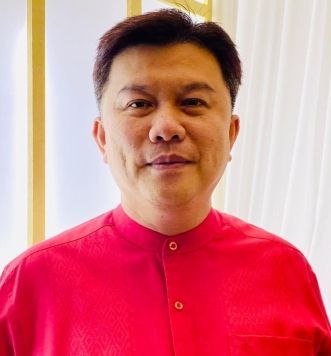
“These customs remained well-preserved because Penang’s Hokkiens maintained a strong cultural identity.
“In Penang, neighbourhood associations (huay kuan) and clan groups organise Hungry Ghost Festival rituals at the grassroots level and often compete to build the tallest Tai Su Yeah (King of Hades) effigies and host the grandest celebrations.
“This created a culture of large-scale, highly visible festivities, turning it into a signature festival.”
In Penang, the festival features free opera performances, getai (stage shows), auctions and community feasts, extending its significance beyond religion into the realms of heritage and entertainment, Liang said.
By contrast, the festival in China is usually observed more quietly within families or temples.
However, Liang noted that the festival in Malaysia, especially in Penang, has undergone changes over the years.
“There has been a noticeable scaling down in recent times, particularly on Penang island.
“In the past, entire neighbourhoods would come together for elaborate stage performances, large-scale rituals and bustling street offerings.
“Today, we see less residential participation and more truncated street celebrations, partly due to gentrification and the shifting demographics of urban areas.”
Despite this, Liang said the spirit of the festival remained very much alive across the state.
“On the mainland, the festival is still vibrant. Communities there continue to participate actively,” he said.
“In fact, we are seeing a growing popularity in the creation of Tai Su Yeah effigies.”

Tradition and caution
With the festival underway, feng shui master Mak Foo Wengg reminds the public to observe the dos and don’ts in order to honour tradition, avoid misfortune and maintain harmony with the unseen.
The festival is not about fear, but rather about remembrance and respect, he said.
“When observed correctly, it can bring blessings rather than misfortune.
“As the festival is a time when the gates of the underworld are believed to open and wandering spirits roam freely among us, showing respect through offerings, prayers and mindful behaviour is essential.”
Among the practices, Mak stressed the importance of preparing food, fruits, joss sticks and paper offerings for the spirits.
“Place them at proper altars or designated festival sites and not at random places such as road junctions or back lanes.
“This helps maintain order and prevents negative energy from accumulating in the wrong areas.”
He also cautioned against stepping on or over offerings, as it shows great disrespect to both the spirits and the families who made them.
Likewise, refrain from whistling at night, leaning against walls or wearing red or black excessively, as these may attract wandering entities, he said.
From a feng shui perspective, Mak stressed the importance of maintaining balance.
“Keep your home well-lit, avoid unnecessary renovations and maintain a calm environment during the festival month.
“Brightness and positive energy discourage unwanted disturbances,” he added.

Honouring through giving
In Penang, the Teong Guan Association, established in the 1970s, serves as the umbrella organisation for hundreds of Phor Thor committees across the state, coordinating annual Hungry Ghost Festival activities.
Recognised as the custodian and key organiser of the festival, the association oversees committees made up of local residents and traders.
These groups are responsible for organising ritual setups and raising funds – often through charity dinners – for Chinese vernacular schools and other educational causes.
Its chairman Steve Yap said the association was focused on raising funds for the construction of SJK (C) Kuang Yu in Batu Kawan.
“We hope to raise the remaining RM3mil needed to complete the final phase of the school’s construction on a 24ha plot of land. The total cost is RM22mil.
“The existing school in Penaga is at risk of closure due to a declining number of pupils.
“To secure its future, we are rebuilding it at a new location where it can attract more pupils and continue to thrive.
“Last year, nearly 300 Phor Thor events were held, raising RM1.3mil for the school,” he said.
The association currently has around 4,000 members, with between 300 and 400 expected to host prayers and rituals during this year’s festival month, Yap added.
Giant effigy
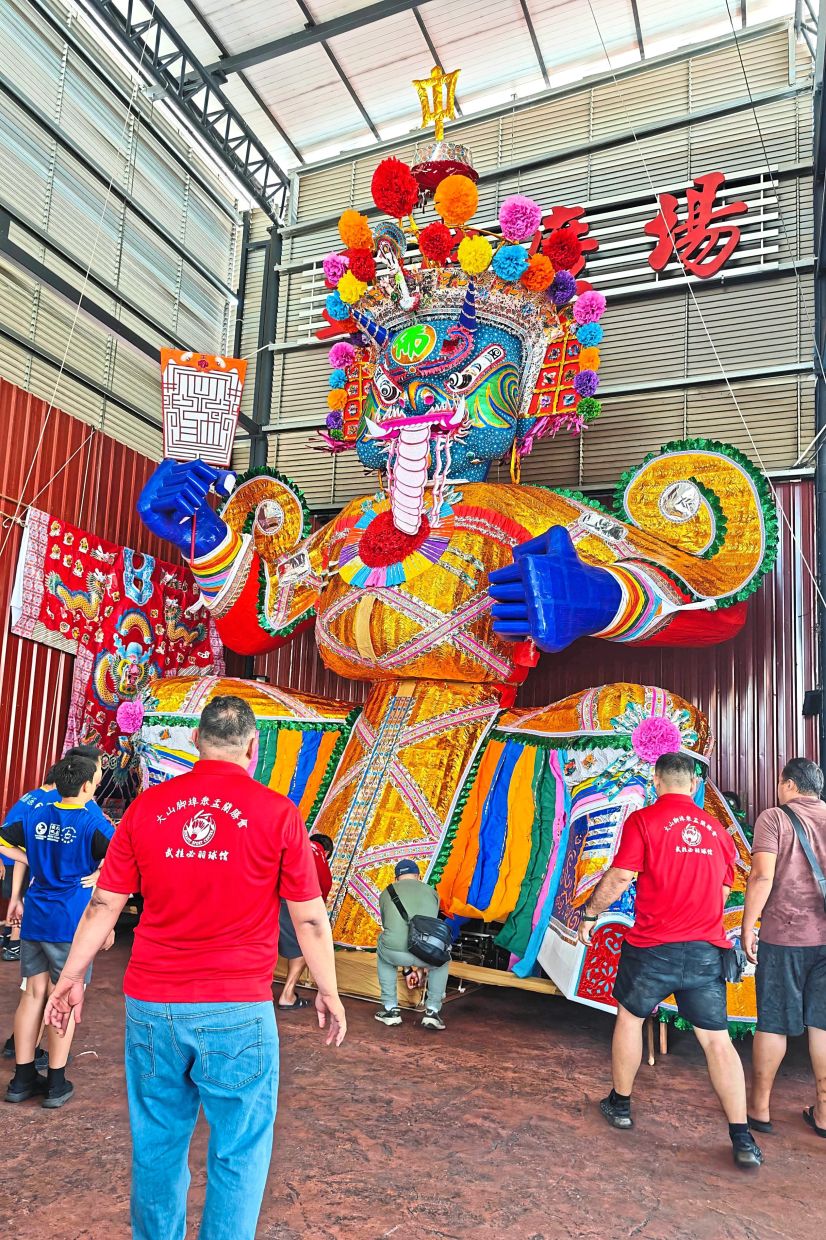
The giant effigy of Tai Su Yeah at the Pertubuhan Perayaan Yu Lan BM building in Jalan Pasar, Bukit Mertajam, rises to 8.84m, which is about 15cm taller than last year’s.
Hailed as the largest in the country, the structure was transported to the site in sections by trucks from Berapit, about 3km away.
Veteran maker Ng Chi Wang, who has been crafting such effigies since 1984, assembled it on-site.
Marking 138 years of unbroken observance, Bukit Mertajam Yu Lan Festival Organisation secretary Datuk Lee Kim Hong said the consecration of the effigy on Aug 25 signalled the beginning of the 15-day celebration.
During this period, thousands of devotees are expected to gather before the effigy, making offerings to seek blessings and protection.
The festival will culminate in a grand send-off ritual, during which the effigy will be set ablaze on the 17th night of the seventh lunar month, which is Sept 8.
Stage performances
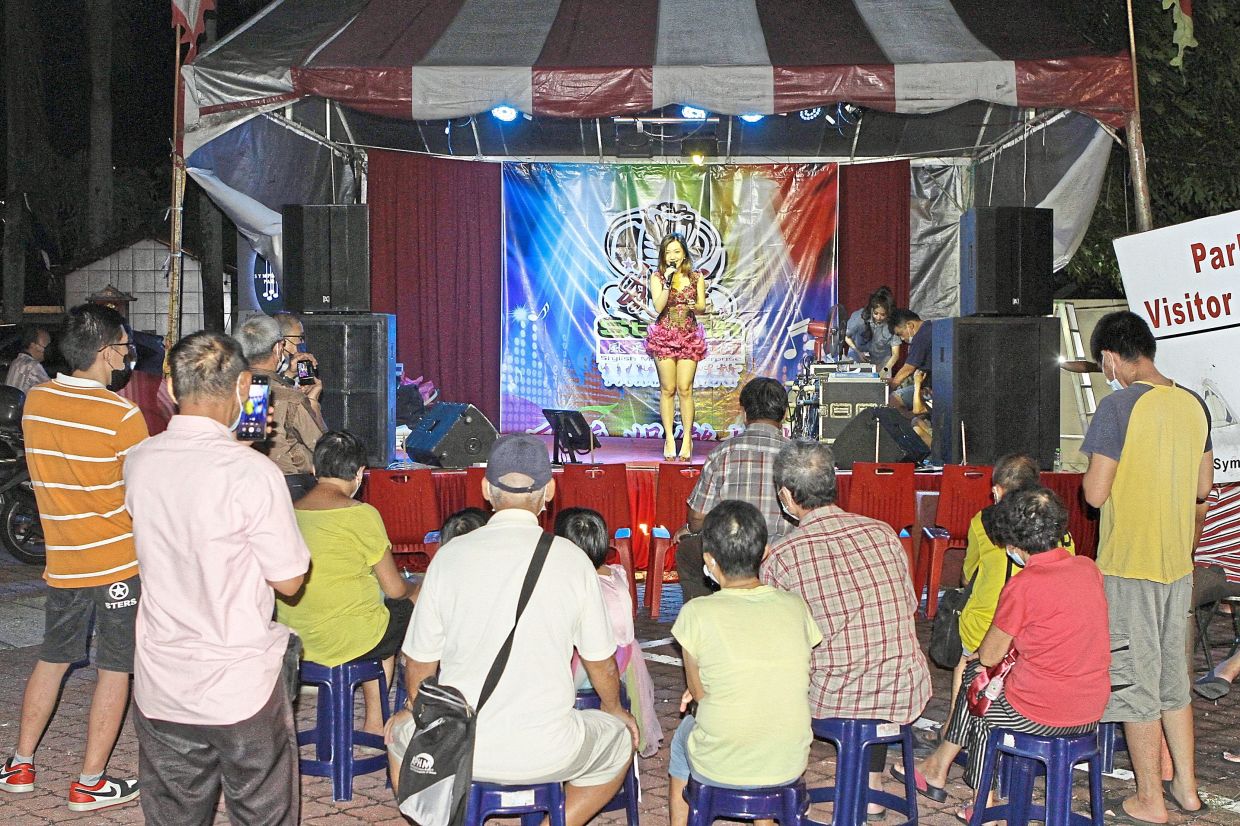
Getai shows have long been a familiar sight across Penang during the festival.
According to a getai operator who wished to be known only as Chuah, the outdoor shows with live performances of music, song and dance are traditionally performed in front of rows of empty chairs, meant for the wandering spirits or ‘good brothers’.
“Some getai singers used to wear sexy outfits to grab attention, but nowadays society and authorities keep a closer watch, so the performers are more modest in their dressing and antics on stage.
“If the audience enjoys a singer’s performance, they can show support by giving ang pow or tips as a token,” he said.
Chuah said getai became prominent in Penang in the 1970s.
“Back then, performances were simpler, usually just a singer with a band.
“The karaoke concept came in before the 2000s, and it has since evolved to be much more elaborate with LED screens, colourful lights and even laser displays.”
Compared to Teochew opera, which is a more traditional art form, getai is much more popular and affordable, although both are facing rising costs and space constraints, Chuah said.
“Opera costs significantly more because performers are harder to find, and a whole troupe with musicians and actors is needed.
“While some elderly may still appreciate the opera, the younger generation does not understand the language or storylines anymore.
“To save costs, some Phor Thor committees have even resorted to screening old Teochew opera recordings on a big screen for Tai Su Yeah to fulfil the ritual purpose,” he added.
It is learnt that Teochew opera performances typically cost between RM4,000 and RM5,000 per night, while getai performances range from RM2,500 to RM4,000, depending on the performers’ rates.
Festival guidelines
As the festival often requires additional public spaces for events such as getai or Teochew opera performances, organisers must obtain approval from local authorities.
Penang Island mayor Datuk A. Rajendran said the Penang Island City Council (MBPP) has issued 48 permits for the festival as of Aug 20.
In the event of a complaint, he said the council would advise organisers to comply with the conditions set and take steps to resolve the issue.
MBPP councillor Tan Soo Siang noted that most rejections were due to unsuitable locations or potential traffic disruptions.
On the mainland, Seberang Perai City Council (MBSP) has approved 24 permits for the festival, said mayor Datuk Baderul Amin Abdul Hamid.
He warned that approvals could be revoked if conditions were breached.
“If the applicant fails to comply with the canopy installation conditions, we may withdraw the approval or require removal of the structure.”
Baderul Amin also reminded the public to keep sites clean and urged organisers to burn offerings safely and moderately.
“Avoid plastic, printed paper or synthetic materials as they harm air quality.
“Use steel barrels or containers for safe and controlled burning.
“Waste and recyclables should be segregated and do not burn on roads or drains.
“Ashes and food waste should be cleared to prevent pests,” he added.
