Hardened fat, oil and grease make contractors’ cleaning work an uphill task
A SIGNIFICANT number of drains across Kuala Lumpur are inaccessible for maintenance due to businesses illegally occupying public spaces.
Contractors engaged by waste management company Alam Flora Sdn Bhd report that large sections of the city’s drainage system are obstructed by illegal extensions, making maintenance nearly impossible in some areas.
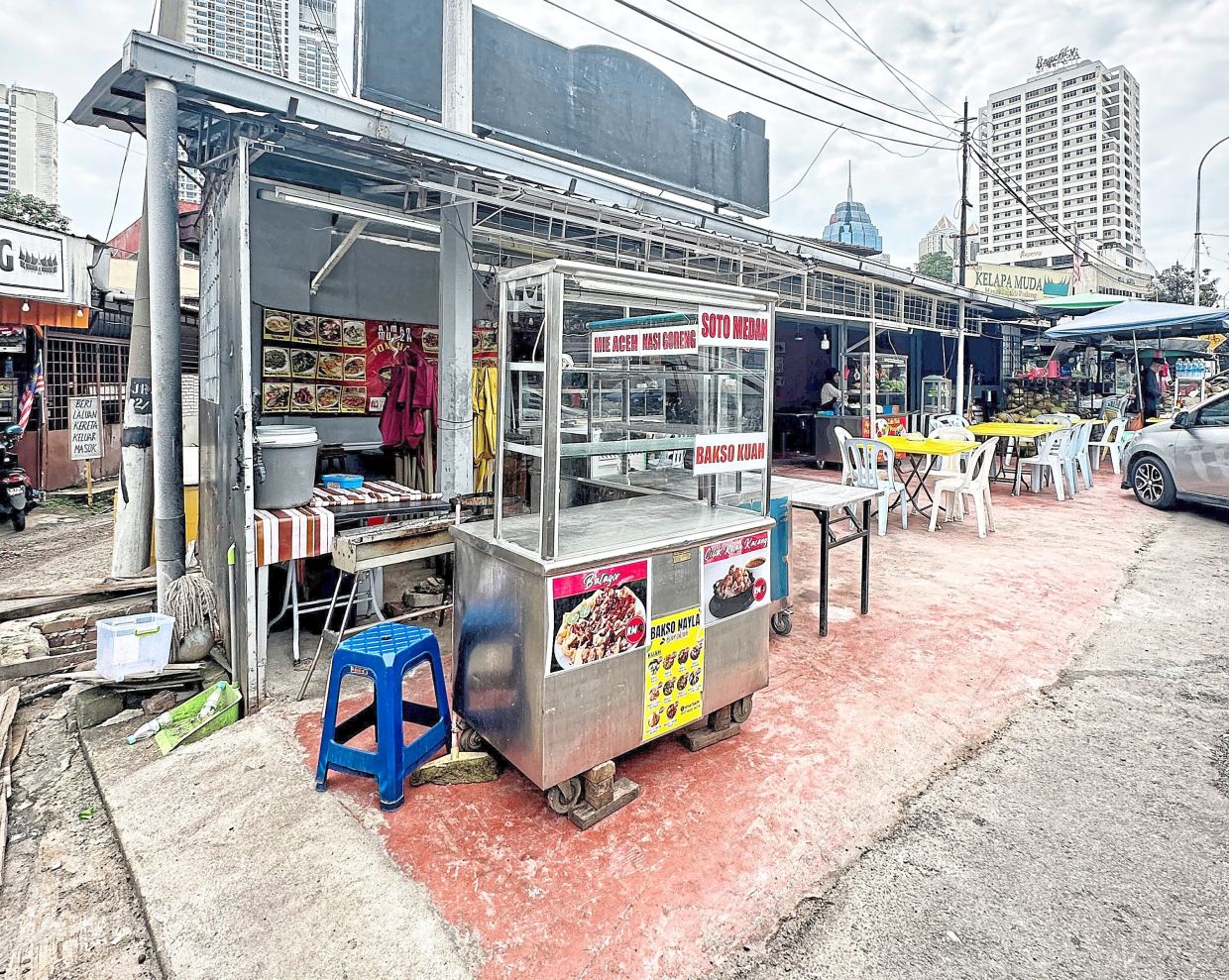
According to the contractors, many eateries have expanded their operations onto public walkways and drains by either permanently cementing over them or erecting barriers, placing large planter boxes as well as setting up outdoor dining areas.
ALSO READ: ‘Illegal drain extension in Tmn Bukit Indah putting lives at risk’
This not only hampers drain maintenance but also restricts pedestrian access, posing a hazard for wheelchair users, parents with strollers, and the visually impaired.
More critically, these obstructions could pose serious risks during emergencies, potentially delaying efforts by the Fire and Rescue Department or blocking ambulance access when every second counts.

“In some areas in Kuala Lumpur, restaurants operating out of converted houses have covered the drains.
“These obstructions are a nuisance to pedestrians and create challenges for our cleaning crew who are only able to clean certain sections at a time,” said Alam Flora vehicle driver Sulaiman Tam, 54.
“Our job becomes even more difficult when we have to spend so much time navigating past illegally parked cars on narrow roads.
“In some areas, restaurants erect barriers, place planter boxes and tables along the walkway, limiting pedestrian access.
“In most cases, we use a catch basin vehicle, which is equipped with a powerful vacuum system to suck up debris, leaves, sediment and other waste.
Ahmad Aktarmizi, 24, a waste cleaner with the company, said, “When businesses fail to instal or maintain grease traps, our job becomes even harder.”
Failure to instal grease traps results in fat, hot oil, and grease (FOG) to accumulate in the drainage system.
“FOG leads to hardened blockages that require manual intervention.
“Due to this, maintenance schedules can stretch from 10 minutes to over an hour,” he said.
Ahmad said apart from using vacuum trucks and water jetters, they relied on high-pressure water jet nozzles designed to remove blockages and sediment buildup.
“If the drains are covered and the sediment has hardened, I have to suit up, jump into the drain and work with my hands, and it is not easy,” said Ahmad.
The water is sprayed through multiple angled jets, which propel the nozzle forward while simultaneously blasting away hardened grease and debris.
“In many areas, due to degrading infrastructure, drain structures eventually collapse.
“This has happened multiple times, making our job even more difficult.
“These problems increase the risk of flash floods and make the city’s infrastructure wear out even faster,” Ahmad pointed out.
Besides waste collection in the city, Alam Flora is also involved in cleaning public drains, road sweeping, grass cutting and cleaning public beaches, public places, public toilets, public markets as well as clearing illegally dumped waste and animal carcasses.
“But that is not even the biggest problem,” said Alam Flora Kuala Lumpur manager-in-charge Kuit Kheng Keong.
“One of the most frustrating parts of the job is simply getting to the site on time.
“Driving through the city is a nightmare with vehicles parked along the roadside, double parking, and stalls set up directly over drains.
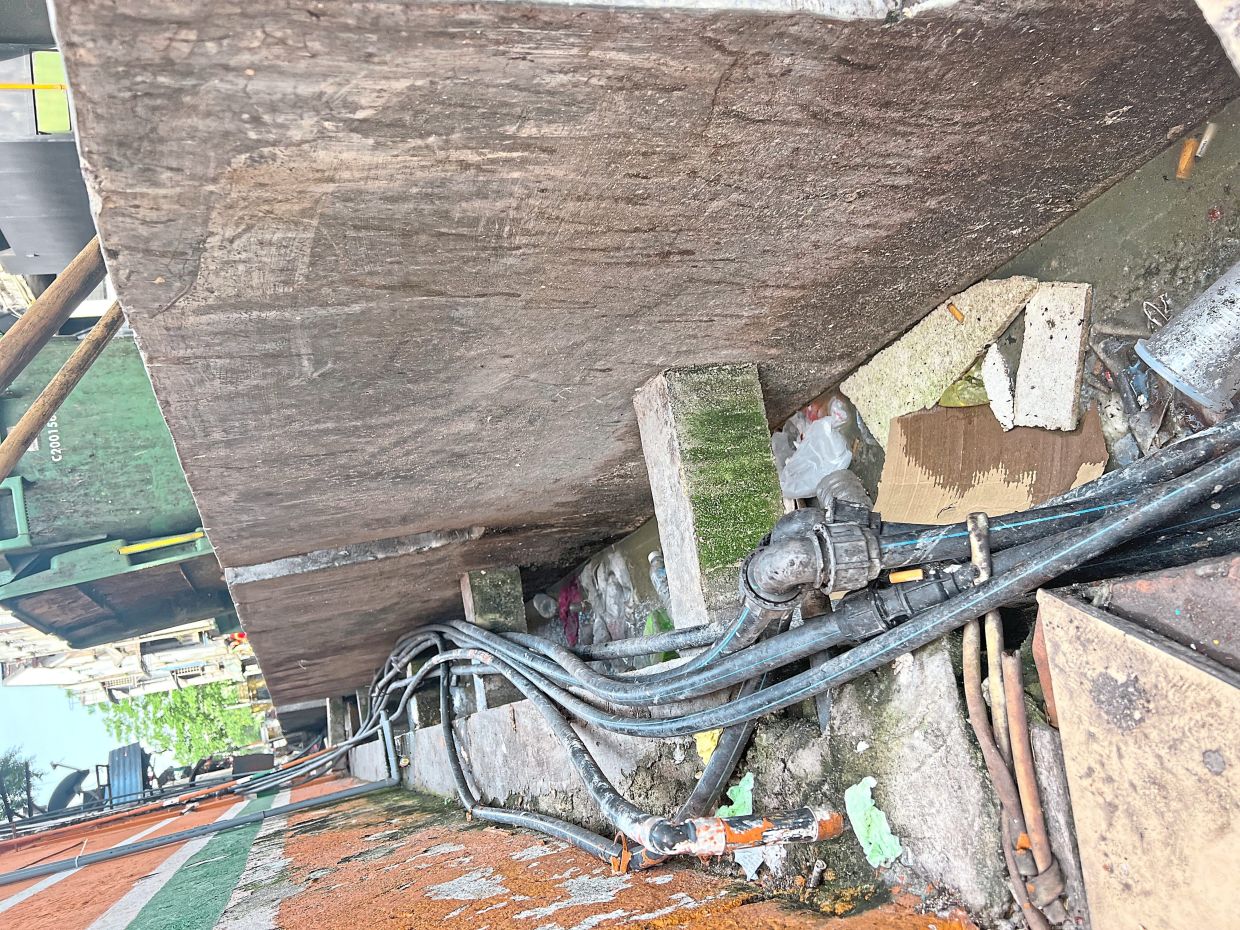
“But even when we manage to reach the location, we often find drains filled with illegal pipes and fibre optic cables, making it nearly impossible to carry out proper cleaning.
“In some cases, the infrastructure has deteriorated so badly that sections of drains have completely collapsed, further complicating the work,” he said.
Kuit said that under normal circumstances, a catch basin vehicle and water jet could clear a drain in just five minutes.
“However, when drains are obstructed by unauthorised installations such as pipes and cables or have suffered structural failure, the process is significantly delayed.
“The more the obstructions, the longer it takes to get the job done,” he added.
Obstructive practices
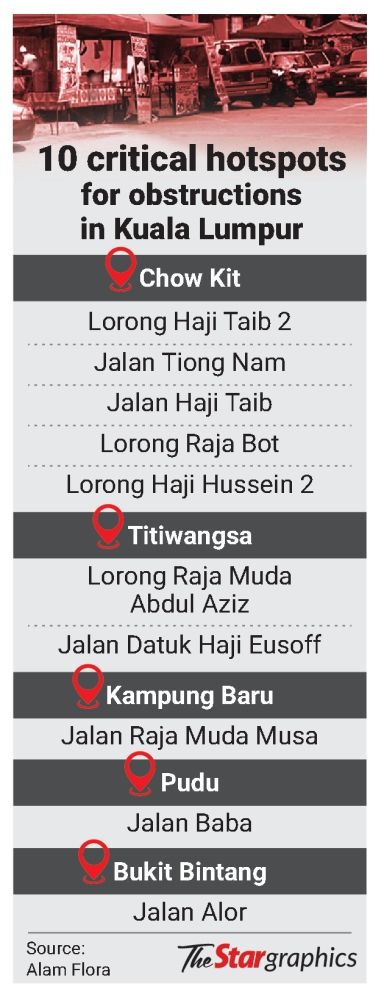
According to Alam Flora, the top 10 critical hotspots in Kuala Lumpur (see graphic) affected by obstructions impacting traffic flow, pedestrian movement, and accessibility were concentrated in Chow Kit, Titiwangsa, Pudu, Kampung Baru and Bukit Bintang.
These areas face persistent issues such as illegal parking, street vendor encroachment, double parking, and construction- related blockages.
These locations are key focus areas for Kuala Lumpur City Hall (DBKL) and enforcement agencies in tackling illegal activities and improving urban management.
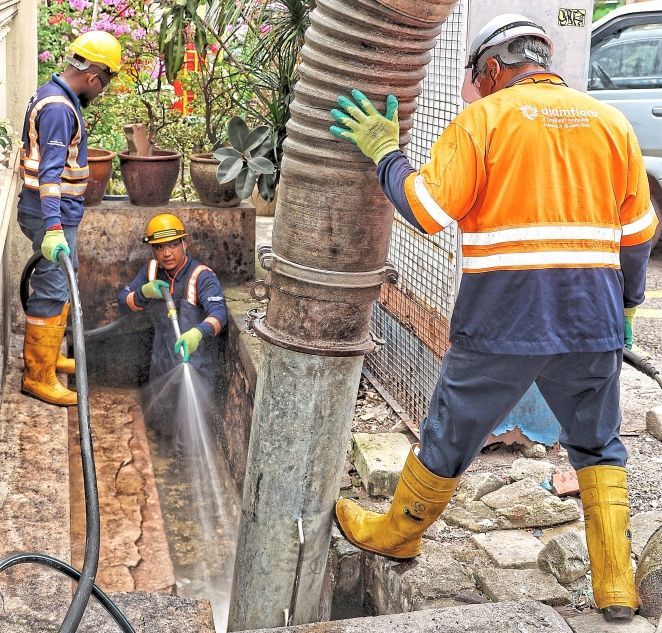
During a site visit by StarMetro to a drain-cleaning operation along Lorong Raja Alang in Kampung Baru, it was observed that an entire 500m stretch of the drain had been taken over by businesses.
Many of the commercial units were originally residential houses that had been converted into business premises.
Some business owners had illegally cemented over drains, permanently sealing them, and placed large flower pots on top – effectively occupying public space.
As a result, there was no pedestrian walkway, forcing people to walk dangerously close to moving vehicles along the narrow lane.
This created a chaotic and unsafe environment, particularly during peak hours.
Additionally, Alam Flora’s catch basin vehicle faced significant challenges manoeuvring through the congested street.
Workers had to cordon off the site with cones to carry out the cleaning operation, which further exacerbated congestion in the area.
Only a small section of the drain remained exposed, with completely hardened FOG noticeable.
This called for the use of a high-pressure water jet nozzle known as “Diamond” to break through the stubborn blockages.
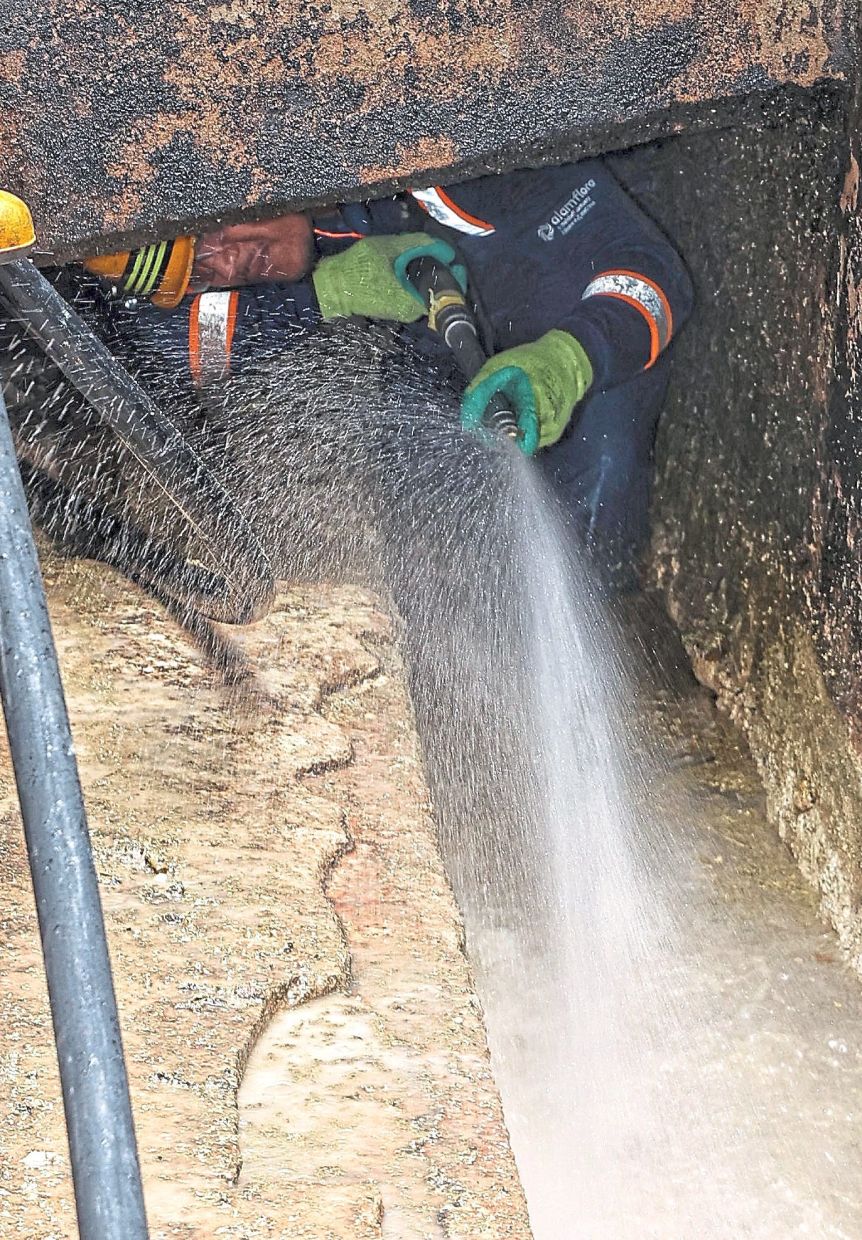
However, due to the severe buildup, a worker had to physically enter the drain and manually reposition the nozzle to target hardened debris along the entire stretch.
Compounding the problem, many businesses in the area had undergone major expansions and renovations, transforming simple shacks into modern commercial facilities.
Some of these extensions have violated city bylaws by cementing over public drains, resulting in obstruction of essential maintenance work and worsening drainage issues.
Short-term initiatives
When contacted, a Solid Waste and Public Cleansing Management Corporation (SWCorp) spokesperson said, “The company is aware of challenges faced by Alam Flora in cleaning drains in Kuala Lumpur, particularly due to obstructions and illegal structural modifications by property owners that hinder access and maintenance.
“While our enforcement under the Solid Waste and Public Cleansing Management Act 2007 does not cover actions against premises that modify public drains without approval, SWCorp monitors and identifies such obstacles during field inspections.
“These findings are reported to local authorities, who can take enforcement action under Sections 46 and 70 of the Street, Drainage, and Building Act 1974 (Act 133) for unauthorised structures or obstructions in public spaces.”
To ensure drains remain open and functional, short-term initiatives are necessary, said the spokesperson.
These include regular drain cleaning, public awareness campaigns and educational programmes discouraging improper waste disposal.
“We also increase monitoring, especially during rainy seasons, to prevent blockages and maintain water flow,” the spokesperson said.
“Long-term strategies involve working with DBKL to instal waste filtration systems, such as grease traps and waste filters, to reduce drain pollution in commercial and residential areas.
“We also aim to enhance drainage infrastructure, encourage community participation in cleaning efforts, and push for stricter penalties against illegal waste dumping.
“Additionally, we plan to introduce mechanical and electric equipment for more efficient drain maintenance, reducing reliance on manual labour,” the spokesperson added.