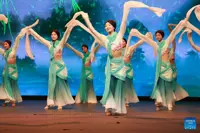
Lew (centre) and fellow dancers performing a Tibetan folk dance during a recent Chinese cultural festival organised by UTAR Chinese Language Society. — Photos: AMANDA LEE/The Star and courtesy pix
Youths find activities to help them embrace culture and heritage
There is ample opportunity for young people to become involved with traditional activities and connect with their roots.
Classes and workshops held by experienced folk give these youngsters an avenue to pick up skills and knowledge that have been passed down through generations.
But not everything needs to be taught in a classroom environment, as there are also some who dive into these activities out of sheer interest.
Delving into dance
Medical student Sandhyah Subramaniam, 21, has always envisioned herself performing classical Indian dance on stage.
Her passion was sparked at a young age when she watched a group of Bharatanatyam dancers showcasing graceful movements on stage.
Amid the throng of spectators, Sandhyah sat captivated by the vibrant costumes and emotional expressions.
Her feet tapped in rhythm with the beat of the music while her hands mirrored the intricate dance gestures.
Her parents decided to fulfil her passion by sending her to a dance school in Ipoh, Perak, where she spent most of her childhood and adolescence honing her Bharatanatyam skills.
“My parents supported me and never complained because they believe it is essential that I learn the traditional dance,” said the student from Universiti Kuala Lumpur Royal College of Medicine Perak (UniKL RCMP).
Sandhyah’s mastery of Bharatanatyam started from the basic steps known as adavus all the way to interpreting complex literary texts such as poems, epics and mythologies through dance.
Recently, she completed dance school, enabling her to execute a dance debut known as arangetram, which signifies the graduation of dance.
“During my arangetram, I had the opportunity to perform in front of renowned Bharatanatyam dancers and hundreds of spectators.
“I can say with pride that I am honouring my tradition and representing my culture, and will continue this journey,” she said.
Similarly, Jayshree Jaya Selan, 21, spent most Wednesdays and weekends at a dance academy in Ipoh.
However, she initially had a love-hate relationship with this artform.
“When I was younger, my mother sent me for Bharatanatyam classes so that I can connect with my culture.
“I did not like it at first because I did not want to be stuck in dance school while my friends were out having fun,” she recalled.
Her fondness and love for the dance gradually blossomed, with the help of friends and a supportive dance teacher.
“I also like expressing my emotions and feelings through rhythm and music,” she added.
During upper secondary school, Jayshree had to give up the lessons to prioritise her studies, but her journey did not end there.
Now, as a dental student at Universiti Kebangsaan Malaysia (UKM), Jayshree continues to rely on the foundation she learnt to perform Bharatanatyam on campus.
“Back then, I was required to master all the adavus and build up stamina for performances.
“With that knowledge, I am able to rekindle a passion from my childhood, which brings me a sense of joy and excitement,” she said.
Jayshree, who also choreographs, is set to showcase a performance of the Radha-Krishna love story from Indian mythology, about the relationship between the human soul and the divine, during her university’s upcoming cultural night.
“I look forward to sharing the uniqueness of Bharatanatyam and showcasing Indian culture to others through this traditional dance,” she added.
For Qayrysya Amirah Aina Azlan, 21, her lifelong dream is to be a dance teacher, inspired by prominent international and local dancers.
She performed Malay traditional dance at her primary school in Sungai Buloh, Selangor, and later attended Malaysia Arts School of Johor where she honed her skills.
“I want to pay homage to my culture and authentically embody its beauty and significance, so I pursued a diploma in dance at Universiti Pendidikan Sultan Idris (UPSI),” she said.
Sharing the same dream, Yong LyQian, 21, aspires to follow in her mother’s footsteps to become a dancer.
She started learning Malay traditional dance in Form Three, where she was selected as a member of the school’s dance team.
“As I grew up learning ballet, Malay traditional dance was out of my comfort zone.
“However, when I started learning it, the cultural and historical aspects caught my attention and made me want to learn more,” she said.
Yong and Qayrysya are currently pursuing dance majors at Universiti Malaya (UM), where they actively participate in dance showcases.
Yong said classical Malay dances such as joget gamelan as well as Malay folk dances such as zapin had elegant hand and knee movements.
“Performing traditional dances allows me to explore Malay tradition and heritage through dance, which is a great cultural exchange opportunity.
“The journey is not easy, but I work hard to showcase the beauty of Malay traditional dance,” she added.
Qayrysya hopes that she can contribute to the Malay traditional dance field.
“After I graduate, I aim to be a professional dance teacher and impart my knowledge to aspiring young dancers,” she said.
Another dance enthusiast, English education major Lew Min Hui, 21, learnt Chinese folk dances when she was in secondary school.
“Seeing my potential, my high school seniors recommended that I join a dance workshop hosted by Perak Folk Dance Association.
“I found the dances fun and challenging as they consist of a balance of soft and strong movements, which propelled me to continue learning,” she said.
Lew has learnt a range of Chinese folk dances from different ethnic groups, including the Dai, Mongol and Miao.
She said she felt more comfortable performing Chinese folk dance compared to ballet, with which she started her dance journey.
“I feel more at ease and connected with Chinese folk dances, allowing for better expression and movement,” she explained.
Lew continues to perform at university events, representing the Chinese Language Society of Universiti Tunku Abdul Rahman (UTAR), Kampar campus, for competitions.
“I want this performing art to continue as it showcases the richness of Chinese culture,” she said.
Preserving connections
Accounting student Chan Hei Yann, 21, enjoys her heritage through the process of brewing Chinese tea.
She said brewing her own tea made her feel zen as it required her full attention and focus.
“It is a comforting activity, as it gives me a moment of peace,” she said.
Coming from a tea-loving family, Chan has been exposed to Chinese tea culture since young.
“In Chinese culture, drinking tea together symbolises unity, so I would usually sit with my parents and grandparents after dinner.
“Sometimes, we would be joined by my grandparents’ friends and all of us would catch up on each other’s lives over cups of hot tea,” the UTAR Sungai Long campus student recalled.
Whenever she visits teahouses or brews her own tea at home, Chan usually indulges in pu’er, xiang pian or sometimes oolong tea, which provides a sweet aftertaste.
Chan said the activity allowed her to feel more connected to her culture.
“Tea drinking has been an essential aspect in Chinese culture, and as a descendant, it is my duty to carry on the tradition,” she said.
Honouring traditional art
As a second year medical student at International Medical University (IMU), Ishani V. Manivannan, 21, de-stresses via batik workshops at Central Market in Kuala Lumpur during weekends.
“I find batik painting soothing as I get to immerse myself in a world of colours and enjoy the calming sounds of delicate brush strokes,” she said, adding that she had been exposed to the activity during her school days, through art class.
In the beginning, it was just a leisure activity that helped Ishani regulate her emotions, but she gradually developed a strong interest in learning more about the traditional artform.
She prefers painting classic floral motifs over modern designs like animated characters.
“It is crucial to highlight and showcase the beauty of local floral patterns that reflect traditional beliefs and values,” she said.
Ishani is looking forward to learning more complex techniques such as drawing patterns on fabric with hot wax using canting, a specialised instrument with a wooden handle and a little copper reservoir with a spout to retain the wax.
“It is very easy for culture to be forgotten with time, so I am keen to keep the Malaysian traditional art heritage alive,” said Ishani.
Passion for timeless games
Traditional games filled 21-year-old Eva Ray Siew’s days with fun and excitement when she was younger.
Growing up, she often played batu seremban and later congkak after being introduced to the game by her friend in primary school.
Now, as a computer-science major at UKM, Siew indulges in traditional games as a break from coding, which involves spending hours in front of a computer screen.
“Playing these traditional games takes my mind off things,” she said.
Siew usually plays batu seremban or congkak with her university friends or dormitory mates.
They borrow a congkak set from the university and create their own batu seremban pieces from pebbles.
“The games not only relieve stress, but also allows me to keep in touch with Malaysian culture.
“They might not be as stimulating as online games, but it is the simplicity of traditional games that I find joy in,” added Siew.