



When street buskers Badrul Hisham, 27, and Norasrul Hanif Abdul Wahab, 32, play their didgeridoos, you can practically feel the uplifting, dreamlike vibrations. You’d understand, too, why the Australian aborigines call it “dreamtime” music.
“If the earth had a voice, it would be the sound of the didgeridoo. It’s all about playing from the heart and feeling close to nature,” says Asrul of this indigenous Australian wind instrument.
 |
Left) Asrul and Badrul demonstrating the different kinds of didgeridoo. |
Badrul and Asrul have been playing the didgeridoo for 10 years. The duo met at a surf camp in Teluk Cempedak, Kuantan in 1996. They started to learn informally from tourists who played the instrument. Most of what they know now is through research on the Net and practice.
Asrul, who also plays the guitar and djembe (African drum), recalls how his curiosity was piqued when he heard the sound.
There were neither notes nor strings, so how does one play it? When he found out that it was all in the player’s breathing, he decided to give it a try. Today, he says, no other musical instrument has been able to give him the same satisfaction.
“The sound of the didgeridoo is still new. Busking is one way to expose the music to the public. Sometimes we don’t plan the music. We just grab our instrument and play. I’ve busked almost everywhere – Amsterdam, Brussels, London, Penang . . .’’ says Asrul.
They have played with local bands like Coffin Cancer and appeared at hot spots like Beach Club and Twelve SI.
Badrul, who has appeared on TV, says that Australian embassy staff once mistook him for an Aussie native when they hired him to play. Only when the performance was over did he reveal that he was indeed a native – of Kuantan!
Badrul explains that the didgeridoo is a wind instrument, often described as a drone pipe. It has its origins with the indigenous Australians.
Archaeological studies of rock art in the Kakadu region (171km east of Darwin) suggest that the Aboriginal people have been using the didgeridoo for about 1,500 years.
The shape is usually cylindrical and measures one to two metres. Authentic didgeridoos are usually made of eucalyptus trees hollowed out by termites. The mouthpiece is covered in beeswax and most instruments are painted with decorative symbols.
Badrul adds that there are no notes involved when one plays the didgeridoo. Each instrument has its own key. The varying shape, length and thickness of the wood determines its key. Shorter lengths yield higher pitches and vice versa. Didgeridoos generally range from a high ‘G’ to a low ‘A’.
“It’s not surprising to see a player with several didgeridoos of different keys. They have to change instruments when the song changes key,” he points out. “The older the instrument, the better it is because it’s seasoned.’’
Badrul adds that not all didgeridoos are made of wood. He also practises on tubes made of glass, steel, wood and even PVC.
“You get very different sounds with different materials. A PVC pipe will have a sharper, smoother sound. Wooden pipes have a bass sound and glass tubes are generally sharper.”
Badrul, who has five didgeridoos, says his favourite is the bamboo pipe.
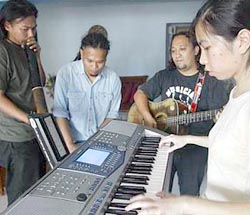 |
The Qala Band jamming with Alice Chan and Chekdet on acoustic guitar. —Starpix by ONG SOON HIN |
“My bamboo didgeridoo is a ‘D’ sharp. I’ve had it for six years. I am most comfortable with this because a lot of songs are either in the ‘D’ or ‘E’ keys. It’s also easier to blow,” explains Badrul.
Droning on
Watching a didgeridoo player, one wonders about the strength of his lungs!
Badrul and Asrul, who play up to an hour each time, explain the secret of circular breathing — a method used by many great players such as Miles Davis and Kenny G.
“The toughest part of didgeridoo playing is learning to circular breathe. This allows a player to continually blow air down the didgeridoo without stopping for breath. The air just circulates in your mouth. It’s like scuba breathing. Every time we do circular breathing, there is a rhythm. It’s like 1-2-3-4 breathe, or 1-2 breathe. We keep up a tempo and follow the music in this way,” says Asrul.
A player has to make use of his vocal chords as well.
The didgeridoo has three basic sounds – imitations of the kookaburra, kangaroo and dingo. The player uses these sounds to give the music an interesting feel and layer,” says Badrul.
And let’s not forget about volume which requires controlling mouth pressure.
“To control the pressure, the lips are tightened and loosened according to the melody.”
Since the instrument has no chords or notes, a player must be able to visualise the beat and follow the music. Asrul says that it is about following the rhythm and harmonising the vibrations.
Sounds easy enough but not according to Alice Chan, 22.
The classically-trained pianist who has seen the duo busk says, “The didgeridoo is harder to play than anything else. Not only do you have to combine all the techniques but there is no guide for the musician unlike in piano where you can refer to notes. With the didgeridoo, it’s impossible to record the process in writing.
And it’s not that Asrul and Badrul haven’t tried.
“I thought I could make use of wavy and circular lines to write down the process but when I woke up in the morning, I couldn’t figure out what the squiggles were. So what we do is commit the rhythm of every song to memory,” says Asrul.
Though the didgeridoo sound has not really taken off, the pair are optimistic that it will soon find its place in the local music scene.
“It can be a versatile instrument. It’s up to the player to experiment how it can complement the guitar or percussions when playing in a band. The idea is to give the music a richer feel,” says Badrul.
Says Asrul, “No doubt the original sound is unmistakably aboriginal, it can also be modified to suit many genres of music from rock to blues. Bear in mind that we don’t play like Aborigines. We play like Malaysians,” he insists. W
To learn more, call Badrul at 016-2494945 or Asrul at 016-4902604.
Or, you can drop by the KLCC train station tunnel or Jalan Bukit Bintang where you will find Asrul playing his didgeridoo from 2pm to 6pm every day.
Badrul often jams with Pink Mod, which is a street band that plays tribal music on Jalan Bukit Bintang near Maybank on Saturday and Sunday.
Related Stories:Instrument maker
Already a subscriber? Log in
Get 20% OFF The Star Digital Access
Cancel anytime. Ad-free. Unlimited access with perks.
