
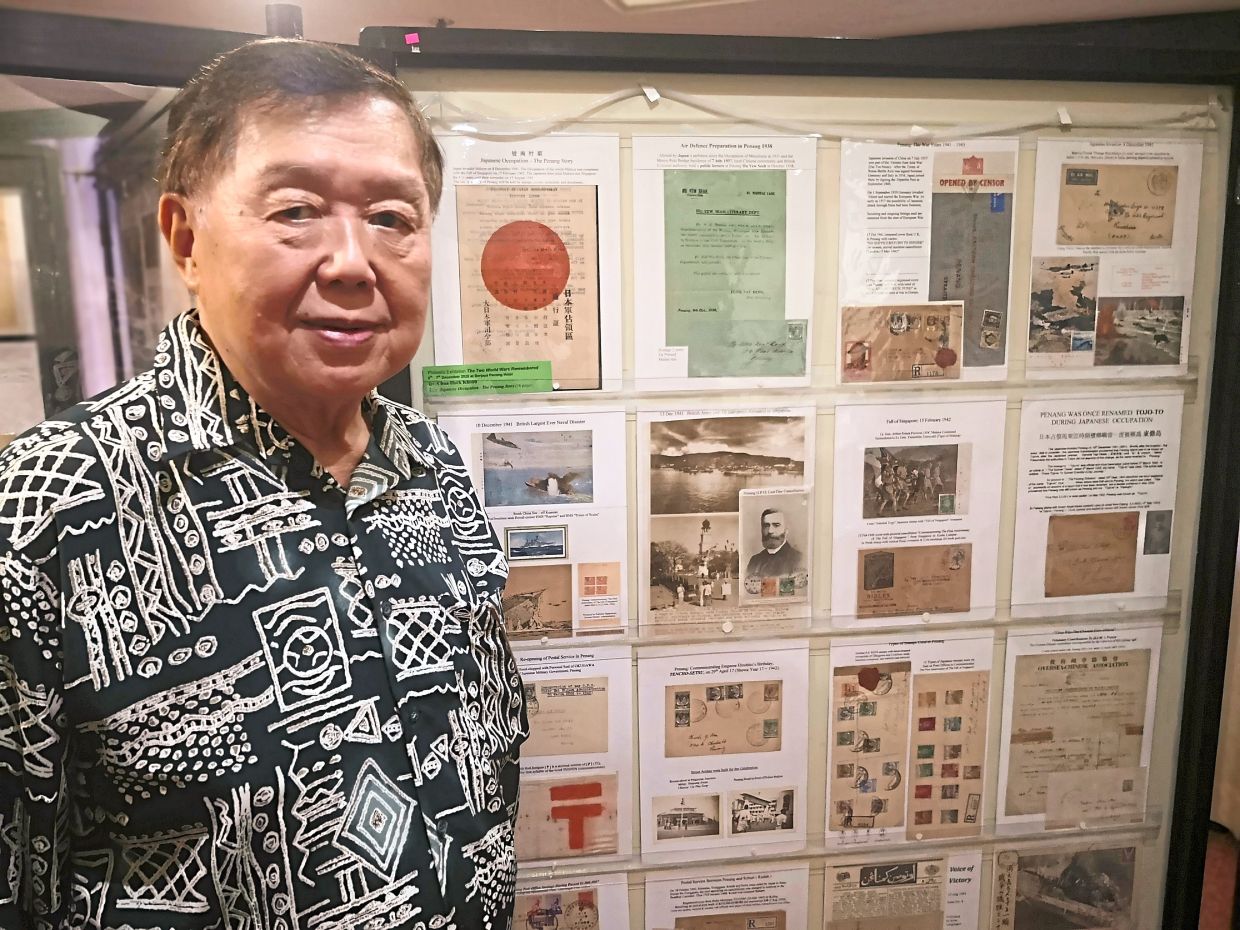
“Tragedies of war must never be forgotten as the hardship suffered and lives lost during conflict caused immeasurable suffering. At the same time, gallant acts of selflessness during those challenging times should be honoured,” Dr Chua Hock Khoon says solemnly during a run-through of his collection of wartime postal stamps at the Berjaya Penang Hotel.
The set was displayed last December as part of the Penang Philatelic Society’s annual exhibition called The Two World Wars Remembered, held in conjunction with the 80th anniversary of World War II cessation.
Dr Chua himself was a former president of the society; currently he acts as its honorary adviser. A dentist by profession, he is an avid postal historian and well-known authority on Japanese Occupation narratives related to Penang.
His treasure trove of vintage photographs, postcards and censored mail serve as poignant reminders regarding historic global conflicts that have profoundly affected our nation in the past.
Drawing attention to a black-and-white picture on a postcard featuring the Cenotaph in Penang, Dr Chua explains that the war memorial was originally dedicated to the casualties of World War I, but as the years passed, memories of subsequent conflicts, like World War II and the Malayan Emergency, were included.
Located in George Town along Jalan Padang Kota Lama (Esplanade Road) and facing Fort Cornwallis, the Cenotaph was originally built with money collected from public subscriptions, donations and stage performance fund raisers. Construction began on Nov 11, 1928 and was completed in time for unveiling on Armistice Day a year later.
Officiated by the Penang Resident Councillor Meadows Frost, the momentous ceremony witnessed a bugler sounding the Last Post and a two-minute silence at 11am, the exact time when World War I hostilities ended in Europe in 1918.
Careful restoration
Unfortunately, the Cenotaph was badly damaged by Allied aerial bombardment during an attempt to retake Penang from the Japanese in January 1945. With collapse imminent, the Japanese dismantled the damaged structure and placed all the granite blocks and bronze decorations into safe storage.
Three years after the Japanese defeat, the Cenotaph was properly restored on Remembrance Sunday in 1948. Although Armistice Day had evolved into Remem-brance Day after World War II, the name change did not denote any significant differences. However, Remembrance Day inclusively commemorates those who had fallen in all wars.
While checking out a tantalising lunch spread at the newly refurbished and improved Wembley Cafe, Dr Chua shifts focus to Wembley Amusement Park which once occupied the strategic venue along Jalan Magazine.
“Affectionately known to Penangites as Choon Man Hui, this prime entertainment venue was the place where Malay bangsawan (nobleman), Chinese opera and Indian theatrical troupes helped raise money to build the Cenotaph,” he explains.
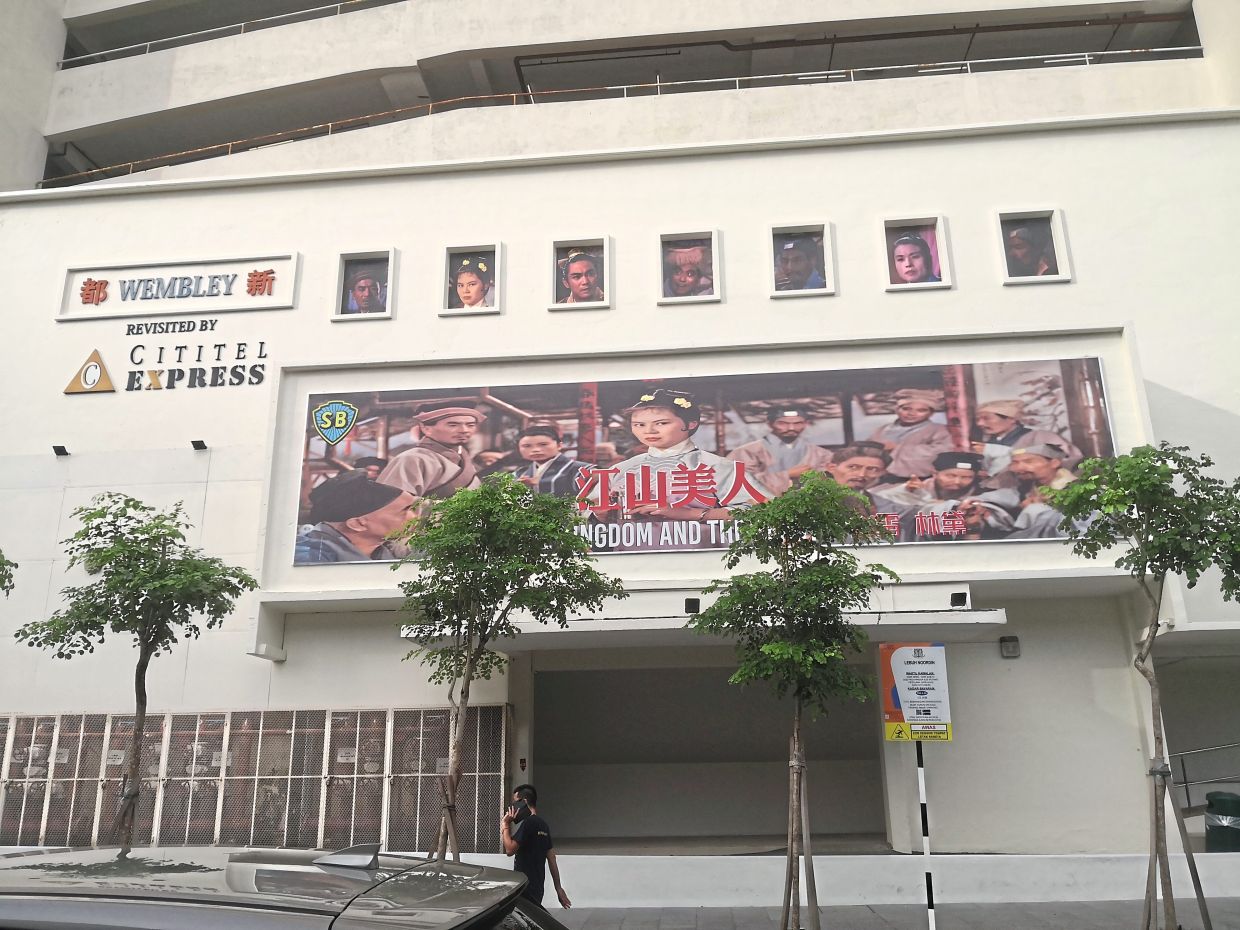
“Although this site is home to St Giles Wembley Penang and Cititel Express Penang today, reminders of the former Wembley Cinema are evident through movie banner displays on the facade. In the months preceding the Japanese invasion, the British used cinemas to promote air raid safety drills,” Dr Chua adds while tucking into the cafe’s refreshed buffet line up that mimics the culinary choices and desserts sold at stalls and restaurants within Wembley Amusement Park in the past.
In between servings of prawn noodle, fish head curry, braised duck and assam prawns, Dr Chua draws attention to another theatre of conflict closer to home. Taking advantage of Wembley Cafe’s redesigned layout, he uses several interesting memorabilia to spin a spellbinding tale interesting enough to warrant a drive to the Ayer Itam War Memorial Park.
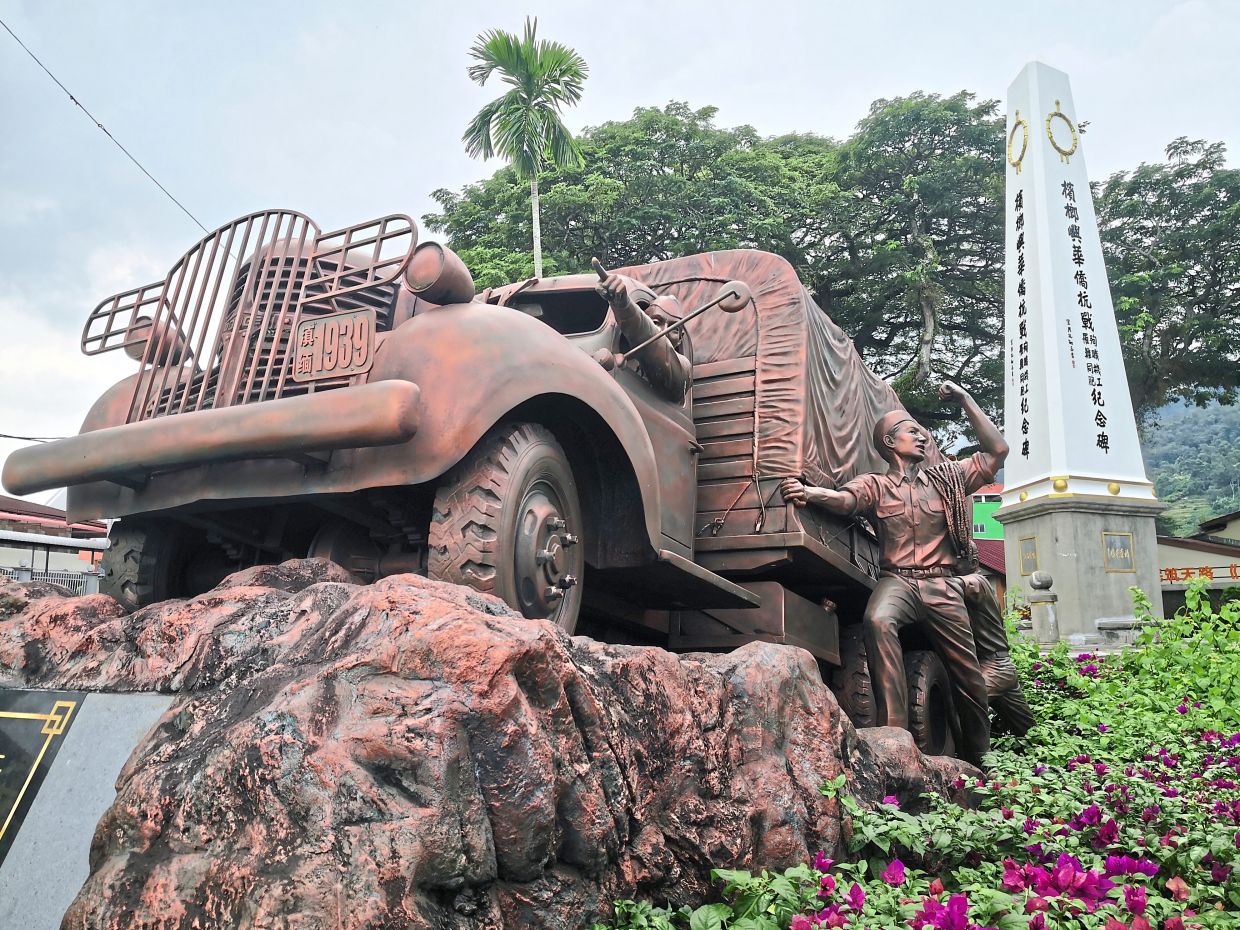
Located close to the Penang Hill funicular train lower station, the towering 14m-tall white obelisk landmark honours those who lost their lives during the Japanese Occupation as well as remember gallant Malayans who risked everything to help China stave off aggression.
“The Japanese invasion of China in 1937 and the subsequent noose tightening blockade of major Chinese ports caused overseas Chinese communities in South-East Asia to respond towards the aggression.
“In Penang, fundraisers in the form of students selling hand-made flowers and opera troupes performing anti-Japanese skits were organised at George Town amusement parks, including Wembley Amusement Park,” explained Dr Chua.
Nobel sacrifice
In order to circumvent the strangling Japanese siege, some 3,200 Malayans willingly exchanged the relative safety of their homes for the uncertainty of war by signing up as volunteer mechanics and drivers in 1939. They transported much needed international aid like strategic supplies, critical equipment and fuel to Chinese frontline resistant forces.
Although a majority of them were Chinese, some Malays, Indians and Sikhs also signed up.
Sadly, nearly a third of those in this multi-racial Malayan contingent lost their lives to contagious diseases like malaria, as well as to vehicle malfunctions, road mishaps and relentless Japanese aerial bombardments. All this happened along the 1,000km route known then as the Burma Road which connected present- day Myanmar to China’s south-west Yunnan Province.
This grim statistic translates to one precious life lost for every kilometre of the treacherous supply line’s rugged terrain.
In May 1942, however, Burma Road was unceremoniously closed after Japanese troops occupied Burma (now Myanmar) and surrounded Yunnan. By then, the courageous Malayans, together with their comrades from Thailand, the Philippines, Indonesia, Vietnam and Burma, had already transported over five million tonnes of machine guns, artillery shells, vehicles, gasolene and medicines.
After Burma Road closed, surviving volunteers were laid off and left to fend for themselves. Some settled down in Burma, while others relocated to ill-equipped retraining centres.
As time passed, despair and desperation overwhelmed their initial enthusiasm and bravery. Many were reduced to begging in the streets. Caving in to opium addiction, they were disillusioned with feelings of injustice towards their noble contributions.
Light at the end of the tunnel eventually came in the form of Japanese surrender in August 1945. Assembling at designated departure ports in China’s Guangzhou, Shantou, Xiamen and Shanghai, returning volunteers boarded merchant liners destined for their desired ports-of-call in South-East Asia, including Penang.
Receiving US$300 (RM1,213 today) and a service medal each as tokens of appreciation, the first batch set sail on Oct 26, 1946.
Only a handful of the 358 volunteers who left Penang in 1939 returned. It was heart-breaking for them as home was no longer the same. The economy was severely crippled while their loved ones had passed away and wives remarried during their long absence.
“The idea to build this Ayer Itam War Memorial was mooted in 1950 after excavations conducted here, Gelugor, Tanjung Bungah and Batu Ferringhi uncovered around 800 skeletons belonging to Japanese Occupation ethnic cleansing victims.
“Treated with the utmost respect, the human remains were cremated and buried in a crypt under this memorial,” Dr Chua reveals.
“This memorial, situated on land donated by the Chow Kok Kin family, was completed later that same year and was formally unveiled on Remembrance Day 1951.
“Kong Min School, from where many teachers were killed during the Japanese Occupation, was appointed as trustee of the memorial, responsible for its maintenance and organising annual memorial services,” he adds.
Eighty years on, the Cenotaph and Ayer Itam War Memorial still resonate with the warmth of humanity that transcends race and nationality. Standing like silent guardian sentinels, they serve as lasting tributes to the brave and selfless souls who gave their lives for their unwavering conviction in peace preservation.