At lunchtime, when our waitress Eileen appeared, I couldn’t help but steal a few extra glances. Her face carried a gentle softness – shy, sweet, bright eyes – the kind you never tire looking at.
At first, Eileen was all business, flawlessly explaining the dishes to guests. This was a Maya-influenced restaurant after all, so not many visitors would know the cuisine.
She knew I was watching her. So, once we started chatting, her personality flipped – she was warm and a little curious, eager to trade stories with travellers. She was a natural fit for the service industry, I thought.
When Eileen introduced herself, I paused. She belonged to the Mestizo group, the largest ethnic population in Belize (about 49%). Suddenly it all made sense. Her fair complexion came from her Maya-Spanish ancestry. No wonder she switched effortlessly between Spanish and English, like changing gears without touching the clutch.
Belize itself is delightfully “anti-formula”. Tucked in the northeastern corner of Central America, it is surrounded by Spanish-speaking nations. Belize stands alone as an English-speaking member of the Commonwealth.
A good mix
With a population of just 420,000, Belize is the second smallest of the seven Central American countries. Yet its ethnic makeup is as concentrated as a perfectly mixed cocktail, complex but harmonious.
The second-largest ethnic group is the Creoles, about 25% of the population. With dark brown skin tones, they are descendants of Africans and Europeans, largely shaped by the Caribbean’s colonial past.
In Belize, many Creoles work in grassroots occupations. How-ever, Creoles remain one of the most influential cultural groups in the Caribbean.
What surprised me most was the Asian community here, with the Taiwanese making up a big chunk of the group. Walking the streets, you’ll spot some signboards written in Chinese, and even catch familiar Taiwanese aromas in the air.
I wandered into a shop selling Taiwanese beef noodles called Milky Way, which apparently has been in business for 22 years. Before long, I was chatting with the diner next to me. He told me the Taiwanese began arriving in Belize in the 1970s, opening shops and starting businesses, hustling hard.
Things changed in the past few years, though as after the pandemic, the younger generation gradually left to seek a better future elsewhere.
Belize’s economy has never been very diversified. Tourism is its current lifeline, while agriculture was once a major source that heavily depended on timber resources. Later, sap from certain trees was exported to the United States to make chewing gum.
Manufacturing? Still waiting to be properly developed here. With such a small population, labour-intensive industries were never realistic to begin with.
Most Belizeans are Catholic. When we were there from Dec 3 to 6, the country was already in a festive mood. At every corner you will see Christmas and New Year decorations, and hear seasonal music being played.
Our guide Roberto, however, sighed and shook his head. “Another year gone, will next year be any better?” he shared.
Post-pandemic inflation has hit hard in Belize. Prices of goods soared while wages stayed stubbornly still. The Belize dollar has long been pegged at BZ$2 to US$1 (RM4.06). Sure, it’s stable, but it also makes daily expenses feel painfully expensive.
Tourism has been slow to rebound, and young people keep leaving.
As I listened to the Christmas songs on loop, a faint melancholy creeps in. The kids are happy as the school year ended early – from December they will be on a break for three months, with the new school term only starting on March 1.
Belize receives at least two large cruise ships daily, unloading 2,000-3,000 visitors every day. If the tourists keep decreasing, the economy could possibly go bust.
The Belize City area itself has only two hotels, a clear sign that overnight visitors are few; most travellers head straight for the islands where there are some resorts.
Nature’s best
Western tourists come for Belize’s natural treasures. The Caribbean coastline is painted in gradients of blue, while the coral reef ecosystems are in pristine condition.
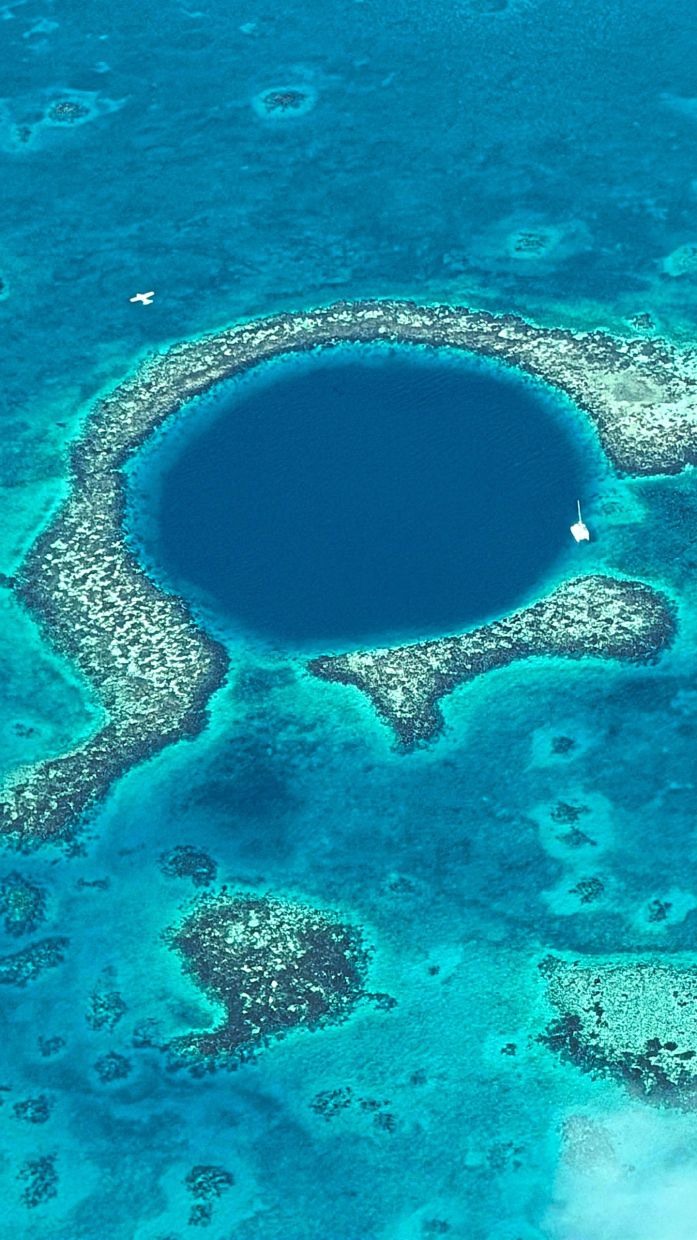
This is where you can find the legendary Great Blue Hole, hailed as one of the world’s eight natural wonders.
At the airstrip in Belize City, we boarded a 10-seat charter plane operated by Maya Air. Seeing my curiosity, the Creole pilot invited me to sit in the co-pilot’s seat. Now that’s a privilege I’ll happily accept as many times as life allows.
The moment we lifted off, the Caribbean unfolded below like a divine palette of layers of blue. This area, ranked by National Geographic as among the world’s top 10 diving destinations, is a dreamland for advanced divers.
That’s too bad for me, though, as my diving licence has long become just a nostalgic artifact buried in my wallet.
When the plane circled above the Great Blue Hole, the sight was so overwhelming I could almost hear my heartbeat. It’s a colossal deep-blue gemstone set in the sea, about 300m in diameter and over 120m deep.
That shade of blue? You can’t replicate that with Photoshop or whatever filter is currently trending on social media.
My thoughts went wild seeing the natural phenomenon from up high. Did Earth, on a whim, pierce the Caribbean Sea with a deep-blue earring? The Great Blue Hole was once a limestone cave during the Ice Age. As sea levels rose, the roof collapsed – or rather, cracked – and a massive marine sinkhole was born.
The deeper it goes, the darker the shade of blue: turquoise to cobalt, sapphire to near-black. It’s like reading Earth’s geological rings in colour.
We circled it three full times. The surrounding waters were absurdly crystal clear – coral reefs, seabed textures, even fish shadows were visible from above. At that moment, only one thought remained in my mind: This is the most luxurious, all-natural aquarium on Earth.
The Great Blue Hole is Belize’s calling card, and the Caribbean’s most precious gift.
The history
We landed on the San Pedro Peninsula and continued under Roberto’s lead, embarking on a journey blending island breezes with ancient civilisation.
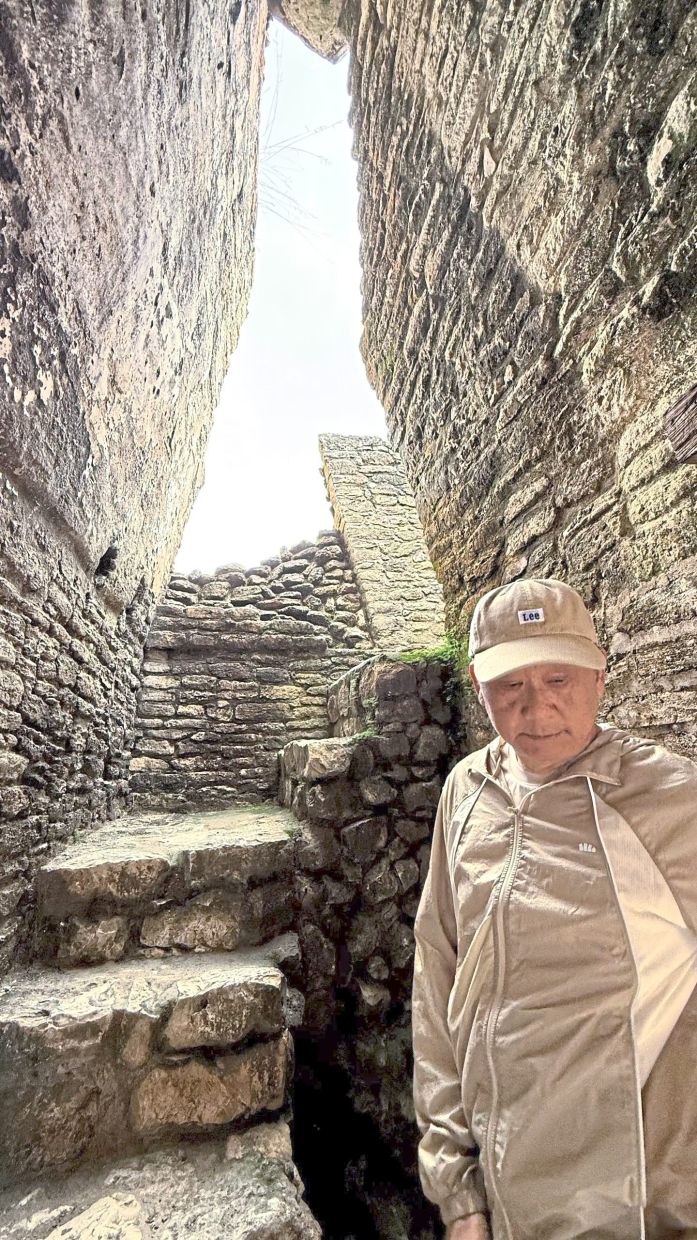
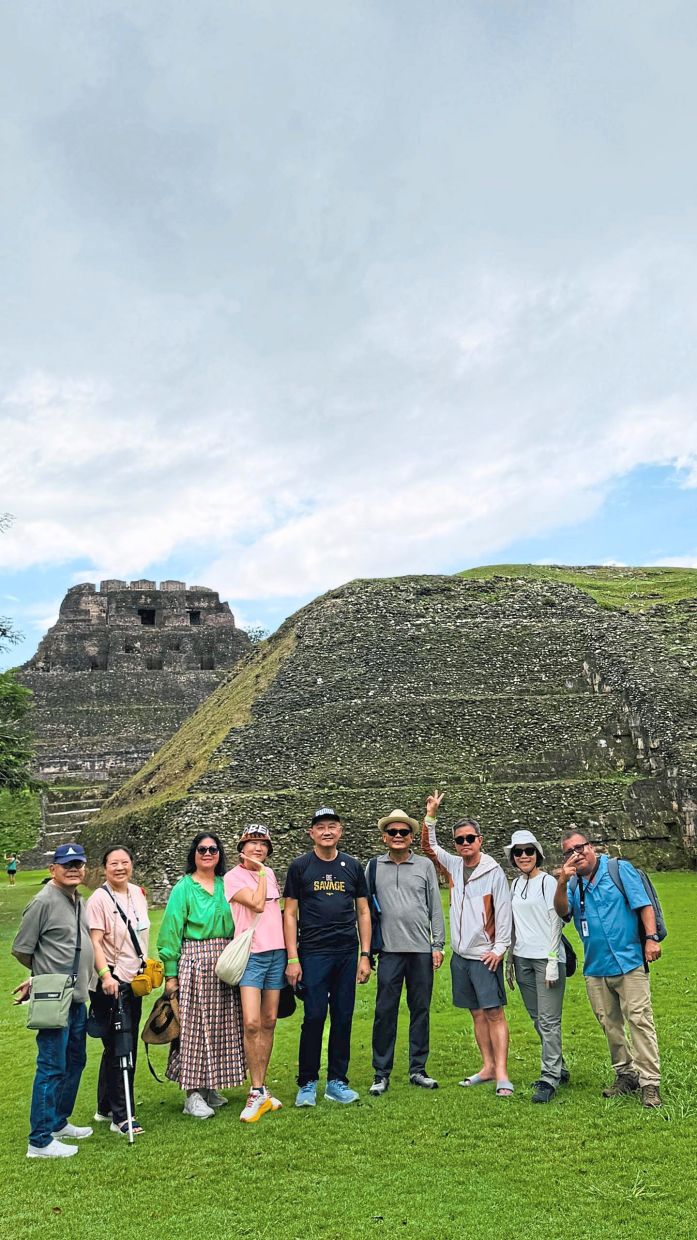
Belize isn’t just about seascapes; it’s also a vital chapter of Maya history. Numerous ruins dot the land, none more striking than Xunantunich near the Guatemalan border. It’s a feast for both the eyes and mind.
Roberto, a true descendant of the Maya people, spoke of history with quiet pride. He shared that the 250-900 CE era marked the golden age of Maya civilisation, where masters of mathematics, astronomy, architecture and literature were aplenty.
Can you imagine that? While others were still hunting and gathering, the Maya were calculating the stars, writing hieroglyphs and building pyramids.
In 1638, British loggers arrived, harvesting logwood and mahogany from the forests, and shipping them across the Atlantic. The African slave trade also expanded, and populations grew, giving rise to the creation of the first Belize Town (later, Belize City).
It originally served as the capital until 1972, when the government decided to start anew inland, founding Belmopan. The reasons for the move might make you raise an eyebrow: 1) Belize City sits astonishingly low – some areas even below sea level; 2) It has soft, marshy ground; 3) There were just too many mosquitoes; 4) Too many floods.
So, for long-term stability, the capital had to move.
Belize may have one of the smallest populations, but it is a vast melting pot of cultures. It has endured colonisation, exploi- tation, and resource outflow – yet has managed to survive on sea breeze, sunlight, and tourism.
The path of civilisation is never straight. Belize is still finding its rhythm, and we, the visitors, are lucky enough to witness its most radiant moments.
With its deepest shade of blue, Belize leaves an indelible mark on our travel journals – one that’s impossible to erase.
The views expressed here are entirely the writer’s own.
Leesan, the globe-trotting traveller who has visited seven continents and 162 countries, enjoys sharing his travel stories and insights. He has also authored six books.