
Kitted out in waders, carrying audio guides and climbing harnesses, we carefully descend stone steps directly into the river.
The Chamb River winds its way through the terrain. Steel cables are stretched across the river, which begins in the Czech Republic and later flows into the Regen River. Here, in Germany’s Upper Palatinate, they mark the Eisvogelsteig trail, or Kingfisher Trail.
Right at the entrance, there are large slippery stones in the water. My feet search for a safe place to stand. I am grateful for the rope. Otherwise, I would not dare to enter the water. Take small steps, we are told during the introduction. Good advice!
“We want to offer a sensory experience with a slight adventure factor,” says Markus Schmidberger, branch manager of the Landesbund fur Vogelschutz in Bayern or Bavaria (LBV), a bird conservation society. That way, the knowledge imparted here really sticks.
People only protect what they know, says Schmidberger. And animals that require diverse, natural rivers urgently need this protection.
The Eisvogelsteig, located at the Nosswartling environmental station, is unique in Germany, says the East Bavarian Tourism Association.
Guests can book a guided tour or learn about river dragonflies, which need rivers with sand and gravel banks and many plants and herbaceous banks, via the audio guide. We learn that such diverse rivers have become rare in Central Europe.
The Chamb is one such river. Flat and deep areas alternate, as do sand and gravel at the bottom, which we can clearly feel through the soles of our rubber boots.
The abundance of plants in and around the water is impossible to overlook – only for the river dragonflies are we still too early; they rise again in the afternoon.
Instead, a cuckoo calls, starlings, grey wagtails and other birds are chirping away.
Strong current, safe path
Now the rope leads to the outlet of the water wheel, which turns at the LBV centre and is used to generate electricity. The current increases the sense of an adventure. The pressure of the water presses rubber boots and waders tightly against my body, but fortunately the rope provides good support.
But it is getting cold – despite the air temperature of 25°C. Hold on tight, place your feet carefully and through the outlet – and this stage is also completed.
We have reached the old arm of the river, the part of the Chamb cut off from the rest of the river for hydro-power generation. The overhanging trees on the banks, the abundance of aquatic plants, sand and gravel create ideal spawning grounds for many species of fish.
Young fish can also hide here easily.
Otters like to use a sandbank as their dining room – but mainly in the morning and evening hours, says Schmidberger. We are out and about at midday.
Nesting site
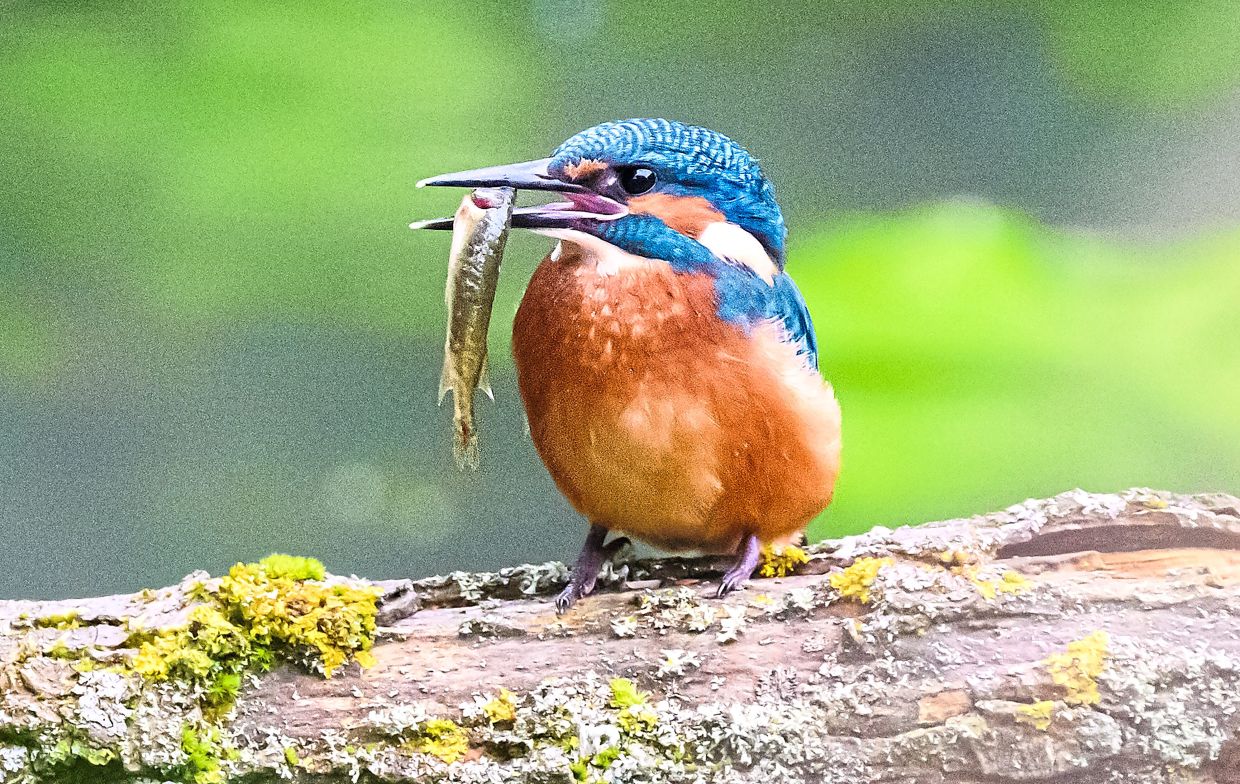
There is also a nesting site for the kingfisher, which gives the area its name. Normally, these small blue and orange birds dig tunnels several metres long into steep banks to use as nesting cavities.
However, the river pathway was probably too busy for them and they have moved into an artificial nesting aid.
This raises the question, how can hiking in the middle of the river be reconciled with nature conservation? Don’t the hikers disturb the animals?
“The LBV looks after 1,700m of the Chamb. The Kingfisher Trail stretches for about 50m. The creatures have plenty of alternatives,” says Schmidberger.
The disturbance on this short stretch is acceptable if it raises people’s awareness of nature conservation. Only 50m? The trail is so varied that it seems much longer to me.
Vault of the water bats
The water bats make this very short but also very special hike an experience. And they show how it can work with visitors: people enter the front part of a vault that spans an arm of the Chamb and in whose crevices the male bats rest during the day.
If it gets too busy for them, they hang in cracks in the wall in the rear part of the vault – which is off-limits to humans.
The kingfishers have also settled in thanks to the nesting aid on the LBV grounds. If you want to see them, you have to take a circular path on dry land to a wattle fence to see the kingfishers during the breeding season.
Especially when the birds are raising their young and the parents are flying back and forth to the nest with food, the chances of seeing them are good, Schmidberger says.
Give yourself plenty of time.
Did the Kingfisher Trail live up to its promise? We didn’t see any otters or kingfishers, but we did get close to them. You could feel it.
After all, in some places we were standing almost up to the top of our waders in their habitat, the river.
As promised, it was a deeply sensory experience. – HEIDI SCHARVOGEL/dpa