
Finnish holidaygoers are clamouring to shell out hundreds of euros to work as shepherds for a week as a vacation, seeking tranquillity in nature and a chance to disconnect from their busy lives.
Petri Stenberg is enjoying a “shepherd week” together with his wife Oona and their two children Fia, age two, and Hugo, four, on an old farm on an island in the Isojarvi national park in central Finland.
The popular holiday scheme, organised by the Metsahallitus company that manages and protects state-owned land and water areas, allows the family to combine recreation and nature conservation.
“We are living very close to nature here. We feed the sheep a couple of times a day, we have been to the sauna, swam and gone fishing,” said Oona, who works as a physiotherapist.
“Not once have I seen any news here. There’s no TV here, we haven’t browsed our phones. So in a way, my mind has somehow calmed down and I’m just concentrating on being here,” she added.
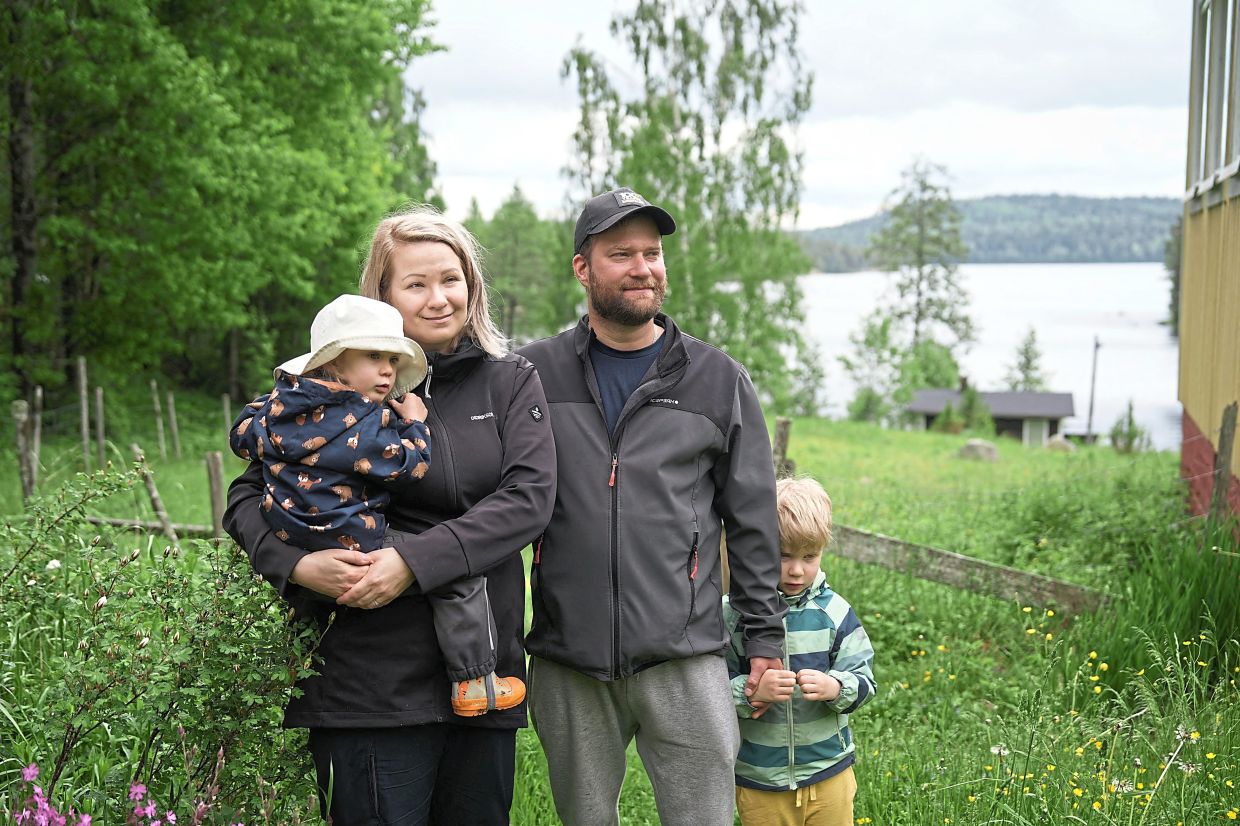
Accessible only by row boat or on foot through the forest and across a bridge, the old farm is one of around a dozen remote sites across Finland to which Finns can apply for a week-long holiday taking care of sheep.
Historically, grazing sheep and other animals have played a crucial role in maintaining biodiversity and habitats for flora and fauna at the various locations.
But changed forestry and agricultural practices, including a “dramatic” decline in the number of small farms in Finland, have seen these traditional biotopes of so-called semi-natural grasslands and wooded pastures become an endangered part of Finland’s nature, explained Metsahallitus expert Leena Hiltunen.
“The main purpose of the shepherd weeks is to increase people’s knowledge about these traditional biotopes,” Hiltunen said.
The vegetation on the Isojarvi island was traditionally kept light and lush as grazing sheep prevented overgrowth, providing the necessary ecosystem for now-endangered plant and insect species.
Compared to the 1950s, less than 1% of Finland’s traditional biotopes and landscapes remain, according to Metsahallitus, with most of them now located in protected areas.
“Appreciation and protection of nature is so important ... So it is really important for all of us to learn about it and for children to learn to appreciate it,” said Oona.
Popular holiday
Metsahallitus received 12,764 applications from 2,236 – many applying for more than one site – for this year’s summer season.
A total of 158 shepherd weeks are selected through a lottery.
“There has been a great deal of interest,” Hiltunen said.
The Stenberg family, who lives in Vantaa, just north of Helsinki, applied a few times until they finally got lucky this year.
A week typically costs between €400 and €670 (RM1,979 and RM3,216) at most locations.
The housing is spartan and simple, in huts or cottages often lacking running water and sometimes even electricity.
“Some people have asked us why we wanted to pay to herd sheep and do some yard work,” laughed Oona.
“But it is really an experience for us, and the kids are loving it,” she added, sipping from her coffee cup outside the family’s yellow cottage, surrounded by old wooden outhouses and a sauna overlooking the lake.
In Finland, many people spend their summers in rustic countryside cottages.
Hiltunen said only Finns could apply for the shepherd weeks because it was crucial to know “how to manage the modest lifestyle” in nature on one’s own.
“We don’t have enough resources to advertise it internationally, or have someone there nearby advising how things work,” she said.
On the lakeland island, a sense of complete serenity hung in the air, the grey sky suggesting rain was on its way.
The family had been instructed to count the dozen sheep every day “... and make sure their overall health is good, that they are eating enough and checking that the fencing is intact,” said Stenberg, who drives excavators for a living.
The small farm was a working farm until 1989 and was bought by Metsahallitus in the 1990s.
Flipping through the pages of a notebook inside the house, Stenberg showed writings and a few sketches of sheep from previous visitors who documented their daily life and observations.
“This is a real break from everyday life,” he said. – AFP