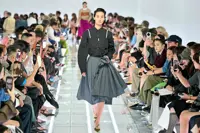
During the Milan womenswear shows earlier this year, I was struck by the amount of fur on the runway – hairy, shaggy, fluffy fur that, if I were guessing, I would have pegged as fox or mink.
But when I went backstage and asked, almost every designer looked very smug and said: “Oh, it’s not fur. It’s shearling!”
For example, Maximilian Davis of Ferragamo told me, “Fur is something that we can’t use today, and we shouldn’t use today.”
But he was just fine using shearling. So are magazines like Vogue and Elle, which have committed to not photographing new fur, and stores like Bloomingdale’s, Nordstrom and Saks, which do not sell new furs.
Shearling has become, in other words, the non-fur fur of fashion, and it is now being made to look like fur, even as fur itself has fallen out of favour.
Read more: Faux real? How fashion is shifting from fur to sustainable alternatives
Most people looking at someone wearing these shearlings would assume that person was wearing fur.
Which, in fact, they are. Shearling is the skin, with wool attached, of a young sheep (sheepskin is the skin without the wool). That sounds like fur to me.
Although animal activists such as Peta condemn the wearing of shearling, the reason it is widely considered acceptable is that, at least theoretically, it is a byproduct of another industry.
Unlike fox or mink, sheep are not killed just for their skins. They are killed for food, and the skins are leftovers, which fashion is using rather than letting them go to waste.
That’s a good thing.
Ugg, which is known for its sheepskin boots and slippers, has an official “ethical sourcing and animal welfare policy” (or its owner, Deckers, does) that states that it “does not accept hides from animals that have been slaughtered exclusively for their pelts or skinned alive” and uses only tanneries that it has vetted as compliant.
That’s not a foolproof solution, as revealed by the various crises in fashion’s supply chain involving, for example, cotton and leather certifications, but it’s about as good as it gets now.
Still, I wonder if the headlong rush to embrace shearling and make it look like old-timey fur is actually a sign that we are not nearly as fur-free as we may like to think.
The net effect of shearling that resembles mink is to get the eye used to the idea that mink and similar pelts are desirable again.
Read more: With vintage fashion becoming trendy, stigma of wearing fur goes away
That’s especially so when twinned with the fact that vintage fur is coming back into fashion.
To be fair, it is more environmentally friendly to keep a garment in circulation, especially one made of natural materials that will ultimately biodegrade, than to resort to new synthetics – that is, faux fur.
So there is a valid argument for embracing your grandmother’s old raccoon coat.
Ultimately, the shearling situation is just another example of consumers wanting to have their cake (feel virtuous about not harming animals in the name of fashion) and wear it, too.
That’s a very human situation, if not one that makes a lot of sense. – ©2025 The New York Times Company/Vanessa Friedman
This article originally appeared in The New York Times.