It was, in nearly every way, an ordinary photo distributed by The Associated Press to news media outlets.
It showed three police officers leaning against a silver car parked in the courtyard of the Louvre Museum in Paris just hours after the brazen theft of a collection of French crown jewels on Sunday.
But then there was the dapper man standing jauntily on the right side of the photo.
The officers, the caption said, were there to block the entrance to the museum. But the man, dressed in a buttoned up vest, a trench coat and a fedora, who seemed to be surveilling the scene, was more than enough reason for the internet to pounce.
In the days since the photo was uploaded, social media users – who had been romanticising the crime as a Hollywood movie – have dreamed up numerous theories of who the unnamed man could be.
He was, many suggested, a detective assigned to the case who happened to have taken more than a few style cues from fictional characters like Sherlock Holmes and Hercule Poirot.
Read more: What should women in power wear, and why do shows get their style wrong?
“Never gonna crack it with a detective who wears an actual fedora unironically,” Melissa Chen, a tech executive based in London, wrote in post on the social platform X that has been viewed more than five million times.
“To solve it, we need an unshaven, overweight, washed-out detective who’s in the middle of divorce. A functioning alcoholic who the rest of the department hates.”
Others urged Netflix to secure the rights to the man’s story for a future series. Some said he was simply being French.
Then, rather quickly, the conversation shifted. This sharp-dressed man, some social media users surmised, wasn’t real.
It was an image of a French detective generated with artificial intelligence.
The assumption that it was an AI creation felt plausible because there is something about the image that, to Matt Groh, a professor at Northwestern University whose research focuses on AI generated images, “seems off”.
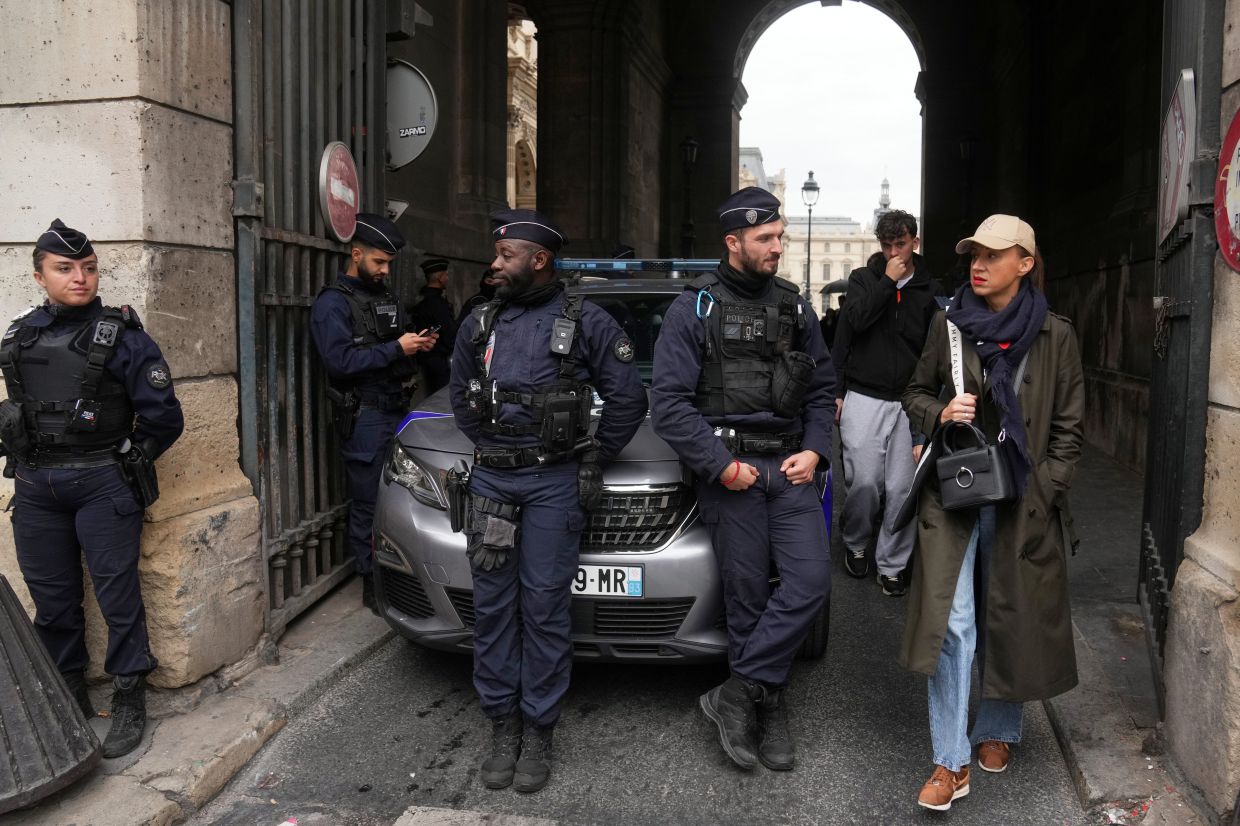
It was perhaps because the man was so incredibly well dressed and so anachronistic compared with the people around him.
His fedora is tilted just so. His skin looks flawless. He looks “too good” to be real, Groh said, like a star of an old black-and-white Hollywood film.
The photographer who took the photo, however, confirmed that the man was, in fact, real, and that he was merely a passerby unconnected to the investigation.
“I don’t know him,” Thibault Camus, the photographer who shot the image, said in a recent interview.
“I don’t know if he is French. Maybe a tourist? Maybe he is English.”
It was the man’s outfit that made Camus want to capture what seemed to him like a pointed moment – with someone dressed in an old-fashioned way walking out of a historic building.
“Old-fashioned like a museum can be,” Camus added.
Another image by Camus of the same alley and the same police officers, but with a woman in a trench coat and a tan Yankees cap instead of the man, seemed to confirm his creative instincts, as that photo received much less attention.
There were, however, factors besides the man’s immaculate style that could have tricked viewers into believing the image had been created or altered with AI, Groh said, including the fact that one version of the image being shared was particularly low resolution.
Read more: Hollywood’s last shoemakers: Footnotes in the story of timeless bespoke style
“If it’s super-high resolution, then it’s less likely to be AI generated, just because it’s really hard to generate super-high resolution,” Groh said.
There is also a proliferation of AI tools, like Google’s Nano Banana, that allow users to paste a person or an object into an image.
“Someone might think, ‘Oh maybe he was copy-pasted in,’” Groh said. “You could imagine the entire scene where this guy didn’t exist and it would look the exact same.”
It is because we are surrounded by these kinds of AI images and tools that users are now also trained to be skeptical of everything they see, he added.
“People are building AI literacy,” Groh said.
And the best way for users to know if an image like this is authentic is for the news agency to say, “We know the photographer who took this – this is a real image.”
Camus was happy to oblige. – ©2025 The New York Times Company
This article originally appeared in The New York Times.