Fashion houses often wax lyrical about their brand’s tradition and history when presenting a new collection. It is seen as something to be proud of – a link to the past or an identity that should not be disregarded.
So, why does cultural heritage then not play a larger role in the fashion industry as well?
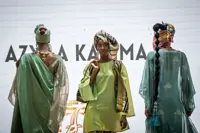
South-East Asia ecommerce fashion site Dia Guild recently held an exhibition in Chinatown, Kuala Lumpur. It called for everyone to explore their roots, plus craft narratives and cultural identities.
“Cultural heritage is a way of living that a community has passed down from one generation to the next. This spans from historical sites to cultural practices, to the values and beliefs different communities shared,” explains one of Dia Guild’s co-founders, Alia Farouk.
“It represents our history, unifying us to our past, present and future. It is one of the very first pillars which makes up the foundation of who we are as people and that ties us to our core identity.”
In the context of fashion, she says that designs can be “significant in documenting the identity of a nation”, for example the baju kebaya, or any other national dress.
“Something as simple as the length of skirt hems or the textiles used can differ from smaller communities to another, and can reflect a nation’s geographical position, available resources, technological capabilities, societal trends, economic and political landscape, as well as their basic values,” Alia comments.
Read more: How a KL-born designer courted trouble over her cheongsam comment
Malaysian jewellery brand Talee was featured in the Dia Guild exhibition.
The founder, Lorraine Lee, says that knowing about her heritage and culture has given her a clearer sense of direction.
It is not something someone can run away from, as well.
“I frequently claim that my work is free of cultural influences, but I realised that it also exists as a result of my personal experience, which has been influenced by my birthplace, family and friends, and is what inspired me to do what I do today.”
Lee, who hails from Sabah, founded Talee when living in Canada. She brought it back to Malaysia upon her return here in 2019.
The brand offers jewellery made from beautifully knotted string.

“A significant part of the stories being told through my work and personal story with my father’s diagnosis were inspired by moments growing up in Malaysia as well – the tropical ocean, rainforest, food and people,” she notes.
Appropriation versus appreciation
Fashion brands have indeed tried to highlight different cultures from around the world. However, these attempts often end up being mired with controversies and labelled as cultural appropriation.
Isabel Marant for example, was accused of plagiarising a Mexican community’s traditional dressing back in 2015.
In 2019, Gucci caused an uproar when it sold a headpiece named “Indy Full Turban”. Social media users attacked it, saying that such a “fashion accessory” was insensitive towards the Sikh culture.
When Loewe included traditional textile patterns into its Spring/Summer 2018 collection, the label was accused of ripping off Ecuador’s indigenous craftspeople and showing disrespect.
According to Alia, there is only a very fine line separating cultural appropriation and appreciation.
“Cultural appropriation involves taking an aspect of a culture that does not belong to you and using it simply as a fashion statement or for your own personal interest,” she points out.
“In contrast, cultural appreciation is taking the time to understand the cultural significance of that item of clothing and wearing it in a way that is not disrespectful to its respective community.”
Read more: Dutch designer under fire for wanting ‘to see Malays dress beautiful again’
Alia says while representation of different cultures is extremely important, brands need to use the right models, more so obtain the correct understanding and narrative.
To her, these actions are essential in authentically and respectfully spotlighting certain cultures.
Dia Guild, for instance, provides context and credit to its partner brands. These come from all over South-East Asia.
The three Malaysian co-founders personally speak to every brand, and after that, there is an additional interview where they are able to share their inspirations and creative processes behind the products.
A profile is further written and lives on the Dia Guild site. On each product page, there is also a section called “Artisan’s Notes”, which reveals more about the item’s production process, or underlying inspiration and cultural influence.
“Different fashion items directly linked to cultural traditions aren’t just about the fabrics they’re made from, or the sewing techniques used. On a deeper level, they represent the struggles and triumphs felt within a specific community,” Alia stresses.
She adds that the clothes someone wears can serve as a mode of storytelling of another person’s heritage, which is why it shouldn’t be taken lightly.
Instances of mistaken identities have happened in the past.
“Gingham, which is thought of as a British print, actually originates from South-East Asia,” Alia says, adding that it comes from the word “genggang”, meaning “striped”.
Anything that touches on culture, can be a sensitive subject. Last year, fashion label Nala Designs angered locals here when the founder said in an interview that she wished to see the baju kurung return and for Malaysians to dress well again.
Baju kurung is the traditional fashion staple for Malay women. It has never fallen out of style.
Kuala Lumpur-born, Singapore-based designer Priscilla Shunmugam got into trouble for equating modern western clothing with social progressiveness.
She made the comment last September when answering a question in a webinar on why the cheongsam, a traditional dress worn by Chinese women, has always been a staple of her collections. The video was recirculated online last week.
All of these emphasise the importance of awareness, and reiterates a need for the industry to be more mindful.
After all, cultural heritage must not be diminished in any way – no matter how in-vogue it may look, or relegated as a fashion trend or statement.
Already a subscriber? Log in
Get 20% OFF The Star Digital Access
Cancel anytime. Ad-free. Unlimited access with perks.