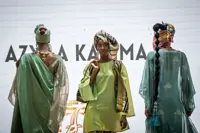
How eco-fashion is offering a renaissance for new Tunisian brands


By AGENCY
French-Tunisian brand Basscoutur aims to prove to the industry that sustainable fashion is possible on a wider scale. Photo: Instagram/@basscoutur75

The sun is setting by the time Tunisian fashion designer Chems Eddine Mechri reaches the breezy, seaside town of Mahdia. He has spent half the day driving in the scorching heat in pursuit of the precious, handmade fabrics he needs for his upcoming winter collection.

With a 200-kilometer road trip from Tunis coming to an end, the designer knows just the place: the basement of a blue-lit workshop, hidden away in the labyrinth of Mahdia’s old medina, where silk weaver Mohamed Ismail’s spinning wheel still is going at full speed.

In a globalised world dominated by fast fashion brands such as Zara, H&M and Topshop, Tunisian designers like Mechri are increasingly going back to their roots, embracing local artisans and environmentally conscious materials.

Read more: How climate positive clothing is shaping the ecological role of fashion

Thanks to North African nation's age-old textile-making traditions, Tunisia is a good fit for the eco-fashion they want to champion. Ismail has been spinning locally sourced wool and cotton, as well as silk thread imported from China, for the last 47 years.

"This work is in our blood... it’s in our DNA, ” Ismail says as he unwinds a crimson silk yarn in his workshop. "It’s intergenerational, and for my family, this work is very precious to us.”

Back in the capital of Tunis, Mechri and his dressmaker sew together a dress from scratch for his fashion brand Nee. They combine a shimmering pink and gold traditional fabric used in Tunisian embroidery with a mesh material from the 1960s.

Both were deemed unsellable by the merchant Mechri bought them from.

"They (didn’t) fit with the tastes of the day, ” Mechri said. "And that’s why they (the fabric merchants) need us, the designers... to give a second life to these materials.”

Lasaad El Beji Amine El Hrairia is an example of a local Tunisian artisan whose craft and production of high-quality hand-made material is being incorporated by these new sustainable fashion brands. Photo: AP

One of the most polluting industries

The US$2.6 billion (RM10.7 billion) textile industry is a pillar of the Tunisian economy, employing 160,000 people and producing roughly 25% of the country’s total exports, according to estimates by the Oxford Business Group.

However, fashion is among the most polluting industries in the world, responsible for producing 10% of carbon dioxide globally, according to the World Bank, and tens of millions of tons of clothing is discarded every year.

Mechri and other designers have turned to the eco-friendly practice of "upcycling” – taking old or unwanted materials and turning them into something new and modern by incorporating high-quality fabrics.

Read more: Fashion explainer: What is 'upcycling' and how did it become a style trend?

Mechri mixes old fabrics with the craftwork of artisans across Tunisia – from embroiderers in Tataouine, on the edge of the desert, to seamstresses in Bizerte in the country's north.

Fashion brands in the West are getting serious about upcycling, too, including American brand Bode and Hotel, a Danish-French brand founded by Alexandra Hartmann.

"People are starting to realise the negative impact of that desire to constantly consume all the time without taking a step back, taking a pause to reflect and ask questions about the environment and the future of humanity, ” Mechri said in his Tunis boutique as clothing on the racks behind him shimmered and rustled at the touch.

"Fashion is an intelligent way to pay homage to local materials.”

The desire to honour one’s ancestry was equally important to Hassen Ben Ayech, a 26-year-old former computer scientist. He founded the fledgling high-end brand Bardo with the express intent of reviving Tunisia’s heritage and traditional crafts in "an era of uncertainty and fear of environmental doom, coupled with the slow death of small pockets of culture in the face of globalisation”.

The brand’s first collection evokes imagery from the famous Bardo palace in Tunis and the era of the beys, the rulers in the Tunisian monarchy that was abolished in 1957.

"We wanted to go back to a period that is often overlooked and avoid the cliches, ” Ayech said. "We wanted to show that there is more to us than kaftans, (and to) dive deeper into our history and identity.”

In 2018, Riad Trabelsi relaunched his French-Tunisian brand Basscoutur to prove to the industry that sustainable fashion is possible on a wider scale. The brand has a growing client base in Japan and South Korea and will soon launch in Italy.

"We’re seeing this concept become normative. If it’s not sustainable, it’s not cool, ” Trabelsi said.

He feels his designs reflect the complexity of the modern Tunisian diaspora: "My identity is complex – I have a Tunisian father, an Algerian mother, meanwhile I was born in France. I draw all my DNA from this incredible mix... I am constantly evolving, reconditioning myself and my understanding of my Tunisian heritage each day.”

Using storytelling

Sofia Guellaty, a Tunisian fashion journalist and the founder of Mille World, an online platform spotlighting Arab youth culture, arts and fashion, said these brands "are using the storytelling of where they come from to make their garments stand out".

"Tunisia is exactly on the mood board: the natural shapes, the beautiful, raw, organic materials. They are what the international and local markets want," she said.

Guellaty notes that most Tunisians, still excited by the novelty of fast fashion brands that only started becoming available locally over the last decade – are not so eco-conscious.

Read more: Can fashion labels attract more shoppers by going 'green'?

Still, she has noticed more young Tunisians embracing their cultural identity and turning to local brands. Ayech says Tunisia’s still-flourishing textile industry represents hope for those swept up in the country's ongoing economic crisis, which has been exacerbated by the coronavirus pandemic.

"The industry sustains a lot of families with a steady income even in remote areas and without access to higher education, ” he said.

Businesses that strike a balance between ethical industrial practices and community-driven craftmanship offer Tunisia "a hope of a better tomorrow”. – AP

Wear eco-friendly fashion pieces at budget-friendly prices with Zalora Voucher

Get 20% OFF The Star Digital Access

Monthly Plan

RM 13.90/month

RM 11.12/month

Billed as RM 11.12 for the 1st month, RM 13.90 thereafter.

Best Value

Annual Plan

RM 12.33/month

RM 9.87/month

Billed as RM 118.40 for the 1st year, RM 148 thereafter.

Follow us on our official WhatsApp channel for breaking news alerts and key updates!

Next In Style

Framing fashion: Bibo Aswan, the photographer shaping Malaysia's visual style
Has Taylor Swift’s wedding just outshone the Met Gala in fashion stakes?
Fashion awaits Taylor Swift's bridal look, but here's what the guests wore
The American dream, dressed: A look into 250 years of fashion and aspiration
Why letting go of a wedding dress can be among fashion’s hardest choices
Fashion sees clearly as glasses emerge as the chic accessory of the moment
The bikini at 80: Fashion is still pushing the limits of this swimwear classic
Two shirts, one outfit: Is this fashion’s smartest layering trick yet?
A shirtmaker so extraordinary that a luxury fashion house is buying the brand
Holidaying somewhere hot and humid? Stylists share their fashion essentials

Others Also Read