Dhanendran Sidambram's current job involves managing how planes and their parts are bought, used and sold. As an aviation asset management consultant, he also deals with companies that specialise in aircraft recycling, which involves dismantling, component recovery and material repurposing.
"Part of my job involves liquidating older aircraft to harvest parts that we would repair and overhaul before selling back to the market. From this, we discovered that there is a huge amount of carcass along with parts from the cabin that were not reusable and destined to become scrap or aviation waste," said Dhanendran, 41, during an interview in Shah Alam recently.

Seeing an opportunity, the former aircraft engineer with Malaysia Airlines decided to venture into a business where he upcycles salvaged airplane parts and components into creative artwork and furniture.
His one-of-a-kind pieces include furniture pieces (upcycled from seats, cabin storage units and class dividers) sleek bar counters (repurposed from aircraft galleys and engine cowls), table lamps (made using pitot tubes and flap tubes) and personalised photo frames (crafted from window shades).

In 2015, Dhanendran was among 6,000 Malaysia Airlines employees who were retrenched as part of the company's downsizing efforts.
Turning waste into art
Dhanendran operates his business from a spacious warehouse at Kampung Baru Subang in Shah Alam, where he houses a range of airplane parts, including flight attendant seats, service trolley (the food cart carrying pre-heated food), luggage bins, plug doors, cargo doors and flight deck seats.

In total, there are about 2,000 plane parts in his 930sq m warehouse.
Many decommissioned plane carcasses are stored in Kansas City, Missouri, in the United States. The planes are later disassembled and valuable parts salvaged. Engines, avionics and other components are refurbished or sold. Metals and materials are separated for recycling.
Once the reusable parts are harvested, the leftovers and junk are shipped to Dhanendran by sea freight in a 120ft (36m) container.

"Just like how we have 'kereta potong' (cut-and-join cars), we also practise a similar concept in aviation. While a decommissioned plane may not have any value, its parts still have value. They are fitted back into a new plane and put back into circulation. Then, they undergo thorough inspection to get certified," shared Dhanendran, adding that a decommissioned plane carcass can cost from US$2mil (RM9.58mil) onwards.
"I think it's astounding that these amazing pieces of aviation history get another shot at being centrepieces in homes and offices instead of being dumped in landfills. The complexity of alloys and materials used in aviation poses a real challenge to recycling.
"Only a few countries have the technology to break down these alloys into pure aluminium and even that would not be feasible if you do not have volume. So upcycling, for me, is the best option for now," said Dhanendran, who invested RM200,000 to kickstart his company, which he runs with four staff.

Too good to throw away
Dhanendran believes he is the only person in Malaysia who runs this specialised business.
"I believe we are different because we do not just cater to aviation enthusiasts. We also customise our products for people in other industries such as food and beverage, automotive and event management. So we don't just sell them as original aviation items."

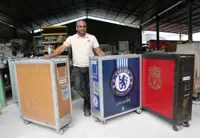
"So far, I have refurbished over 100 carts for my customers, who are mainly aviation enthusiasts and cabin crew staff from Malaysia, Singapore, Thailand and Australia. Most people want custom-made service trolleys which are then turned into make-up racks, wine bars or cigar bars. The starting price of a service trolley is RM2,000.
"People don’t realise how expensive aviation things cost. We take between seven and 10 working days to make a customised cart. We buy them very damaged and we break down every unit, rebuild and refurbish up to 80-90% (of its original) condition. Minor dents and nicks will still be visible," said Dhanendran.
The upcycler has also made several carts for diehard fans of football clubs like Liverpool, Chelsea and Manchester United. They come complete with printed stickers of the club colours, logo and the works.

"I started this venture hands-on as I have always loved to tinker with things. Plus, I too am an aviation enthusiast and I love all things related to the aviation industry. My house has many aviation art items like my handcrafted table lamp made from a pitot (aircraft sensor) and my Liverpool FC bar cart."
Each airplane part that he receives must go through a demilling process.

"We list down the serial numbers of the parts we have and we destroy/permanently damage it at fittings and structures. We do not sell components, spares and primary structures for this reason,” said Dhanendran, who is looking at collaborating with stores in Singapore and Thailand to place his upcycled products.
Already a subscriber? Log in
Get 20% OFF The Star Digital Access
Cancel anytime. Ad-free. Unlimited access with perks.
A skyward transformation
'I love all things related to the aviation industry,' says Dhanendran. Photos: The Star/Art Chen
These airplane parts and components, deemed unfeasible for reuse, are destined to become scrap or aviation waste.
— Photos: ART CHEN/The Star
'I am an aviation enthusiast and I love all things related to the aviation industry,' says Dhanendran.
ART CHEN/The Star
Each airplane part must go through a demilling process to prevent abuse, trafficking and circulation of parts that are not certified fit for use on active/operational aircraft.
— ART CHEN/The Star
'I started this venture hands-on as I have always loved to tinker with things,' says Dhanendran.
— ART CHEN/The Star