

Dust coats balconies, fuel fumes drift through cracked windows, and every step crunches on the remains of homes that never fully healed.
Among these battered streets live women who have returned from the al-Hol camp, women once trapped in a world shaped by Islamic State (IS), war and survival.
They arrive in buses called “Hope Convoys”, carrying children who have never seen a city and carrying labels that society refuses to let go.
Women of the camp
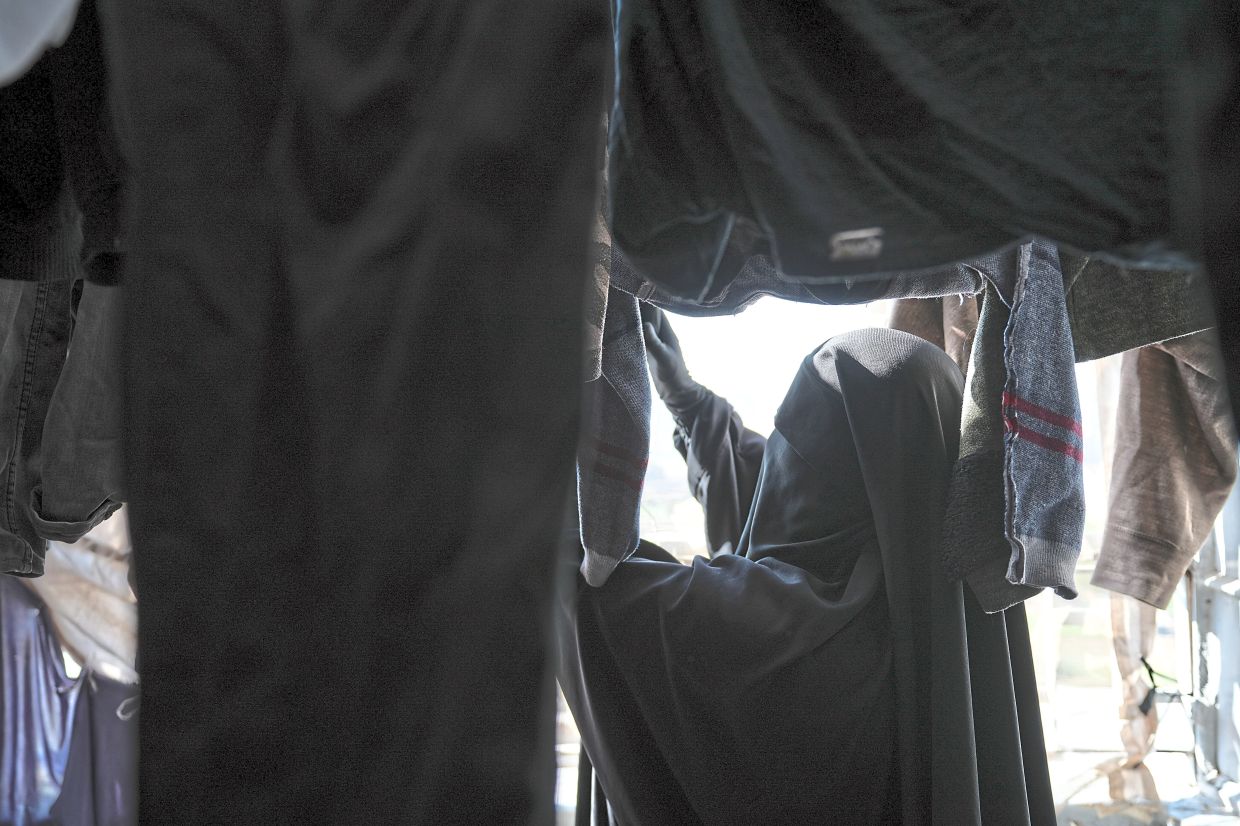
Fatma, 45, opens the door to her new apartment in a dim, cracked stairwell, her figure framed in black, her voice calm but heavy. Black gloves cover her hands.
She spent six years in al-Hol with eight surviving children. Her ninth died there as an infant.
“To this day they say we belonged to IS,” she says, lowering her eyes. “Even though we weren’t fighters, even though we weren’t part of them.”
Fatma says her husband disappeared when Kurdish forces took him in 2019. She never heard from him again.
She insists they were never members of IS but admits she adopted the clothing the group enforced.
“I was convinced by it,” she says softly. “It gave me modesty.”
Now she lives in an eastern Aleppo neighbourhood in Syria where the destruction is familiar and anonymity is impossible.
“People smile politely,” she says, “but they still whisper. To them, we are the women of al-Hol.”
“Integration is easy”, they are told – but reality is harder.
Officials working on the reintegration programmes speak with optimism. In cooperation with the United Nations, the non-governmental Stabilization Support Unit (SSU) has launched the so-called Hope Convoys.
They bring Syrian families from the camps back to their home towns.
Until now, this was mainly possible for “humanitarian cases”, for example when a family member was ill.
When the first convoy rolled into Aleppo, there was criticism and hatred. Many did not want people from the camps in their neighbourhood, says SSU director Munser al-Salal.
But now the picture has changed, and there is increasing understanding.
Today, many even demand the dissolution of the camps so that the ideology has no further breeding ground.
Many of the children know nothing other than the camp. When the first buses headed for Aleppo, they marvelled at the realities of the present.
Residential houses and buildings – they had never seen such things.
There were hardly any trees or nature in the desert area around the camp near the Iraqi border. These insights can beaseen in mobile phone videos taken by NGO employees.
The education of the children and the integration of the families into society is the most important and at the same time the greatest challenge, says al-Salal.
The women who went are either staying with their brothers or fathers, and they say the communities have begun accepting the returnees.
Integration, they say, is “easy” only on paper, not in people’s eyes: Every move is watched; every veil is judged.
“My children do not have identification papers so they cannot go to school, but I send them to the mosque to learn how to write, as in al-Hol camp, teaching was the only entertainment for the children.”
Memories of a prison
Zainab, 29, who also returned recently, raised four children in al-Hol on her own in a tent she describes not as a shelter, but as a cage. Her husband died in the bombardment of Baghuz, the last IS enclave.
She insists – again and again – that he was not a fighter.
“He worked there,” she said in a shaky voice. “That was all.”
She came back to Aleppo with no documents. Her children, aged six to 12, still struggle to read.
They gasp when they see trees, balconies, water fountains, things they never encountered in the desert camp.
Now they live in a neighbourhood rebuilt only partially, where walls are pockmarked, and where whispers follow them.
“It is better than the camp,” she says, “but we are not free from people’s judgement.”
A life under observation
In another home, Hiba, 43, sits beside her three children. Her youngest daughter, Maria, only seven, wears bright colours that stand out against her mother’s black gloves.
The girl wants to become a doctor, she said.
Hiba hopes Aleppo will allow her children to dream like that.
“The camp is behind us,” she says. “But for many people, al-Hol is still written on our faces.”
In the streets around them – streets once torn apart by Bashar al-Assad’s battles and the rebel front lines – the war has ended in name only.
Dust and memories cling stubbornly. Here, women from al-Hol walk between broken buildings and the eyes of those who still doubt them.
The women have suffered as single mothers in a camp where life was described as “hell” and they raised children without proper education.
“All I want now is for my children to have proper education and have their own house,” Hiba said.
“Maybe one day,” Fatma says, “they will see us as more than the past.” – dpa
