
One of the most impressive experiences you can have with wildlife kicks off with a shouted command. "Come on, come on, come on - into the water," guide Georgia Clements yells to her guests.
Everything was relaxed up to this point, but now there is no time to lose on the excursion boat.
Like lemmings, the guests slide on their bottoms to the stern of the boat. Plop, plop, plop, one after the other disappears into the water.
"Now form the lines!" Georgia shouts.
Strung together like pearls on a string and instructed in advance, the tourists hold their positions in two rows, paddling with their diving fins.
They are here to see the largest fish in the world.
The whale shark is a docile, filter-feeding creature known as a "gentle giant" that cruises tropical oceans, eating plankton and small fish by straining water through its massive mouth, despite having hundreds of small teeth.
They are easily identified by their huge size, broad flattened heads, and unique patterns of white spots and stripes.
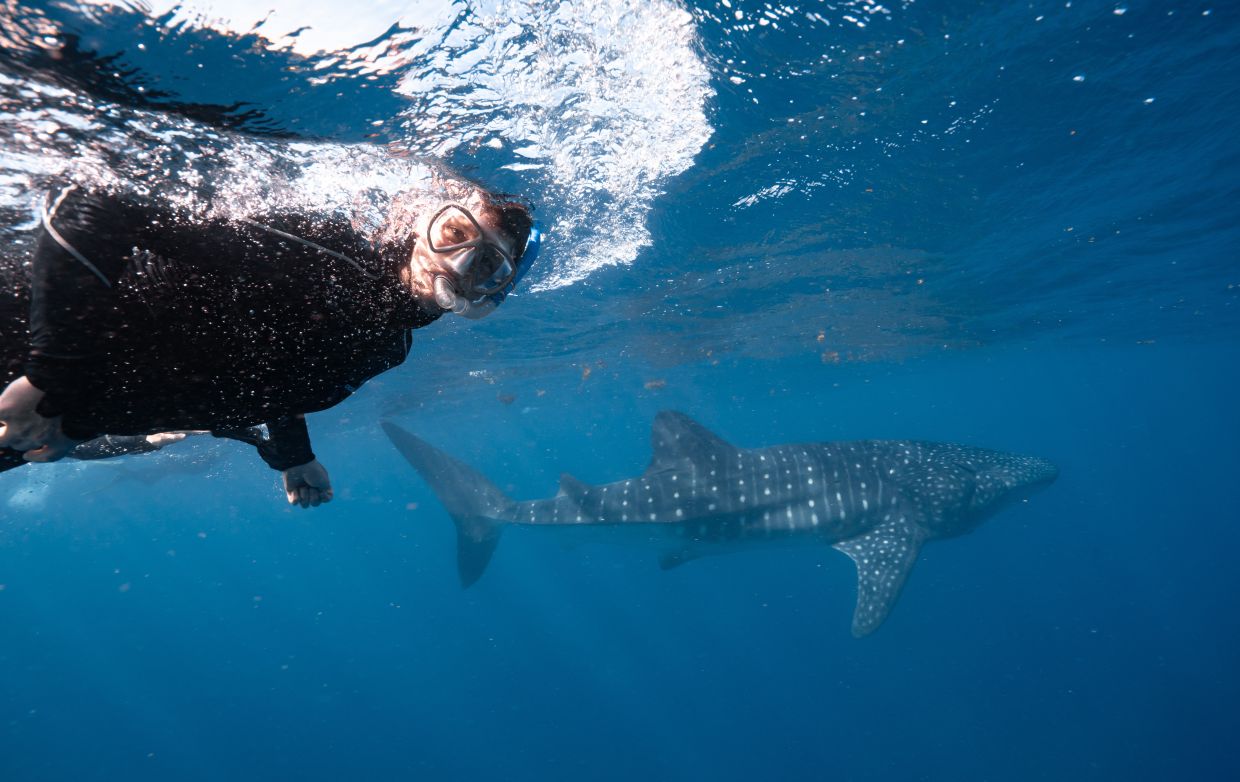
Whale shark season starts in spring
Apart from the blue of the Indian Ocean here, a few hundred metres off the coast of Western Australia, the tourists do not see much at first. Sunbeams, deflected at the water's surface, seek their way into the depths. The surface glistens and tiny things sparkle in the water.
Because of these tiny plankton, hundreds of whale sharks come to the waters off North West Cape, over 1,000 kilometres north of Perth, in the first months of the year.
This is their food. In March and April, the corals of Ningaloo Reef, the largest fringing reef on Earth, spawn en masse. Millions of cnidarians release eggs and sperm into the water, a feast for krill. These crustaceans are microscopic plankton, but they form huge swarms.
This is what whale sharks like most and the reason why they head for the nearly 300-kilometre reef. Up to 600 of these giant fish arrive and stay until August, meaning you can plan an encounter.
Tragic tipping point for corals
A visit to Sal Salis is a perfect example of how swimming and snorkelling with sharks is a normal part of life here.
The camp's tents are scattered across the dunes of Cape Range National Park, which, together with Ningaloo Marine Park, forms the Ningaloo Coast UNESCO World Heritage Site. The ocean is just a stone's throw away.
The staff say to look in a shed next to the breakfast terrace with sea views. "There you can find masks, fins, swimsuits and sunscreen." The marine life that awaits guests is said to be abundant. No mention is made of the fact that reef sharks are among them.
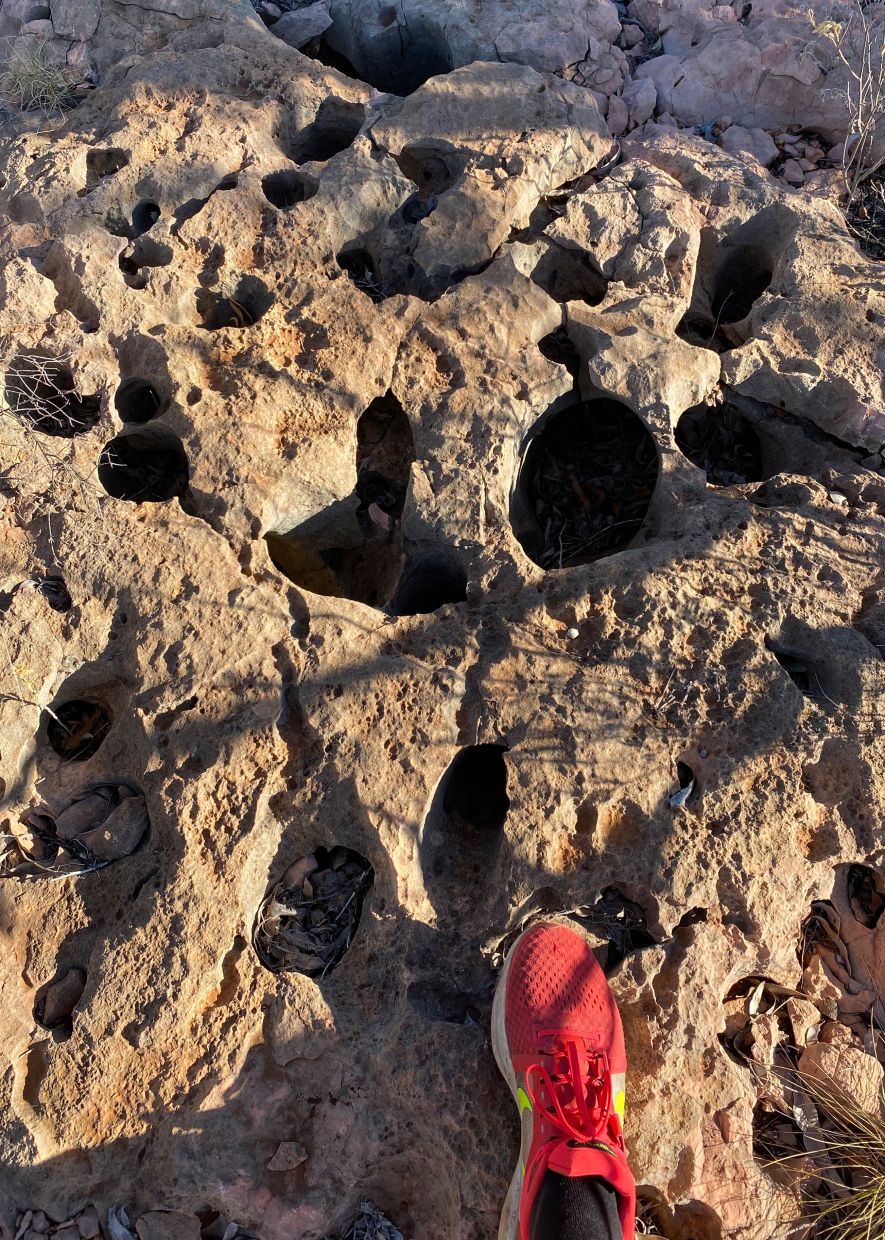
The sandy path to the beach is lined with coral, as if floods of times past had sent harbingers of what can be experienced after just a few strokes.
Unlike the famous Great Barrier Reef, the Ningaloo Reef is located directly off the coast. "You go into the water and you're in an aquarium," says one camp guest.
Suddenly you're surrounded by masses of colourful fish, some the size of violins, others as small as fingernails.
Then along comes the first shark. A blacktip reef shark, perhaps two metres long. It swims past 3 metres away, not seeming to pay any attention to the snorkeller.
You can drift with the current over the coral garden and see turtles the size of coffee tables. Hammerhead sharks and tiger sharks are also among the more than 500 species of fish that inhabit the reef. Sometimes you can even see dugongs, rare sea cows.
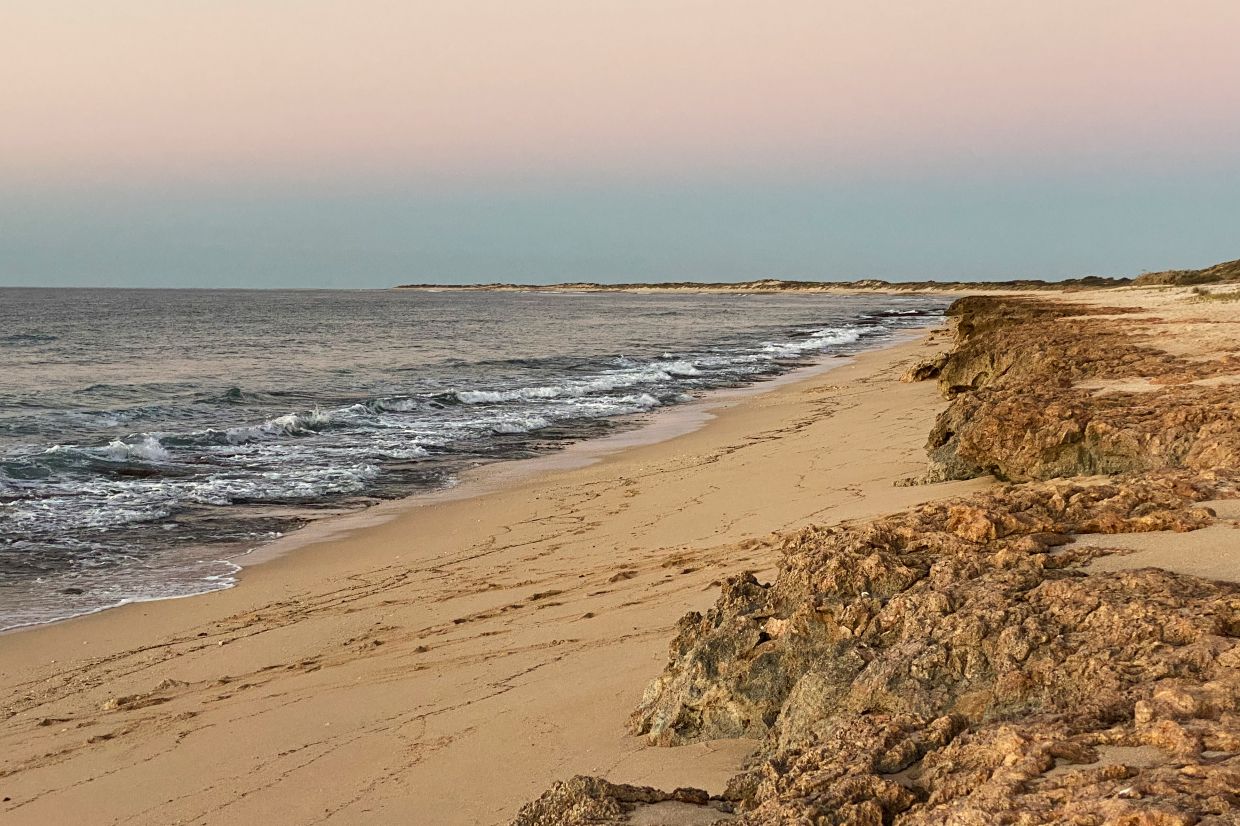
Hiking on a former reef
From July onwards, humpback whales also visit Ningaloo Marine Park on their migration across the ocean. In ancient times, the cape was a coral reef. It rose from the sea some 9 to 12 million years ago, and now forms a mountainous landscape with deep canyons in the limestone.
Guide Ian Vickers regularly explores this world of red rock faces. This morning, too, he set off while it was still dark. "A night swallow!" Vickers suddenly looks up, where the bird's eyes flash in the light of his headlamp.
Then the sun rises. Slopes and valleys become visible as silhouettes, contours emerge and we see the meandering flanks of Charles Knife Canyon, the spinifex sweet grass overgrowing it and a silvery shimmering sea.

During humpback whale season, Vickers sits up here at an altitude of 300 metres and points his binoculars towards Exmouth Gulf. "That's where they swim down there." During one of his hikes, the guide found a fossilized tooth from a prehistoric shark.
The megalodon grew up to 24 metres long and roamed the ancient Tethys Ocean millions of years ago. "You think you've seen it all, but then you experience something that amazes you all over again," says Vickers. For him, this includes the shell fossils that are regularly found on the hikes he leads.
Whale sharks are not quite as large as megalodons, but they come close. They can grow up to 20 metres long and weigh over 30 tonnes, as much as two buses.
Their more than 3,000 teeth are only a few millimetres in size, which is why whale sharks limit themselves to filtering plankton, spawn and small crabs out of the water with their gill rakers, like a vacuum cleaner.
Strict rules for mutual protection
To protect observers and the observed, strict rules apply at Ningaloo Reef, hence the harsh tone of the guides. Only 10 people are allowed to be with a shark at any one time, five on each side. You are allowed to come within 3 metres of the shark, but no closer.
Fourteen boats have a licence to take tourists to the giant fish at the reef, and they must always remain at least 30 metres apart.
Small aircraft patrol the air to locate the sharks and radio their positions to the boats. It is a sophisticated system that balances the whale shark and the lucrative tourism surrounding it.
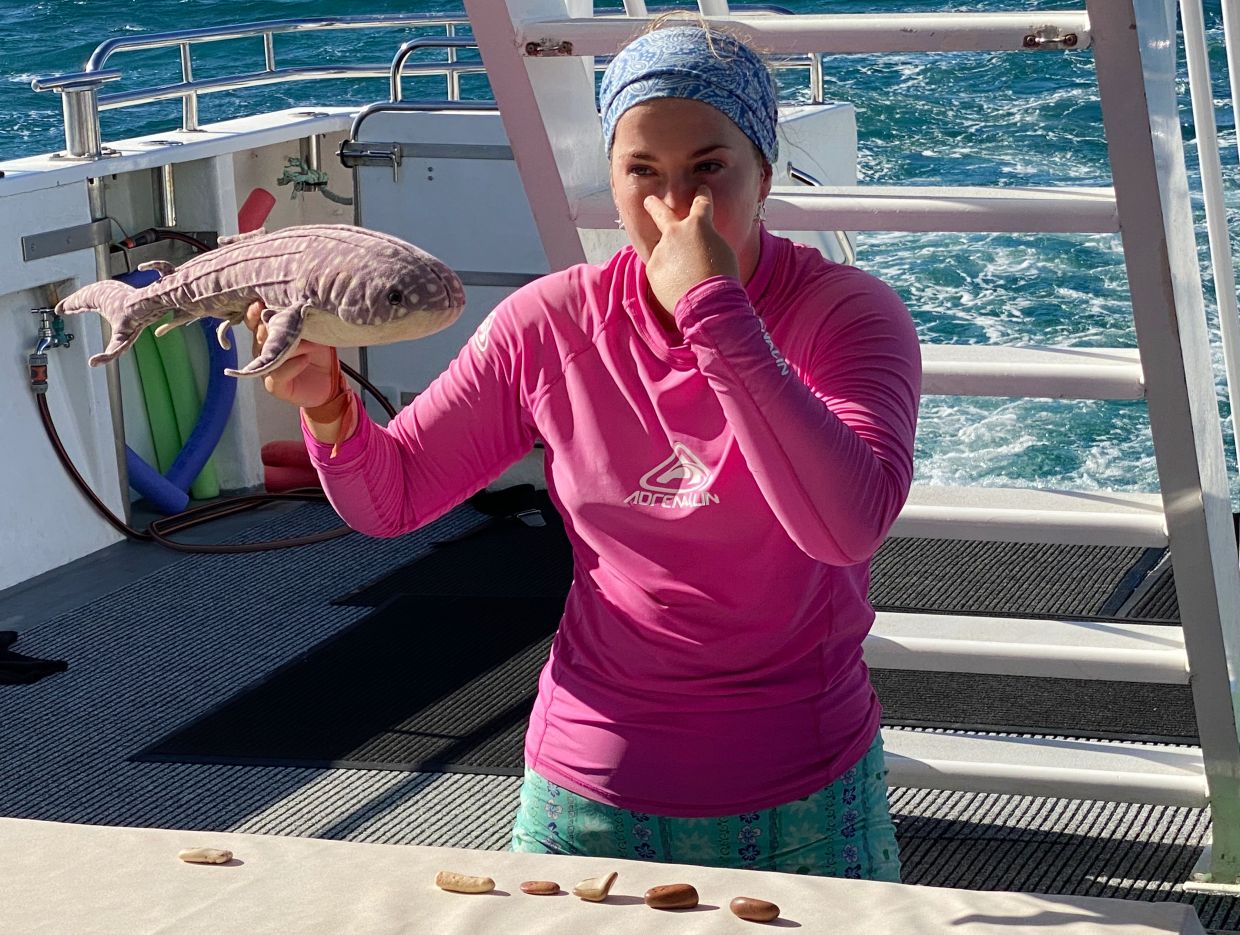
The Ningaloo Reef is perhaps the best place in the world for this, says skipper Asa Croak, adding that part of the proceeds from the whale shark tours go to the national park administration.
Encountering one of these giant fish is a "once-in-a-lifetime experience," says Miecha Bradshaw, a marine biologist who is on board for pleasure, rather than in a professional capacity.
And who knows how much longer shark watching will be possible. The Ningaloo Reef is also being ravaged by coral bleaching due to global warming and 2025 was particularly bad. "The corals don't have time to recover," says Bradshaw.
The experience
Everything is still blue in front of the masks of the shark trip participants. But then a pattern appears, something speckled. The shark is there. Twice as long as a car, it glides close to the surface of the water.
"Now swim with it," Georgia's voice echoes.
Crystal clear and as if painted, the brown-bluish skin pattern of dots and lines is right in front of you – as long as you can keep up with the shark by paddling.
If you're lucky, you can look the animal in the eyes, watch it open and close its mouth, and see how smaller fish attach themselves to it symbiotically.
"Stop now!" Georgia commands, and after a few timeless minutes, you have to let the fish go on. Those are the rules.
Back on board, the excitement is palpable. Kevin Lamon, who drove five days from Adelaide for what he just experienced, sums it up in a single word.
"Unreal!" — By Stefan Weissenborn/dpa