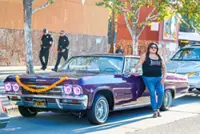
For Angel Romero, every detail of her car is a reflection of her history. The shining purple paint job accents sleek gleaming chrome that flashes bright in the light of golden hour.
Pinstripes adorn the hood and the roof of the car — which hovers mere inches from the road, floating on white-wall tyres — and the trunk is emblazoned with a photorealistic portrait of her mother, the first lowrider Romero ever knew.In the back window sits a metal engraving reading "Duenas” in elegant script.
Six years ago, Romero founded a women’s lowrider club. Tired of hearing others say "that’s your boyfriend’s car” or "that’s your daddy’s car”, she named the club Duenas – meaning "female owners” in Spanish.
"You can’t get any more straightforward than that,” she said.
The club became one of the biggest women’s lowrider clubs in the region, making its imprint in the Bay Area, California, the United States by defying stereotypes and inspiring other women to get in the driver’s seat.
Lowrider culture is most famous for cars that are modified to ride "low and slow” and often have extensive, intricate paint jobs, but Romero says the movement goes beyond the cars.
"It’s not just about lowriding. With Duenas, its also about community and giving back,” she said.
For decades, lowriders were associated with gang activity. Now, Romero sees a return of "ugly narratives” around immigrants and Latino communities, and hopes that Duenas can help push back against them. "Our culture is so beautiful – the women, the lowriders – it’s art,” said Romero. "We’re changing the narrative. We’re not the stereotypes people think we are.”
The seeds of the club were planted nearly 50 years ago when Romero’s mother got her first car, a 1977 Monte Carlo, for her quinceanera. Romero’s mother fell in love with lowriding and when she became a young mother of three, it offered an affordable escape for a family trying to make ends meet.
"My mum didn’t have a lot of money, so for fun, a lot of what we did was ride and cruise around,” recalled Romero, for whom driving has been a source of solace since she was driven around the block as a baby to help her fall asleep. Those childhood rides became formative.
"That’s how all of us fell in love with the car culture, the lifestyle,” she said.
"There wasn’t too many women out there,” she remembered. "It was just me and a couple other women who had their own rides.”
When she did get into car clubs, she was the only woman member. And while the clubs were "amazing” in how active they were, she says she was sometimes treated like a "receptionist”, a "pencil pusher” or "not a real lowrider”.
"(My voice) wasn’t really being heard or taken seriously,” she said.
In the early ‘70s, a wave of car clubs sprang up in San Jose, sporting the distinctive style that included the smaller wheels and spoked rims associated with lowriders.
The era saw the birth of Lowrider Magazine, founded by students from San Jose State University, and Andy’s Hydraulics – the first shop to flip a car using hydraulics.
As cruising was stymied in Los Angeles, thousands gathered from around the state to cruise along Story and King roads in San Jose, riding low and slow up and down the street.
Among the wave were several all-woman car clubs, including the Sophisticated Ladies, whose leader, Rachel Flores, organised the first version of a lowrider council and campaigned to allow lowriders to congregate along Story and King.
As cruising was pushed out of the limelight, much of lowrider culture faltered, including the legacy of all-woman car clubs.
Recent years has seen a resurgence of lowrider culture, and after years of advocacy by groups like the United Lowrider Council of San Jose, the city finally repealed its ban in 2022, allowing clubs like Duenas to cruise freely and rise to prominence.
After decades of clubs being relegated to the shadows, Ricardo Cortez, Historian for the United Lowrider Council of San Jose, calls Duenas the most prominent all-woman lowrider club since the ’70s.
"The only reason why we’re here now is because of the resilience of the community. There’s this cultural wealth,” said Cortez. "Duenas is a really cool example of that... and they’re changing the narrative again by being an all-female car club.”
Of the over 70 clubs in the United Lowrider Council of San Jose, only three are all-woman.
With that as her inspiration, she and the club began a flurry of activity to give back to the community in Sunnyvale, San Jose and other cities. They collected truckloads of diapers and wipes for an organisation that supports young and teenage mothers called Shine Together – inspired by some of the members who also were young mothers.
They have gathered hundreds of toys for Sunnyvale Community Services and handed out hygiene products at homeless encampments. Each year, the group raises thousands of dollars for breast cancer research.
"The lowrider community is very giving, and San Jose is a big pillar of the lowriding community,” said David Polanco, president of the United Lowrider Council of San Jose, who points out how lowriders organised to give school supplies to children of farm workers and did drive-by cruises to celebrate graduations during the height of Covid.
"It’s not a hobby, it’s definitely a lifestyle, and that lifestyle is being active and supporting one another. Duenas is a big part of that, just adding to the legacy of lowriding. They’re a good group of people.”
Duenas has inspired others to start their own car clubs for women. Lola Perez of Hollister founded Chulas Unidas — "beautiful women united” in Spanish — after having conversations with Romero and seeing Duenas out in the community.
In 2021, she joined with other women from the South Bay and began to carve her own path with the help of Duenas.
"They had my back 100%. They are strong women. They are the ones that encourage. They are the ones that support. They are the ones that say 'yes, you can do it’,” said Perez.
"Now, I hope another woman starts another car club.” – The Mercury News/Tribune News Service