
Before we step outside, most of us put on a pair of trainers, shoes or boots without thinking twice. But if the weather is pleasant where you are, why not try stepping out barefoot now and again? It’s good for you, and a real treat for your feet.
If you’re wondering how going barefoot strengthens your feet, how to go barefoot more often, and who perhaps shouldn’t try this, here are some answers:
Being confined in shoes is rather monotonous for feet over time. “Walking barefoot lets the soles of your feet experience other stimuli,” says Dr Thomas Schneider, a specialist in foot and ankle surgery at Gelenk Klinik orthopaedic hospital in Gundelfingen, Germany.
Different surfaces – grass, sand, pebbles, mud – stimulate the nerve endings in your soles, which relay the signals to your brain. This promotes better body awareness – your sense of your body’s position and movement – and often a more upright posture too.
“Consequently, barefoot walking ameliorates possible postural faults,” Schneider says. In addition, it leads to better joint stability and body balance over the medium to long term.
“Barefoot walking also helps to strengthen your foot muscles,” says podologist Tatjana Pfersich. Strong foot muscles lower the risk of developing heel spurs, which are often painful bony growths where the heel bone connects to the plantar fascia, the thick band of tissue between the heel and ball of the foot.
No. It doesn’t matter whether the floor is tiled, parquet or carpeted, “these surfaces provide too few stimuli for your foot soles,” says Schneider. It’s better to walk barefoot in natural surroundings with varying ground conditions.
“But going barefoot at home has a positive effect too,” he says, adding that walking around your house or flat in socks or stockings often has the same effect as being barefoot.
There is a risk of injury, Pfersich says. Sharp objects such as glass shards can easily pierce your foot soles and cause cuts. And wasps and bees on lawns and meadows can sting you if you accidentally step on them. So you should be careful where you step when walking barefoot outdoors.
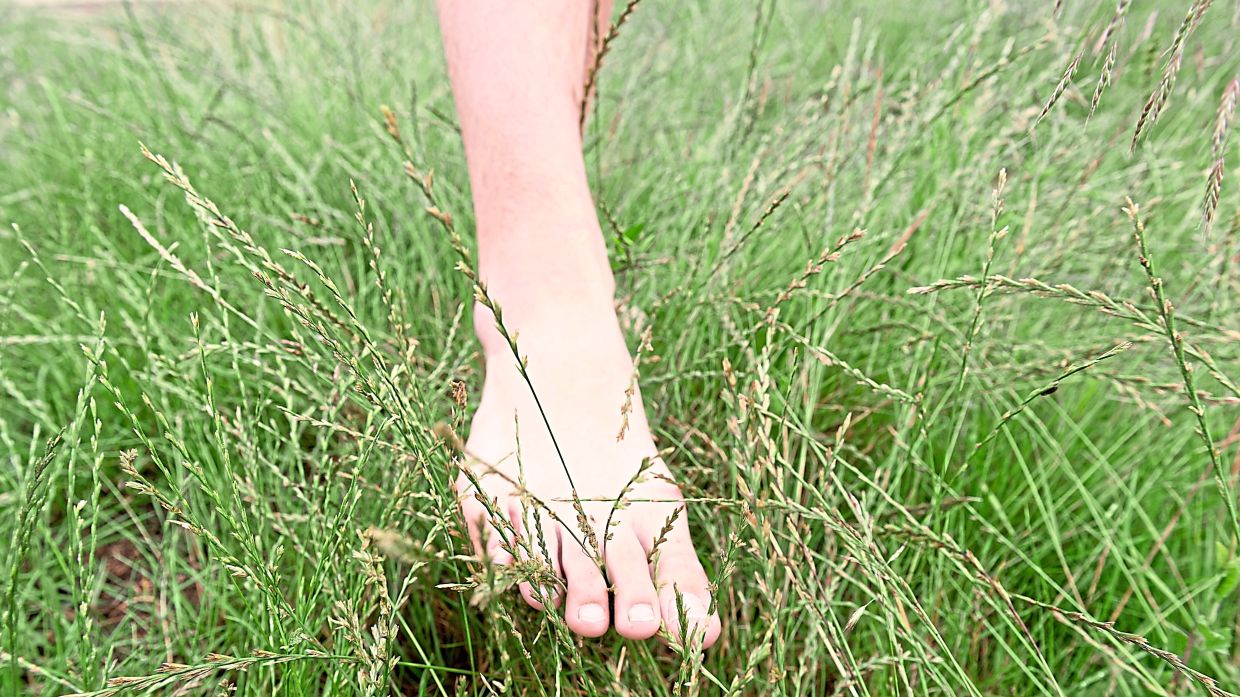
Basically, yes, “including seniors and children,” says Schneider.
However, people with nerve damage resulting in diminished or absent sensation in their feet, such as can occur in diabetics, need to be especially careful. They’re at particular risk since they can’t feel potential harm to their foot soles. If they’re unsure about going barefoot, it is best to consult a doctor.
“Barefoot walking isn’t a problem for healthy feet,” says Pfersich. This may not be true, though, if you have a deformity such as flatfoot, splayfoot or skewfoot.
Although barefoot walking has positive effects in these cases too, “affected persons should get medical advice before starting,” Schneider says.
It’s important to begin barefoot walking gradually, as your foot muscles need time to adapt to the new stresses, he says. At first you should walk without wearing shoes or socks for only about five minutes on soft surfaces. If this goes well, you can progress to longer durations on other surfaces.
This can happen. “Your skin moves when you walk, and when you walk barefoot, it’s directly subjected to all the friction and pressure,” says Pfersich.
The formation of callouses is a protective mechanism of the body. “But if they get too thick, they’ve got to be removed to prevent open wounds or skin fissures, to which diabetics in particular are susceptible,” Pfersich says. If you remove too much of them though, they’ll come back especially quickly.
Here are three tips:
“Consciously allow time for barefoot walking,” says Schneider. It can suffice to simply potter around your garden, on the varying surfaces it may have, with no socks or shoes.
A possible alternative is visiting one of the designated “barefoot” parks or paths that are found in some places. Check the internet to see whether there are any in your area.
“So-called barefoot shoes can be helpful as well,” Schneider says. They have a very thin and flexible sole, no heel drop, and a wide toe box. Your feet process the various stimuli from various surfaces via the nerve endings in your soles but unlike going barefoot, are protected at the same time. – dpa