
The two women who arrived at his clinic in Ukraine were "somehow different from all the other patients," Dr Andriy Kiselyov, a psychiatrist, remembered telling a colleague. They had a form of depression that did not respond to traditional treatment.The women shared another trait. Both were returning from working as caregivers in Italy.
Soon, he started to notice that others who had returned were similarly affected. He and his colleague started informally referring to the malaise as the "Italy syndrome."
That was 20 years ago in the aftermath of the collapse of the Soviet Union, when, needing to feed their families, many women from across Eastern Europe migrated to Italy to fill its expanding need for elder care.
In the decades since, doctors across Eastern Europe have adopted the term, not as a scientific or medical diagnosis but as casual shorthand to describe caregivers’ psychological distress.
The women who leave
The term is now familiar to groups representing caregivers’ employers, and to the women who whisper among themselves about the insomnia, anguish and depression they feel after spending years away from their families tending to older, often disabled people abroad, in near-confinement with them.
"The fact that such a syndrome has the name of the country that raised me gives me goose bumps," said Maria Grazia Vergari, an Italian psychologist who has focused on foreign care workers.
The women’s suffering is a hidden cost of a labour migration that has become increasingly essential in Italy, which has the oldest population on average in the European Union, and a vital financial lifeline for many immigrants.
Despite the distress being first identified with Italy's name, migrant care work is a global phenomenon, with thousands of workers from Moldova, Ukraine and Romania, but also Peru or the Philippines tending to the older in much of Western Europe.
Far from all workers return home damaged. Yet the syndrome has rippled through Europe not only geographically, but generationally. Doctors say they are also diagnosing mental health and behavioural problems in children who stayed back while their mothers were absent.
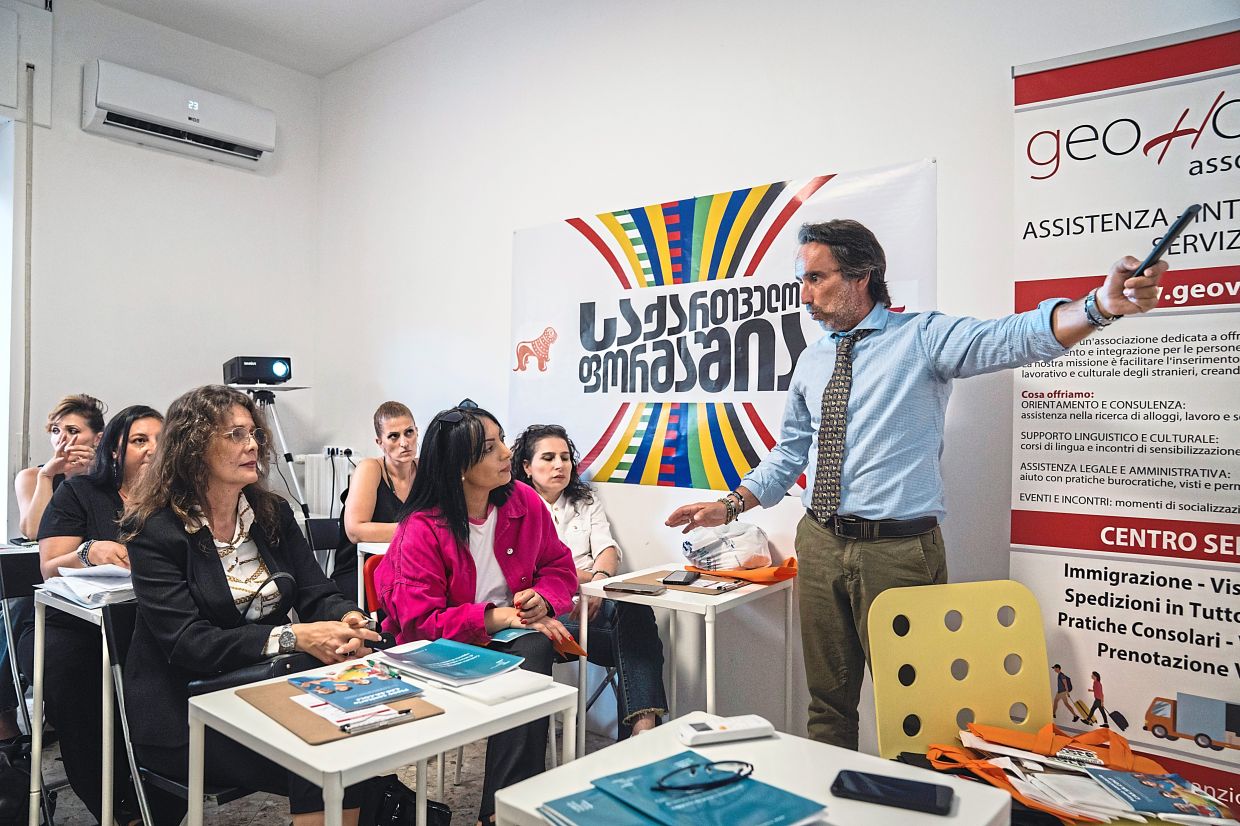
There is now a "post-Italy syndrome," too, said Dr Cristina Elena Dobre, the manager of the Socola Institute of Psychiatry (SIP) in Romania, the country where most of Italy's care workers come from.
"You have a beautiful house, you have some money in your account," Dobre said, "but you have a totally shattered family."
Romania's health ministry has acknowledged the existence of "Italy Syndrome" but does not keep an official tally of those affected, making the scope of the phenomenon hard to gauge. A spokesperson for SIP hospital said doctors there had treated more than 900 patients with the syndrome since 2016. Doctors at SIP say some of those have experienced burnout, psychosis and attempted suicide.
Modoranu said she was following dozens of patients whose syndrome had become chronic.
Sleep deprivation often combines with other factors that are typical of caregiving jobs, doctors said.
Live-in caregivers are expected to be available 24 hours a day, unlike nurses in hospitals or retirement homes who have special training, shifts, private lives and homes.
Unlike other migrants, the women working as caregivers often cannot take their children with them. They are likely to witness the deaths of the patients they have single-mindedly dedicated themselves to.
While many women recount positive experiences in Italy, with understanding and generous employers, for some the difficulty of work spent cleaning, bathing, dressing and feeding is compounded by the fact that they are highly educated professionals like engineers, teachers and architects.
"These people were completely erased by care work," Vergari said.
That was the case for Veronica Durughian, 73, a doctor who left Moldova because her wages were low and often went unpaid.
In Italy, she worked for a non-verbal woman with Alzheimer's disease, then for another one who called for her parents all night. A third woman she cared for was constantly hostile, criticising her every move.
"I cried for no reason, I got up in the morning and cried and I did not sleep at night," she said. "It ruined me."
She was prescribed anti-depressants, which she continued to take for about a decade.
Now back in Moldova after about 20 years in Italy, she attends learning programmes for retired women, many of whom have also returned from Italy.
"Many of us have that syndrome," she said. "Many of us bear the scars."
A family divided
Now, a generation into the wave of migration from Eastern Europe, the effects of the Italy syndrome have metastasised in many families. The children of women who left home are showing up in psychiatric wards, too.
Mihail Tamba was only eight when his mother left Moldova for Italy to work as a caregiver. He hoped that, like his cousins, he would receive toys and new clothes from abroad. When she returned, bringing a jar of Nutella, Mihail said he could not recognise her.
He struggled to connect with her, he said. For most of his youth, his mother continued to come and go from Italy, and Mihail lived with uncles and neighbours, but mostly with his stepfather, who drank and was prone to violent attacks.
"There was nobody around to protect me," Tamba, now 30, said. "That's when my depression started," he added.
"We had to go through abandonment, through solitude, through everything only to be fed," he said. "And this is something very painful."
Doctors in Romania say they are alarmed at the rate at which youths who grew up without their mothers are now suffering from depression, attachment issues, substance abuse, attention-deficit/hyperactivity disorder and even attempted suicide.
Loredana Balan, a child psychologist in the Romanian city of Suceava, said that last year nearly half of her patients had at least one parent working abroad, and 15% had a mother in Italy.
Lucia, 58, a Moldovan care worker who asked to be identified only by her first name because she is still working with a family in Verona, said that after she arrived in Italy in the early 2000s, her daughter tried to kill herself at 16.
Now Lucia gets up at night, thinking she is hearing the older woman she cares for calling her, only to find her asleep. But despite being "sick with stress and solitude," she is not going home.
"Nobody is waiting for me at home anymore," Lucia said. When she sees her children, she added, "they are like strangers." – ©2025 The New York Times Company