
De your dog eat something poisonous? Was it hit by a car? Or did it suddenly fall ill for unclear reasons?
Dog owners need to be prepared for all kinds of emergencies. In these situations, it’s crucial to know the answers to important questions, such as:
- What colour should your dog’s mucous membranes be?
- What is a normal pulse rate?
- How many breaths does your dog typically take per minute?
As with all emergencies, the first rule is to stay calm and seek help as quickly as possible.
For dogs, this means contacting a vet or the nearest animal hospital.
If you are too distressed to make the call, ask someone else to assist.
This person can also provide the vet with all the necessary information if needed.
The veterinarian will likely ask questions such as the dog’s age, sex and if there are any known pre-existing conditions.

Since most veterinarians do not come to the scene of an accident, the location is often less important.
Instead, it is crucial to describe the dog’s condition as accurately as possible. Expect to answer the following questions:
- Is the dog unconscious?
- If not, does it respond to being spoken to, or does it appear listless?
- Is the dog visibly injured?
- Where is the wound? Are bones visible?
- Is the dog adopting a protective posture?
- How can I check my dog’s condition?
Looking at a few factors will help you get a sense of your dog’s health. According to the Foundation of Veterinary Medicine at the University of Hanover in Germany, there are four things to examine when checking a dog’s vital signs:
Count the breaths by observing the chest movements for one minute. When not panting, small dogs typically take 20 to 50 breaths per minute, while large dogs take 10 to 30.
Find the pulse on the inner thigh and count the beats for one minute. Normal ranges are 80 to 120 beats per minute for small dogs and 60 to 80 for large dogs.
These should be pink, moist and shiny. Pressing a finger on the gums can test circulation – after two seconds, the pressed area should return to pink.
You can use a thermometer to rectally measure the dog’s temperature. Normal values range from 38°C to 39°C.
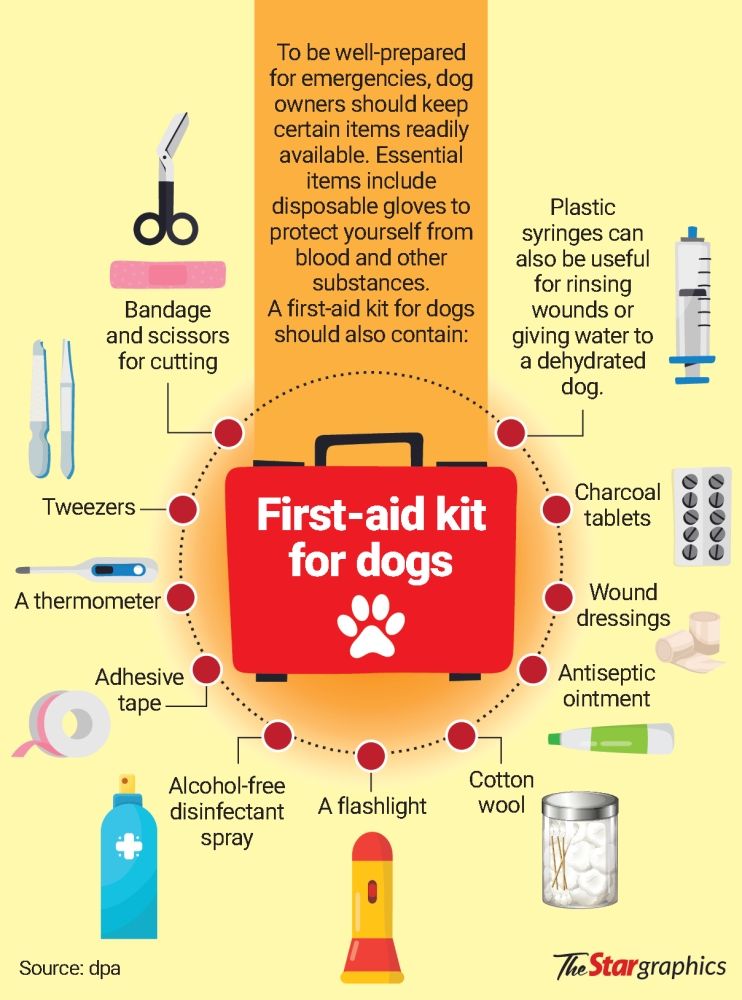
While it’s not necessary to carry the first-aid kit everywhere, it is a good idea to have one nearby. You might consider keeping it in the car boot if driving to walks. At home, aim to keep it in the same spot so that you always know where to find the right items in an emergency. – dpa