
After every banana harvest, piles of discarded trunks typically cluttered Hanisa Boumin’s farm in Kampung Kurangji, Kota Marudu, Sabah.
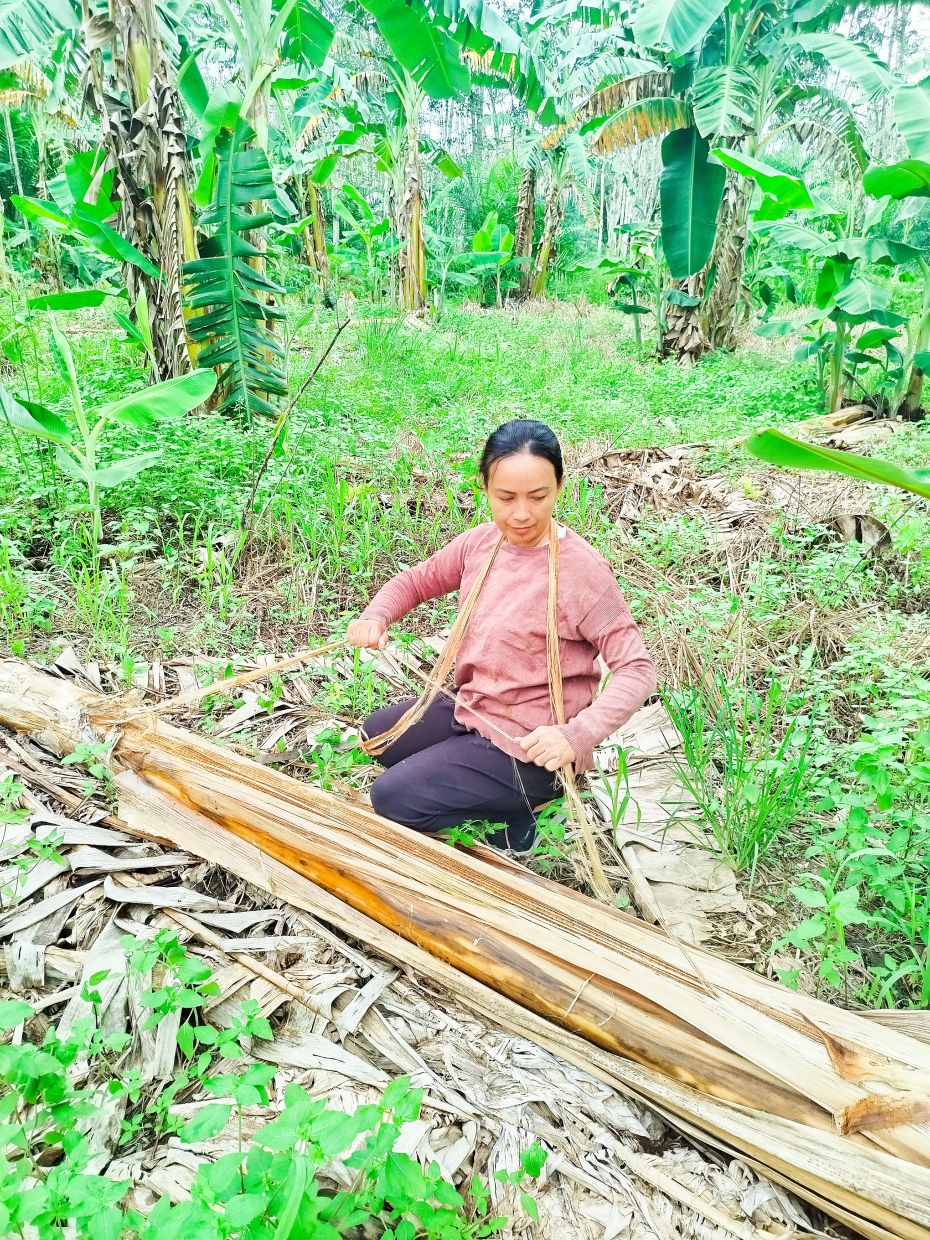
“It all started as an experiment. I watched videos on social media about communities in Africa, Indonesia and India turning banana tree trunks into craft items, cups and plates.
"I was inspired by this and I also wanted to reduce waste on my farm,” says Hanisa, 38, in a Zoom interview.
Since 2023, Hanisa has been crafting baskets, handbags, coasters and lampshade covers from banana fibre.
“I can usually extract about 100 to 200 grams of usable fibre from one banana trunk. It depends on the size of the trunk and the variety of the banana plant.
“For example, varieties like pisang tanduk and pisang nangka have taller trunks that produce more fibre, while shorter trees such as pisang emas and pisang berangan produce less,” says the Dusun Kimaragang farmer.
Like many farmers, Hanisa is always looking for ways to improve her income.
“The inner part of the banana stem is often used in cooking to make curries, soups and even bosou, a type of dried pickle.
"But the tougher outer layer is usually burnt, and it’s common to see open burning around village farms. By reusing banana fibre, I can reduce waste and pollution while creating something useful and eco-friendly.”
On top of handicraft, banana byproducts are increasingly being repurposed into biomass for energy, natural fibres for textiles, and even paper products, making it a versatile and sustainable resource.
In Uganda, Kenya and Cameroon, for example, discarded banana trunks are processed into sustainable sanitary pads.
In India, fibres from the banana pith of plantain trees are used to make vazhai pattu sarees, which are biodegradable and renewable.
A 2023 study titled “Plant fibres as sustainable alternatives for textile and non-textile applications” highlights banana fibre as a material of great interest because it is widely available, affordable to produce and highly disposable.
More importantly, it is also biodegradable and eco-friendly.
For example, the fibres of the abaca plant – a species of banana – are strong and resistant to seawater, making them excellent materials for marine ropes.
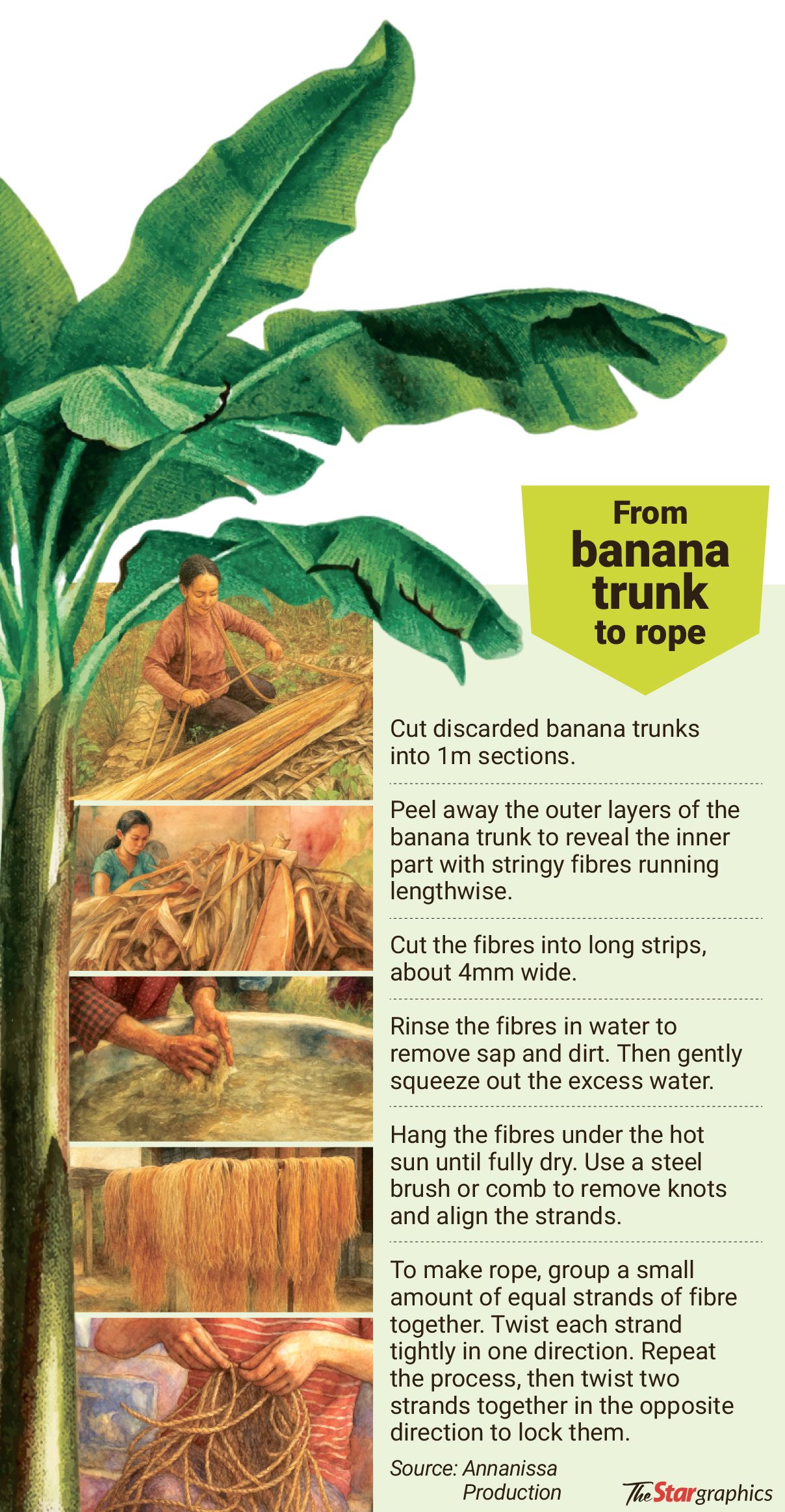
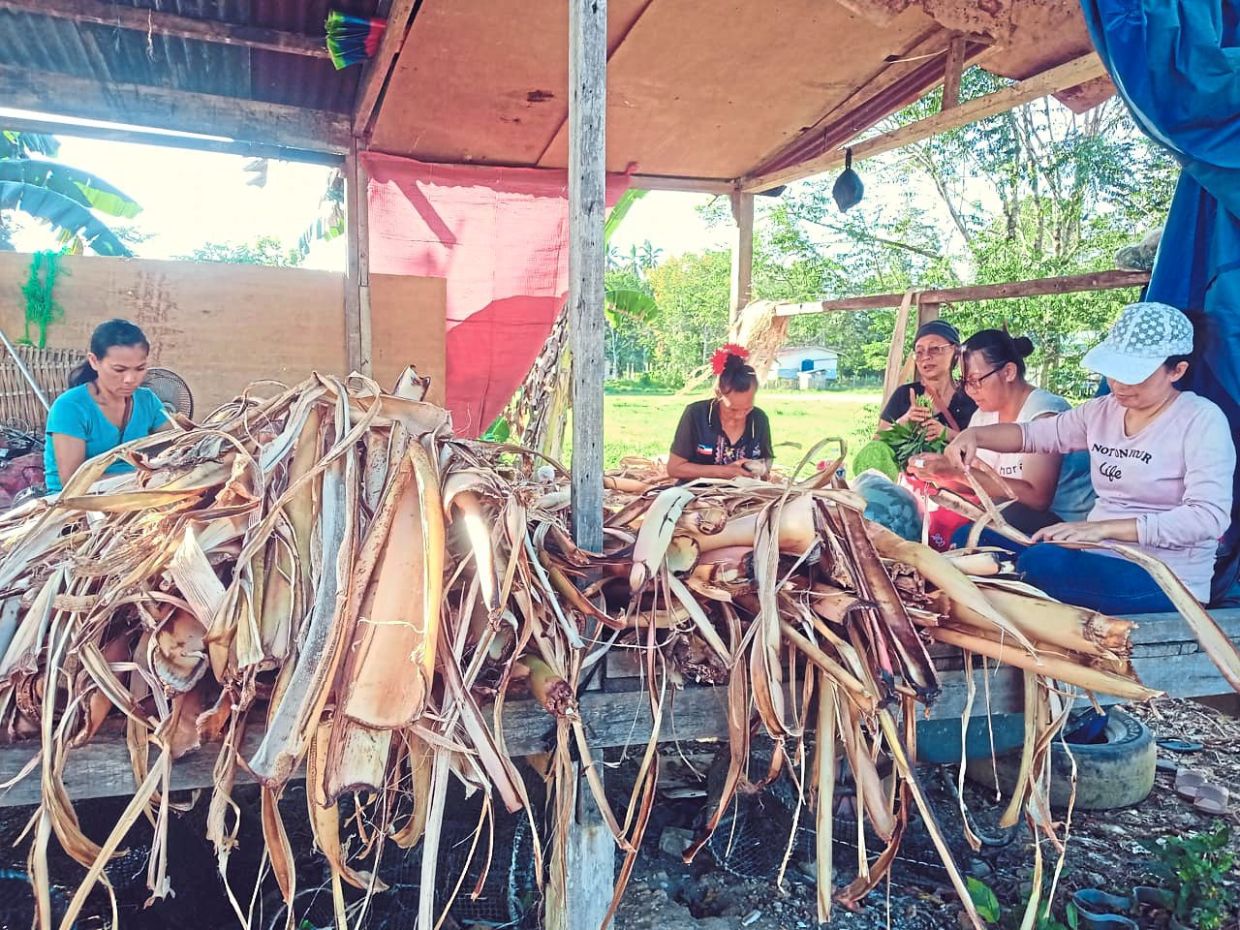
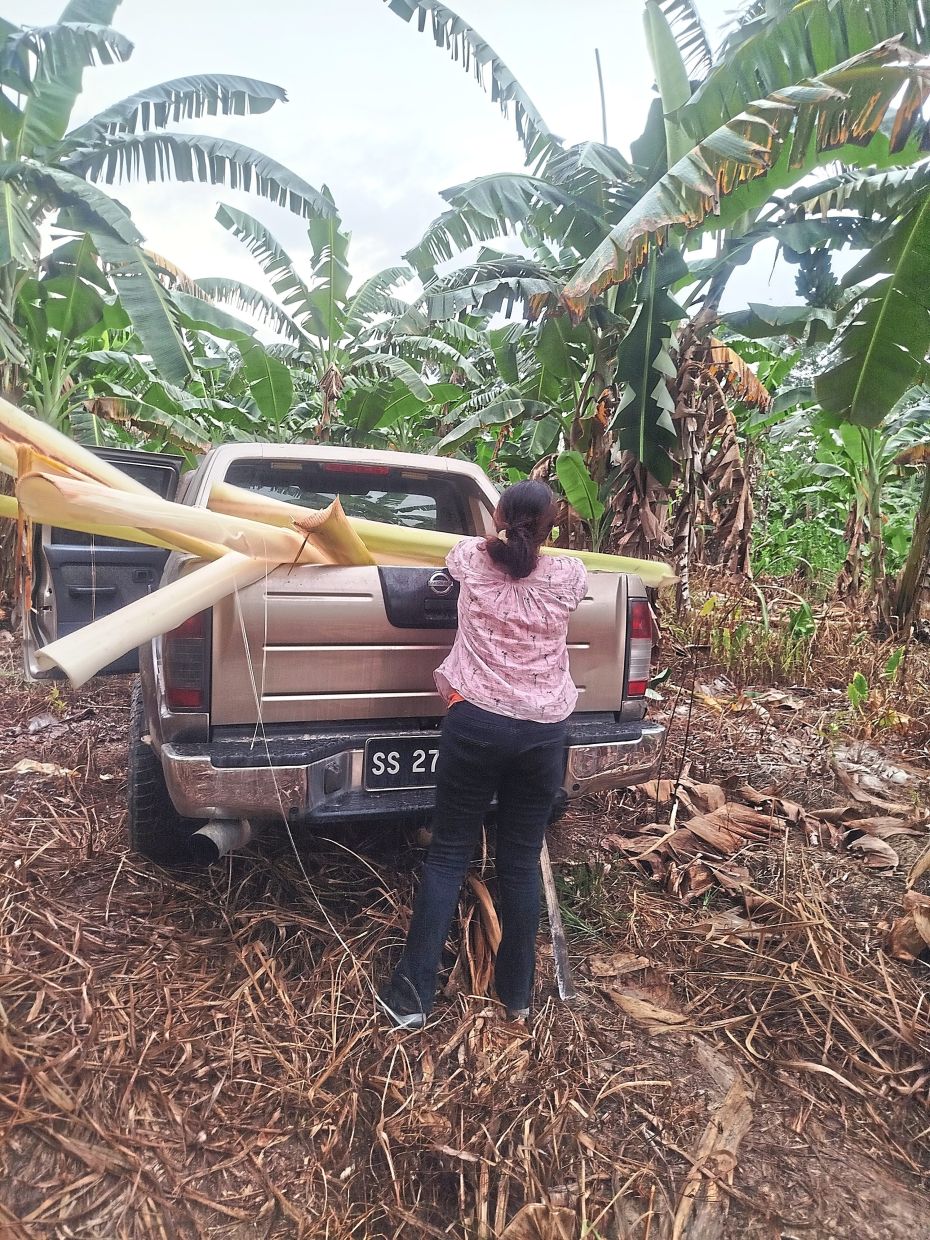
Hanisa uses a knife or wire brush to strip the banana trunk.
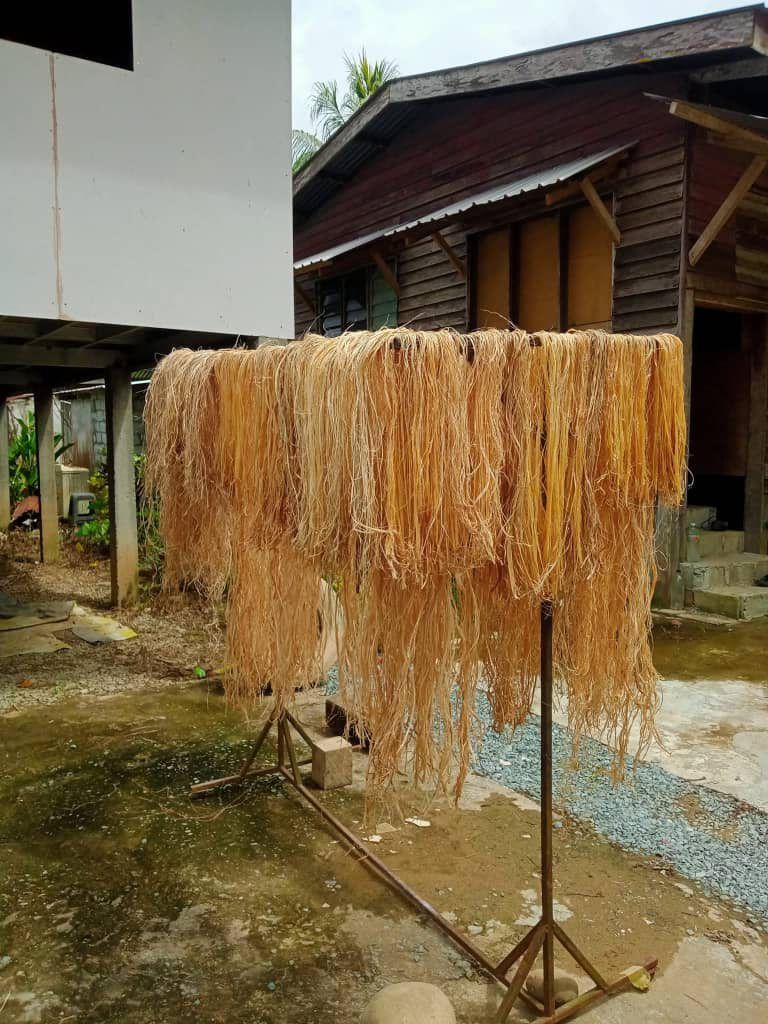
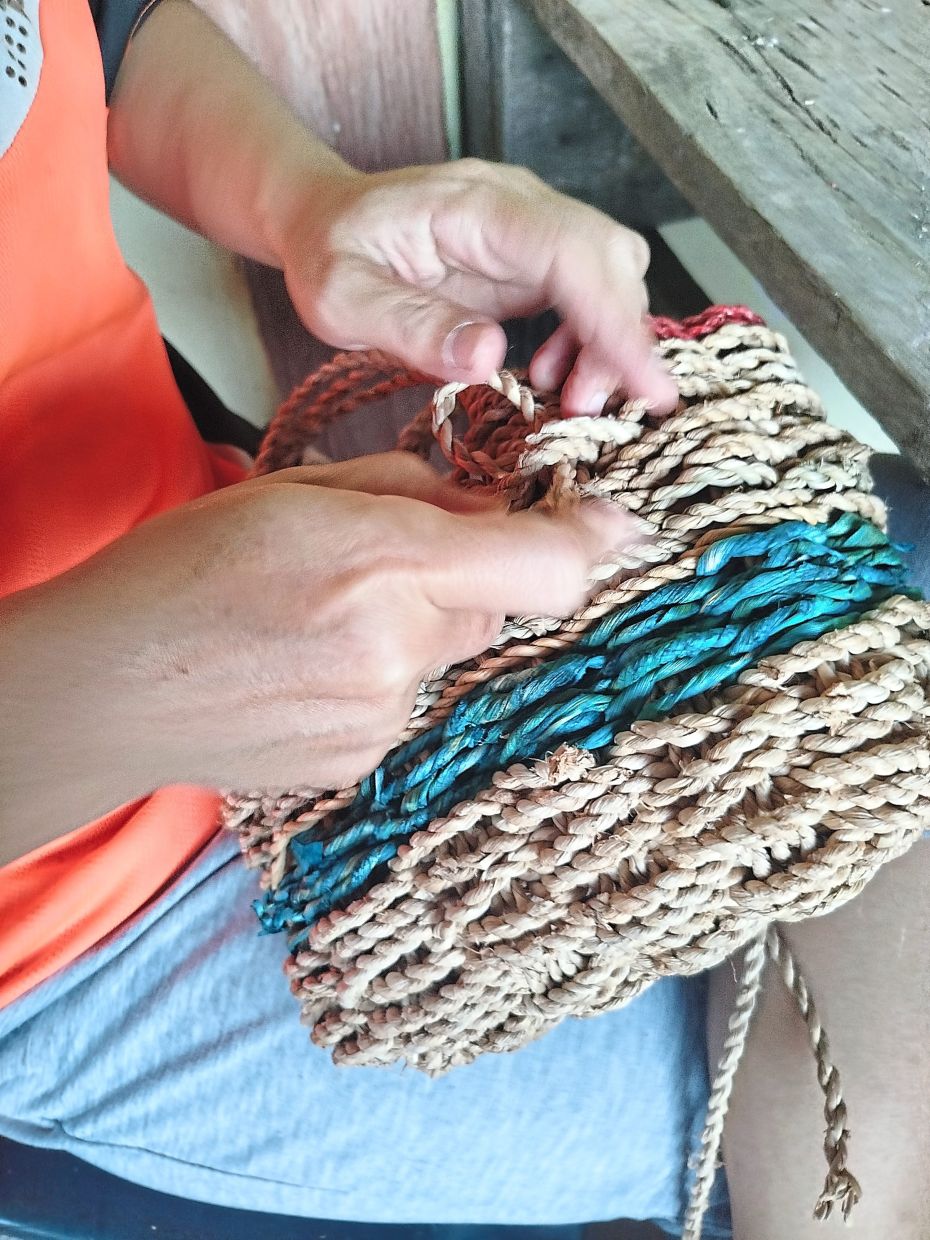
It is then washed clean and air-dried for a few days. Once ready, the pliable fibres are handwoven into ropes for craft.
“It is very important to completely dry them. If there’s moisture, fungus can start to grow, and this will make the fibre weak and unusable.”
Hanisa admits that turning banana trunks into rope is a labour-intensive process that requires both time and patience.
“Without machines, the work is slow and physically demanding. It’s tough, but I keep going because I believe there’s a future in this venture. Hopefully, once I’ve saved enough, I can invest in machines to make the process easier and increase my production,” says the mother-of-two, who promotes her products on Facebook and TikTok.
To improve her skills, she also travels to Kota Belud, which is a two-hour drive from her village. There, she meets other tree bark crafters and learns about the traditional techniques of processing tree bark into fabric and rope.
“The Dusun community in Kota Belud is well known for this heritage craft, and learning from them gives me new ideas and inspiration for my own banana fibre work.
“Slowly, I started making bags and baskets and I started selling them at the market near my home. I created my own brand, Kogozz, which means “to tie” in Dusun language. I can earn about RM600-RM1,000 each month from this business.”
Earlier this month, she was named one of the 10 winners of Pitch Borneo 2025, an annual competition for Sabah entrepreneurs to showcase their business ideas for a chance to win startup funding.
“I am thrilled to have received this grant – it has motivated me to work even harder,” explains Hanisa, who walked away with RM20,000 in business funding.
Crafting a better future
Hanisa is regarded as one of the more successful home-based entrepreneurs in Kampung Kurangji.
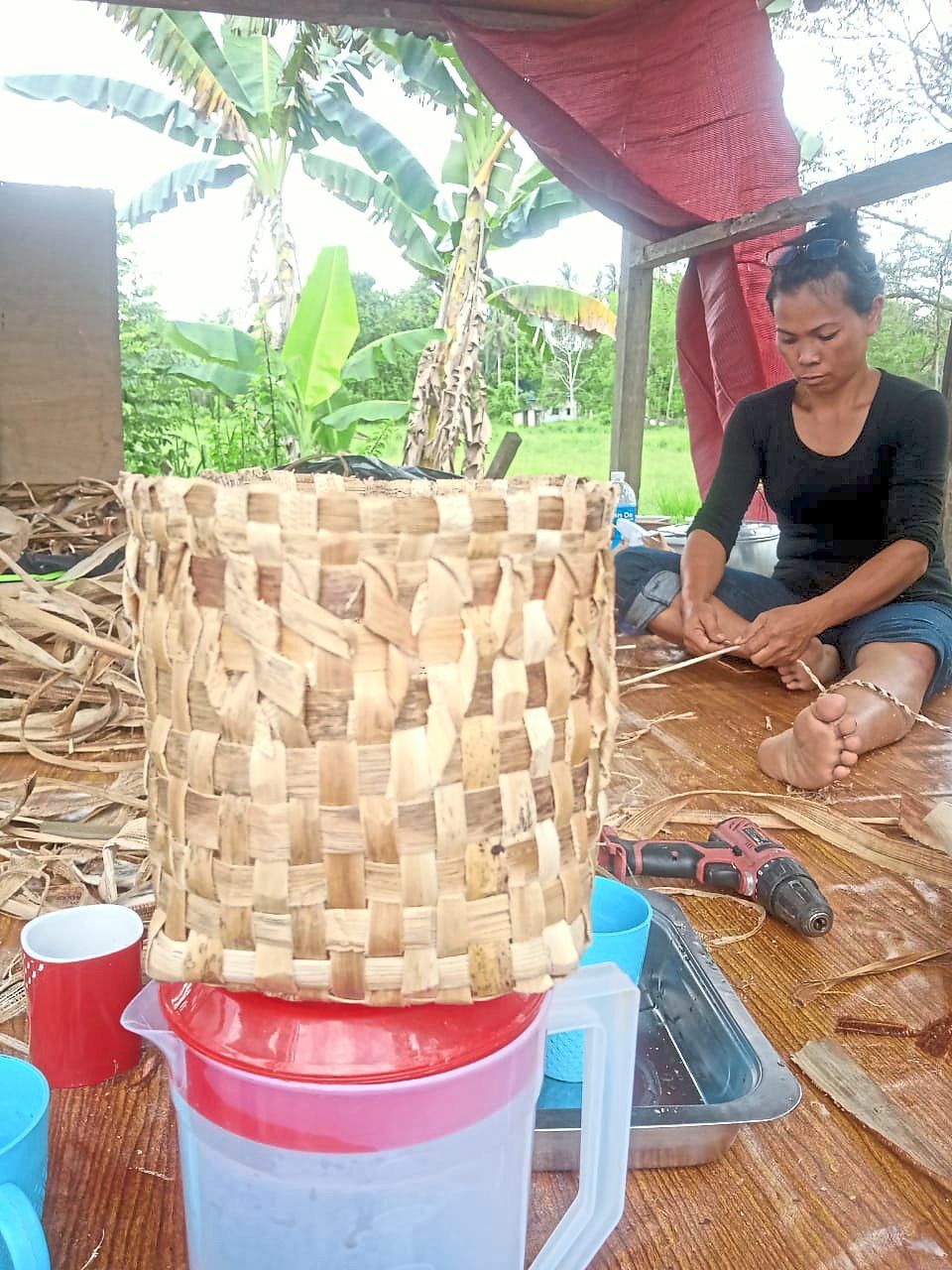
To fulfil her orders, she works with women from neighbouring villages.
So far, she has engaged 30 women from over six villages including Kampung Rasak Darat, Kampung Geruda and Kampung Salimandut in Kota Marudu, a district that is about 125km north of Kota Kinabalu.
These crafters are mainly homemakers, farmers and single mothers.
She equips these women with dried banana fibre so they can craft from home at their own pace.
“Most of these women face the same struggles as me, trying to make ends meet. I want to share my skills so they too can earn extra income. With the money, they can improve their livelihood and build a better future. They don’t need advanced skills to start – just patience and creativity.”
Their products are also sold at a shop in Pekan Tandek, a small town in Kota Marudu.
She considers herself lucky because her team of crafters are hardworking and are willing to go the extra mile to learn a new skill.
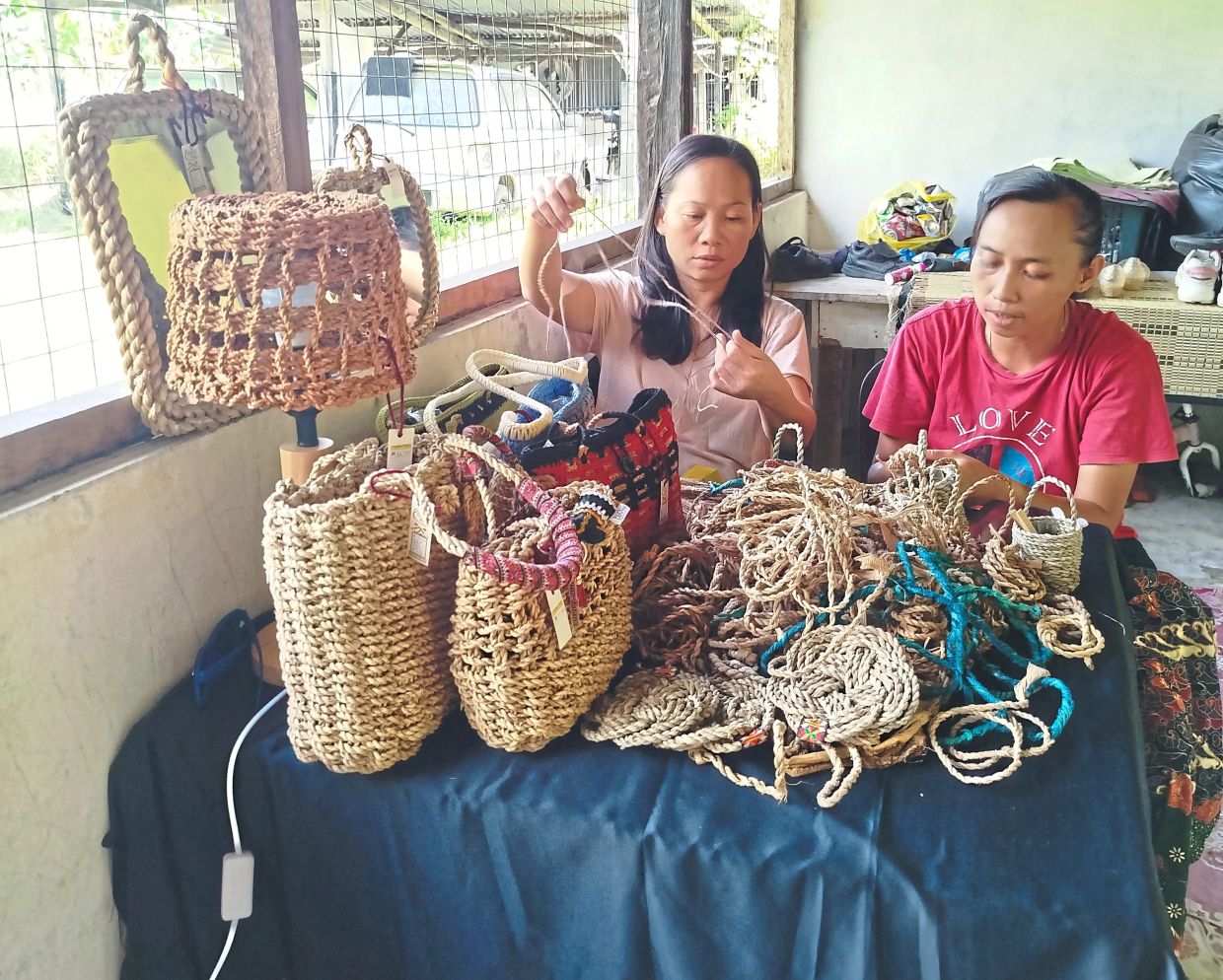
One of the crafters under Hanisa’s wing is her childhood friend, Vida Maijon, 38. The homemaker joins the project to supplement her family’s income.
“My husband is a farmer and he earns about RM1,000 to RM1,200 a month. My kids are still in primary school, and my youngest is only three years old.
"With the prices of milk, diapers and daily needs rising, his income isn’t enough,” shares Vida, who lives in Kg Nolotan, a 20-minute drive from Hanisa’s home.
She used to sell handmade crocheted earrings and mittens, but it was not enough. Now, by making banana fibre craft, she has an extra source of income for her family.
“I worked as an assistant at a speech therapy centre in Kota Kinabalu before I got married. After I had children, I chose to stay home to raise them, but I always wished I could still earn money. Now I feel happier because I can contribute to my family financially,” says Vida, who also joins Hanisa at bazaars to promote their items.
Like other crafters, Vida finds part-time work flexible as she can still focus on her role as a homemaker. She manages her children and household chores, then spends her free time crafting – often in the afternoons or at night once her chores are done.
“Banana fibre craft isn’t too difficult for me since I already know the basics of crocheting. I usually make baskets and coasters whenever Hanisa receives bulk orders. She gives us the dried banana fibre, and we turn it into finished items according to the orders.”
These days, Vida earns about RM300 a month, which she puts towards savings and extra food for her children. “Before this, we could hardly afford treats like fast food or drinks at beverage chains for the kids. Now, with the extra money, I can give them a little more,” concludes Vida.
Growing prosperity
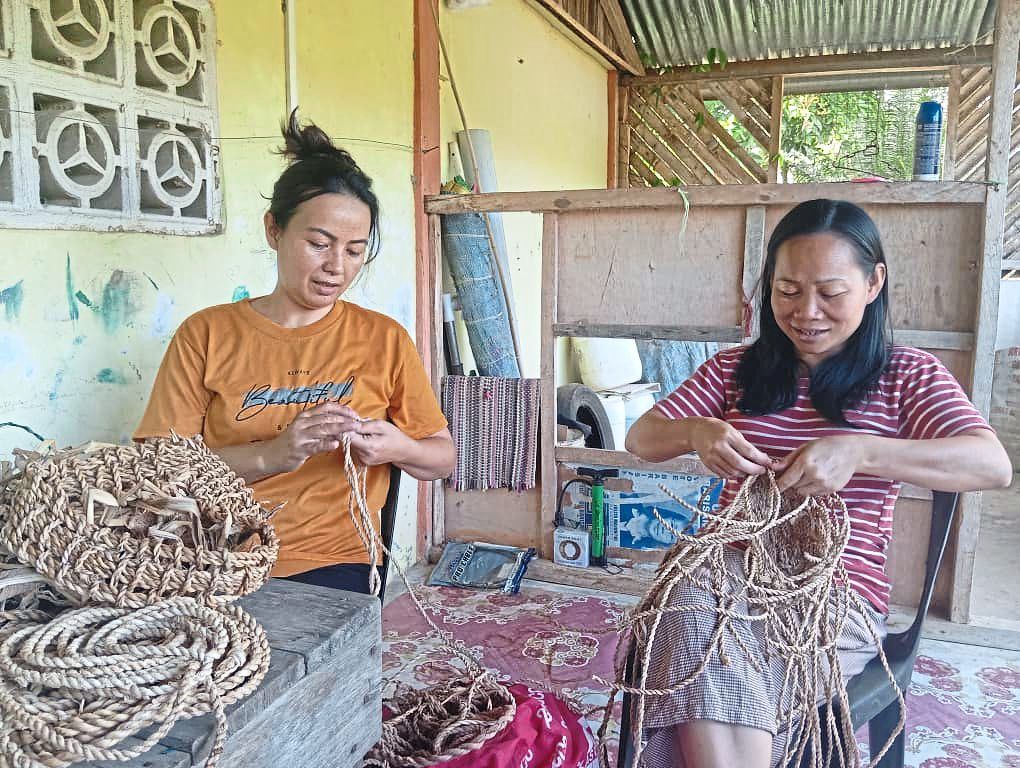
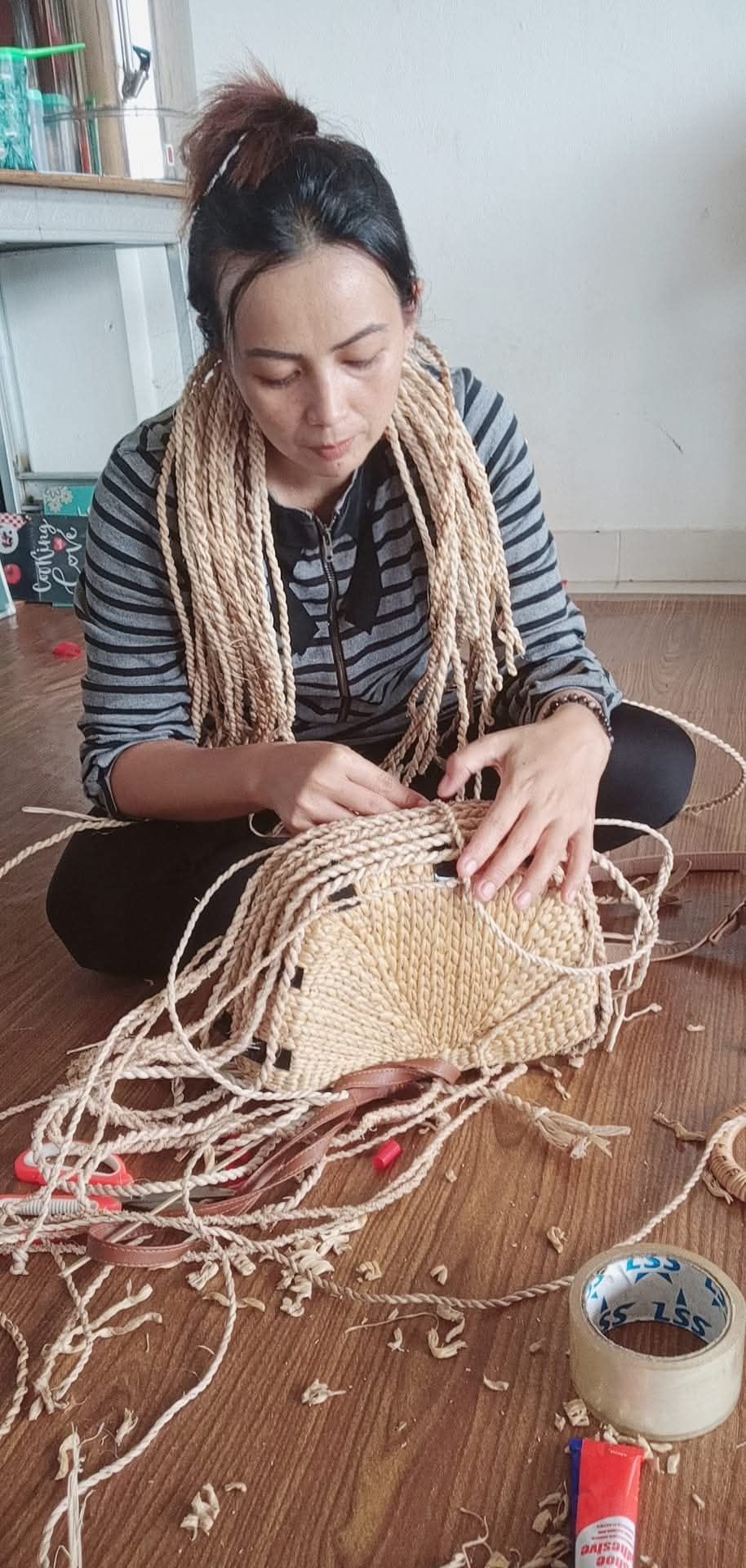
With Hanisa’s (left) guidance, Vida now crafts banana fibre items to support her family. Photos: Hanisah Boumin
Vida (left) and Siti Amisah Boumin are among the banana trunk crafters who repurpose the waste into daily items.
Photo: Hanisa Boumin
Hanisa loads freshly cut banana trunks into her car, ready to be processed into fibre for crafting.
Photo: Hanisa Boumin
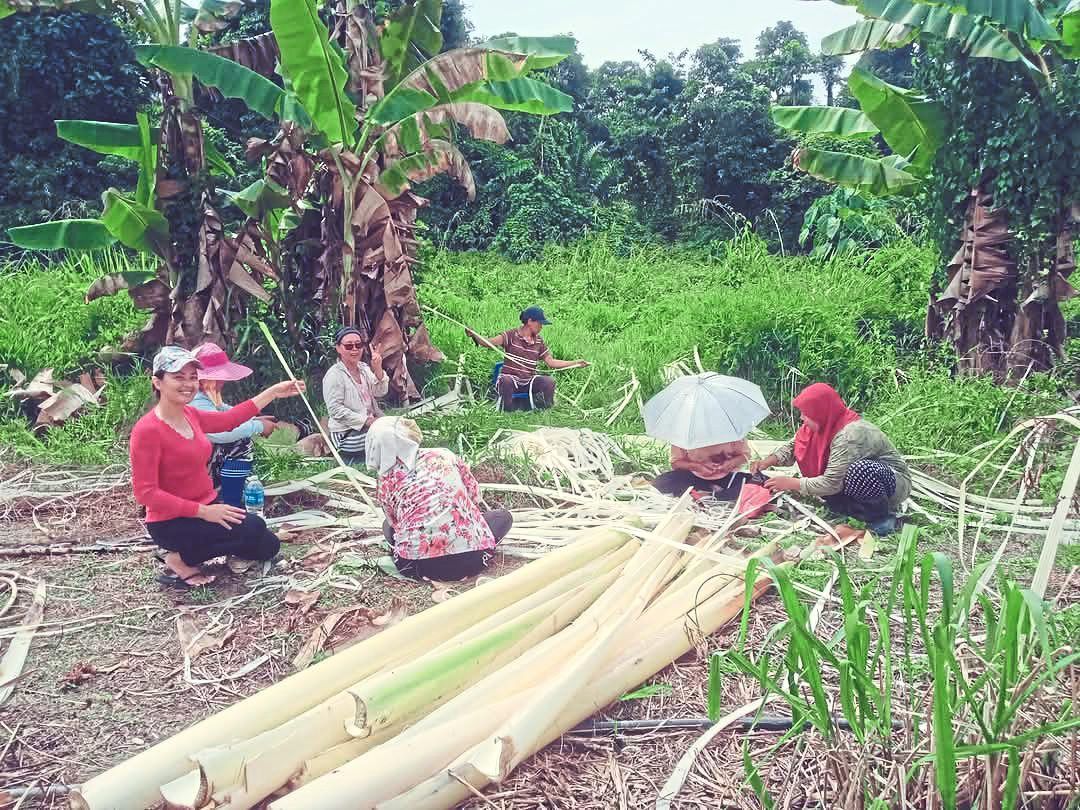
Women in Kota Marudu process banana fibre strips.
Photo: Hanisa Boumin
Strands of banana trunk fibre are hung out to dry naturally.
Photo: Hanisa Boumin
By teaching women in nearby villages to upcycle banana trunk fibre, a small community of crafters is turning farm waste into a new income stream.
Photo: Hanisa Boumin
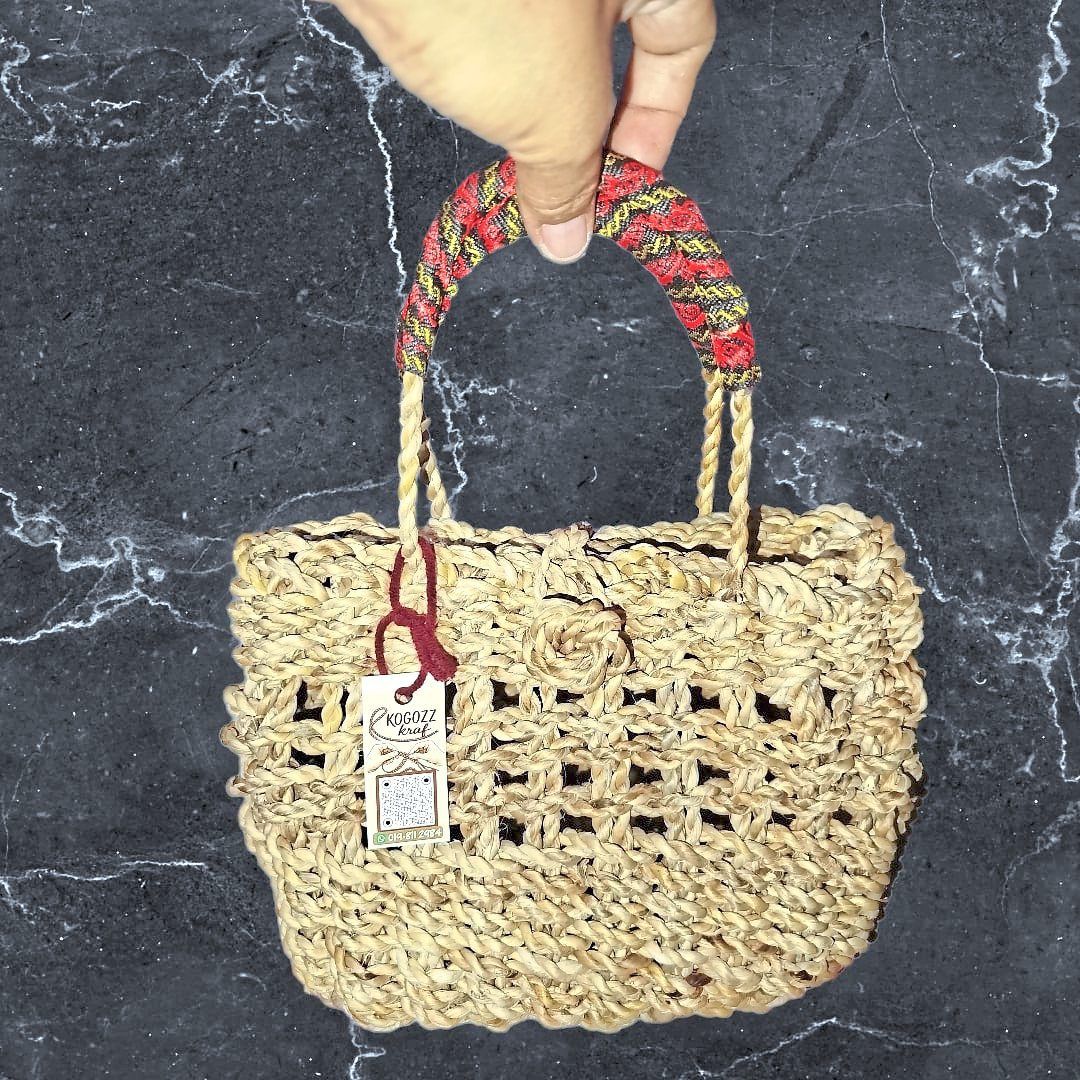
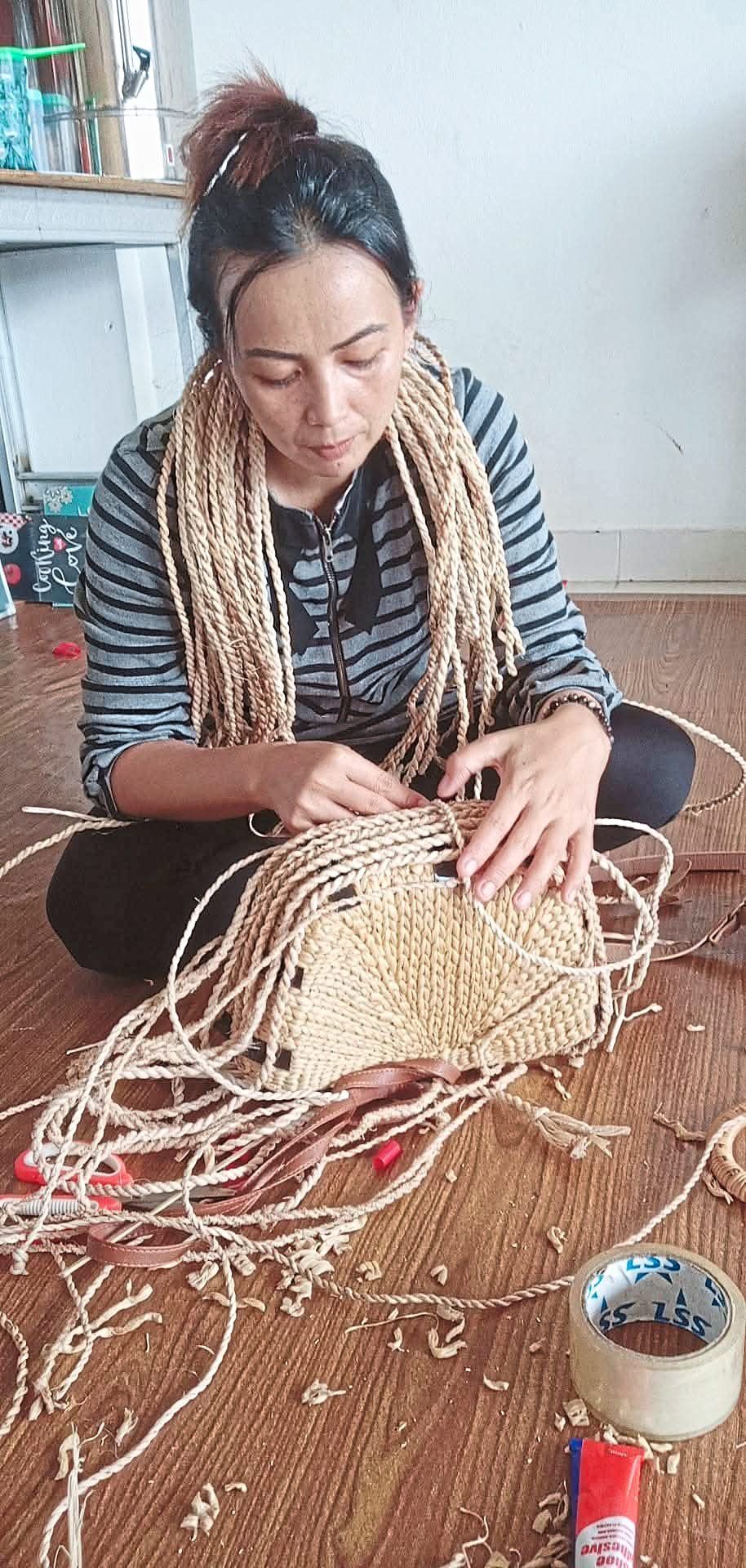
Hanisa crafts handbags using fibre from discarded banana trunks from her farm.
Photo: Hanisa Boumin
Banana fibre rope is strong and pliable, making it ideal for crafting.
Photo: Hanisa Boumin
Hanisa transforms banana fibre into beautifully weaved handbags.
Photo: Hanisa Boumin
The project empowers women to earn and financially contribute to their families.
Photo: Hanisa Boumin
Hanisa turns discarded banana trunks into eco-friendly crafts, giving new life to agricultural waste in her village in Kota Marudu, Sabah.
Photo: Hanisa Boumin
Using fibre from discarded banana trunks, Hanisa crafts stylish, sustainable handbags by hand.
Photo: Hanisa Boumin