With Malaysia Day just four days away, tanjak maker Herin Mansor is racing to complete last-minute orders for the traditional Malay male headgear.
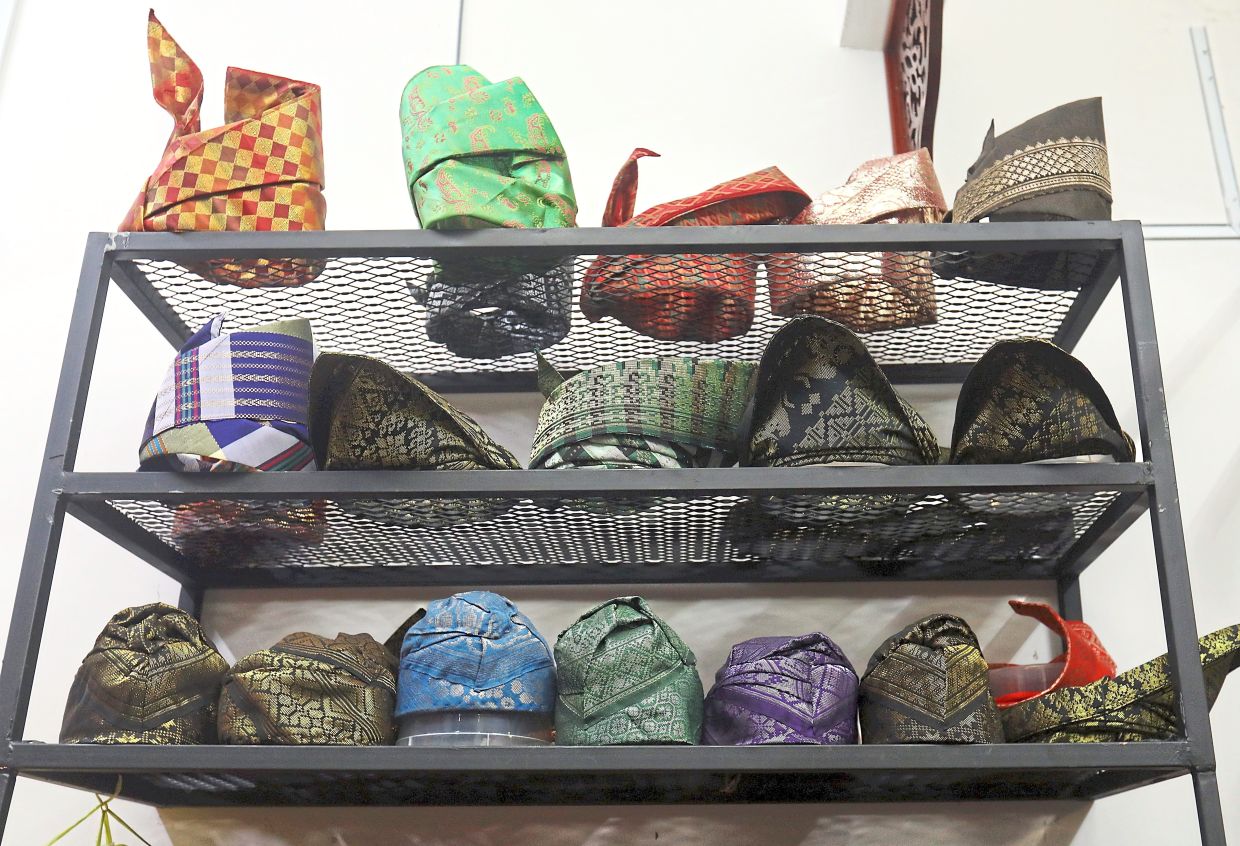
Stacks of handwoven and machine-made songket, rich with intricate patterns, lie ready to be folded into elegant tanjak styles. Completed pieces are neatly arranged on shelves in the corner, waiting for customers to collect.
“I have over 50 orders for the tanjak in different folding styles. Most orders are from students and teachers for Malaysia Day celebrations in schools. There are also some orders for weddings, as well as the upcoming cultural event Keretapi Sarong, happening tomorrow (Sept 13),” says Herin, 45, during an interview at his boutique in Kajang, Selangor.
He adds that fabrics featuring songket designs in yellow, red, pink, green and blue, highlighted with silver and gold threads, are among the most popular choices. They are perfectly suited for Malaysia Day, which marks the formation of Malaysia in 1963, uniting Malaya, Sabah, Sarawak and Singapore. (In 1965, Singapore became an independent country.)
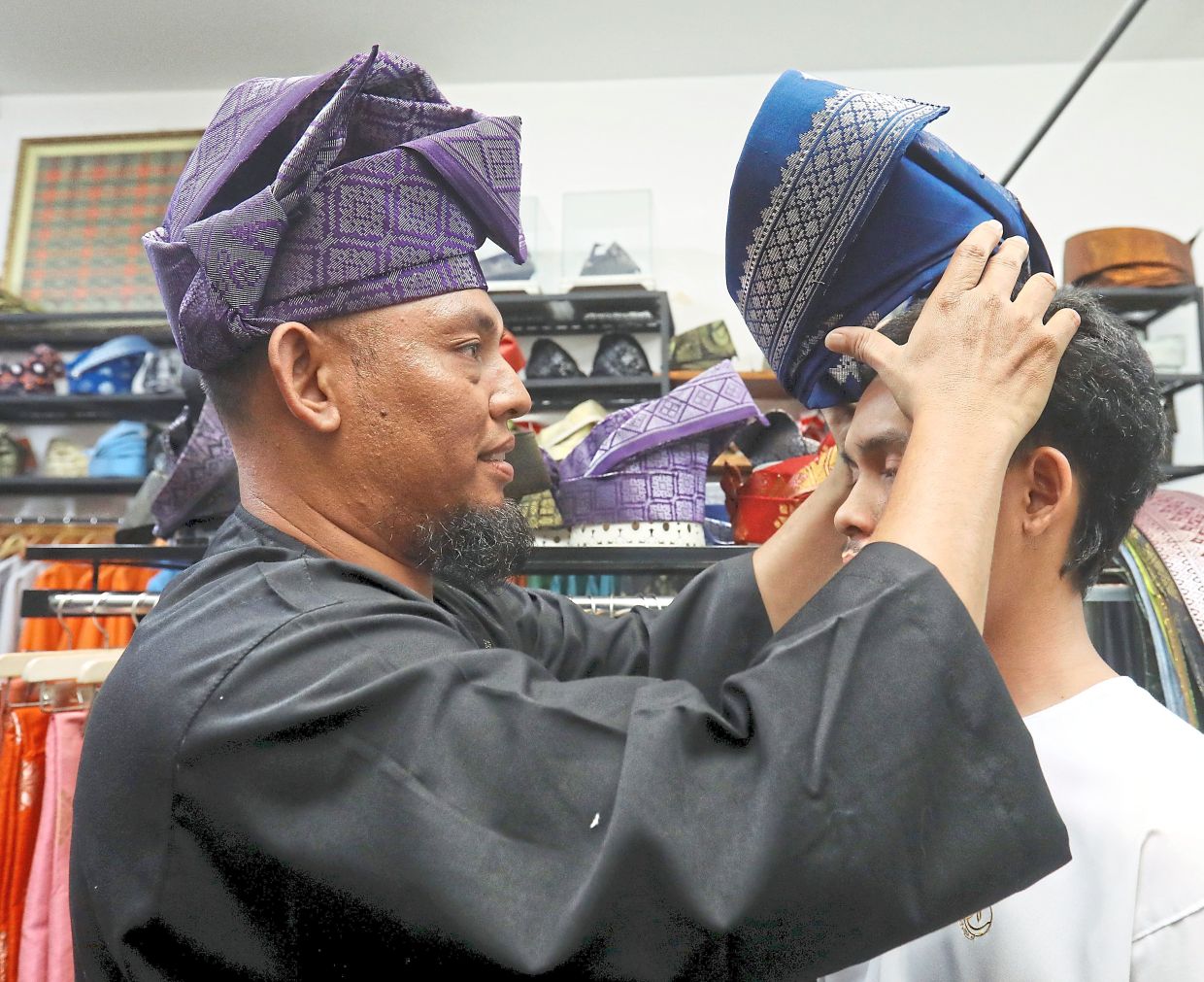
“There are countless ways to fold a tanjak. This season, however, I have received many requests for styles such as solok timbo (compact fold) and naga berlabuh (resting dragon).
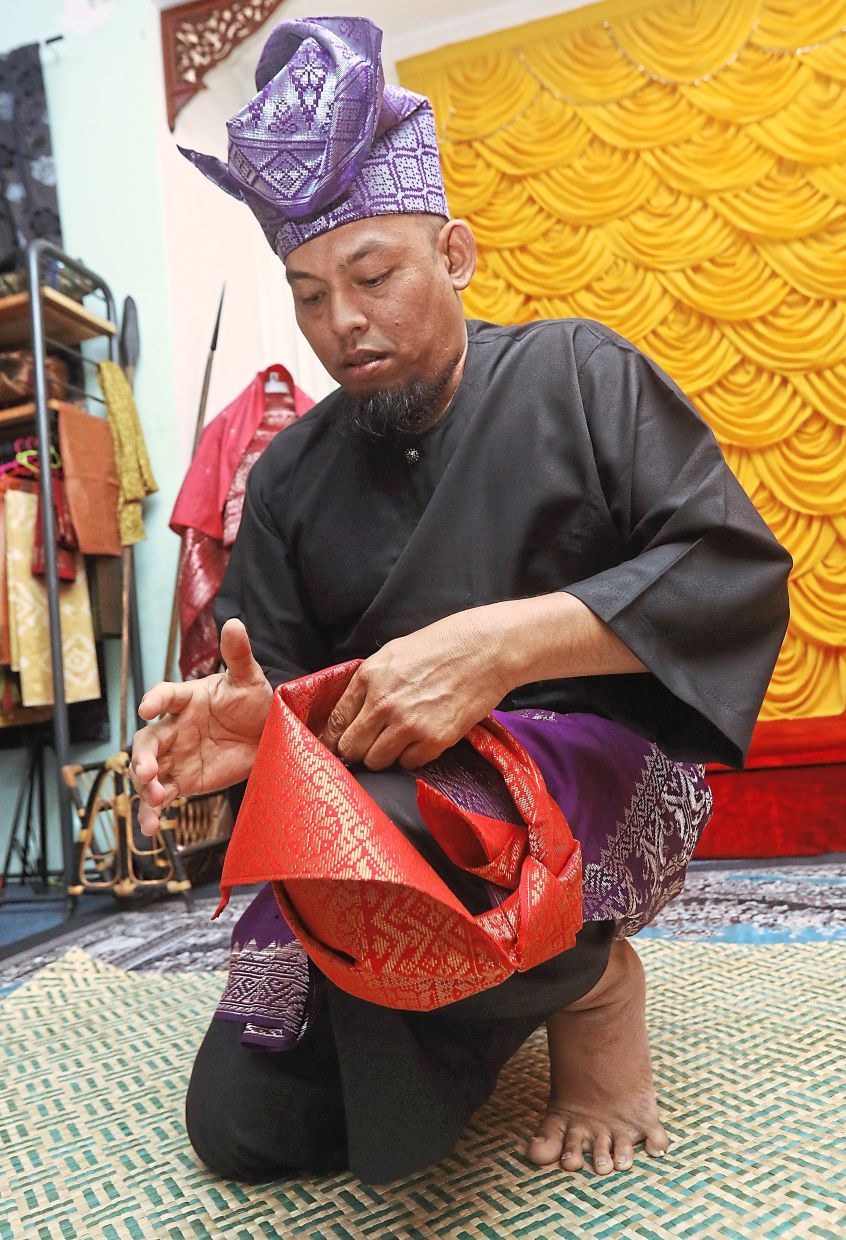
“There is no right or wrong choice – it all comes down to personal preference,” says Herin, carefully adjusting the fittings and edges of the songket fabric for a tanjak called ayam patah kepak (thought to be named for its shape, which resembles a chicken with a broken wing).
According to the book Destar Alam Melayu by Dr Johan Iskandar Abdul Karim, the tanjak falls under the category of destar, which includes all types of head adornments significant in Malay attire.
Within this category, there are many subtypes such as tengkolok, getam, songkok and semutar. Each design carries its own meaning and holds different histories and origins.
From care to craft
Herin, who was born and raised in Parit Sulong, Batu Pahat, Johor, has always had a deep interest in arts and crafts. As a child, he enjoyed making wau kites, kuda kepang frames and weaving rattan baskets. Sewing was also something he loved.
“I often used my mother’s Singer sewing machine to stitch bags, batu Seremban (five stones) and curtains. Looking back, I think this passion and creativity eventually inspired me to pursue a career in clothing and, later, in crafting the tanjak,” says the former student of SMK Dato’ Sulaiman in Parit Sulong, Batu Pahat.
After Form Five, he earned a diploma in culinary arts from a private university in Subang Jaya. Following a brief stint as a hotel waiter in Langkawi, Kedah he decided to pursue a nursing course, believing it would provide a more secure path with a government job.
The father of three subsequently worked as a nurse at Universiti Malaya Medical Centre in Petaling Jaya, Selangor, where he served at the dialysis and nephrology centre for 15 years.
He considers himself fortunate to have learned the craft of tanjak folding under Johan Iskandar, one of the country’s most renowned tanjak gurus.
The pivotal moment came in 2016, at his younger brother’s wedding. Herin wanted him to look perfect, so he carefully prepared the full traditional attire, complete with a tanjak, sampin (decorative waist cloth) and bengkong (sash worn around the waist).
Soon after, friends and relatives began asking him to stitch outfits and headgears for their own celebrations.
“At first, I was hesitant about starting a business because I didn’t think I had the skills to run one. But a friend of mine – a local designer who specialises in Muslim outfits – noticed me making traditional headdresses and encouraged me to venture into designing clothes.
“He offered to help with the stitching, and that’s how I began my journey in clothing and design. I chose the name BinMansor for my brand as a tribute to my late father.”
Herin resigned from his full-time job in 2017, uncertain of what the future would hold. What kept him going was his faith and the courage to try something new.
“Sometimes we never know where our future will take us. In the end, it boils down to your interest and the courage to try new things,” said Herin.
The same year, he got his big break as the clothing designer for the reality TV series Pendekar Muda, which showcases the traditional martial art of silat.
In 2021, he went on to serve as the costume designer for the movie Kampong Pisang Musikal Raya Istimewa, directed by the late Mamat Khalid.
A rich heritage
Herin says there are hundreds of different styles of tying the tanjak, which differ according to the various Malaysian states.
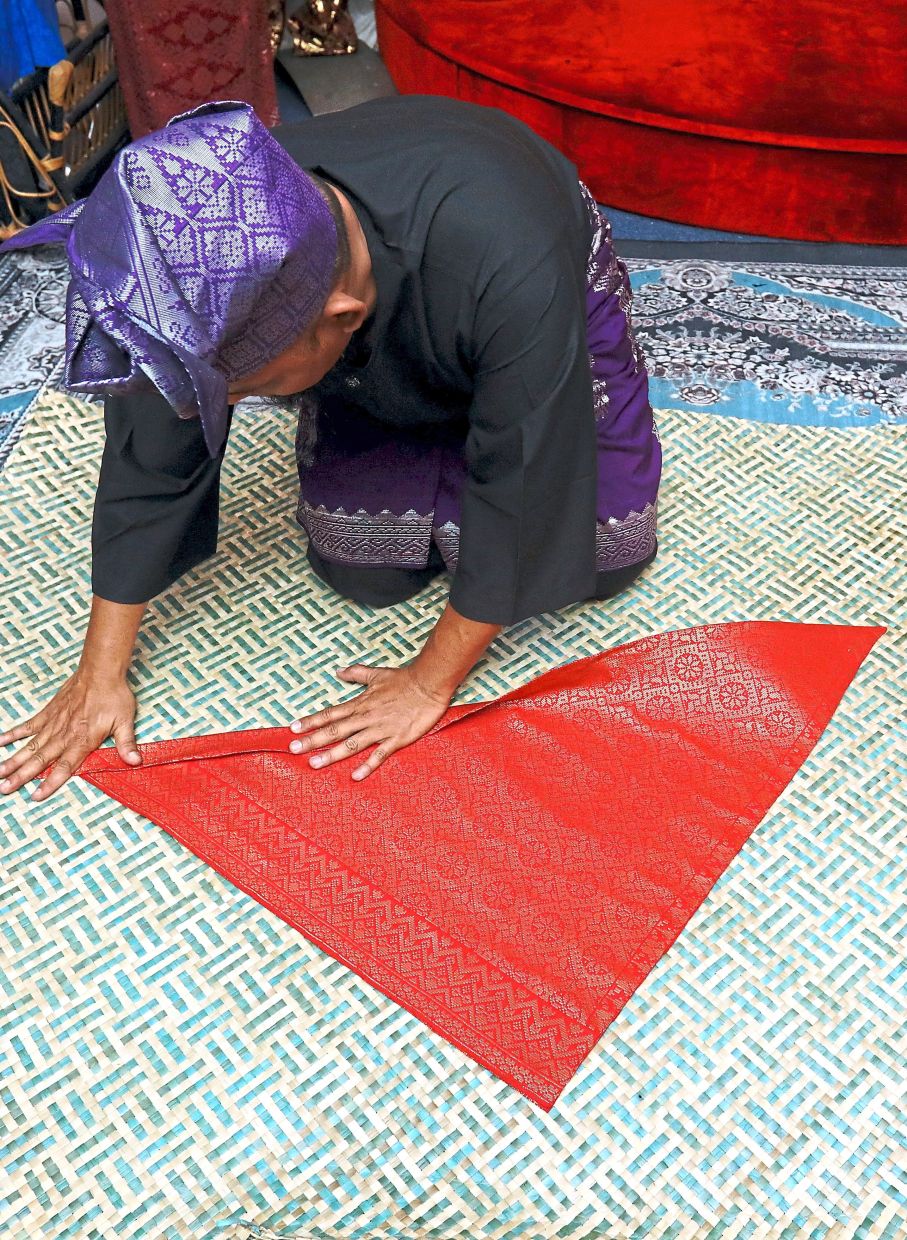
Each tanjak typically consists of a square piece of cloth, about 33in (84cm) wide. To fold a tanjak, Herin first irons an interfacing onto the cloth, before skillfully folding and tying it to create its distinctive shapes and peaks. It takes him between an hour and an hour and a half to finish folding a tanjak.
It is impressive how Herin can recall every folding style of the tanjak with such ease, as if he were a walking encyclopaedia of Malay headgear.
Asked how he manages to remember so many styles, Herin explains, “It is due to repetition. I have been doing this for 10 years, and it’s the many hours of practice that have helped me remember the different types of ikatan (folding).”
He also keeps several books on tanjak styles which he refers to for guidance.
“Nowadays, foreign tailors are hired to make tanjaks,” he says. “The problem is they use cardboard and wire to hold them together, which makes them uncomfortable to wear. It has become more about selling tanjaks than preserving the traditional craftsmanship and heritage.”
Among all the styles, Herin’s favourite is dendam tak sudah (unending revenge), worn mainly by royalty. It is iconic for its history, symbolism and prestige, and is considered one of the most challenging styles to fold due to its precise layers and angles.
“It carries a deep symbolic meaning, often interpreted as determination, resilience and loyalty,” he explains. “The upright points give the tanjak its majestic height, reflecting the wearer’s stature.”
So, how does one choose a tanjak? Do people select it based on their state of origin, their skin tone or their facial shape?
“When choosing a tanjak, the colours and style should suit the wearer’s features: soft colours like purple, red or pink work well for smaller frames, while black and gold suit all skin tones; bold, tall folds in red can make a baby-faced wearer look majestic, whereas pastel shades soften a fierce-looking face,” Herin explains.
His tanjak pricing varies depending on the fabric: RM150 for machine-woven songket and RM1,500 for handwoven cloth.
While he observes a growing interest in tanjak among youths, he is concerned that many are motivated more by potential income than by preserving the heritage.
And social media is also changing perceptions.
“People are inventing new names for traditional tanjak styles. The more popular you are on Instagram or TikTok, the more accepted these names become.
“But Malay traditions are precise. If you want to do it, you must do it properly, follow all the rules, and respect the art form.
“It is crucial to stay true to tradition and keep it alive,” he concludes.
Keeping a tradition alive
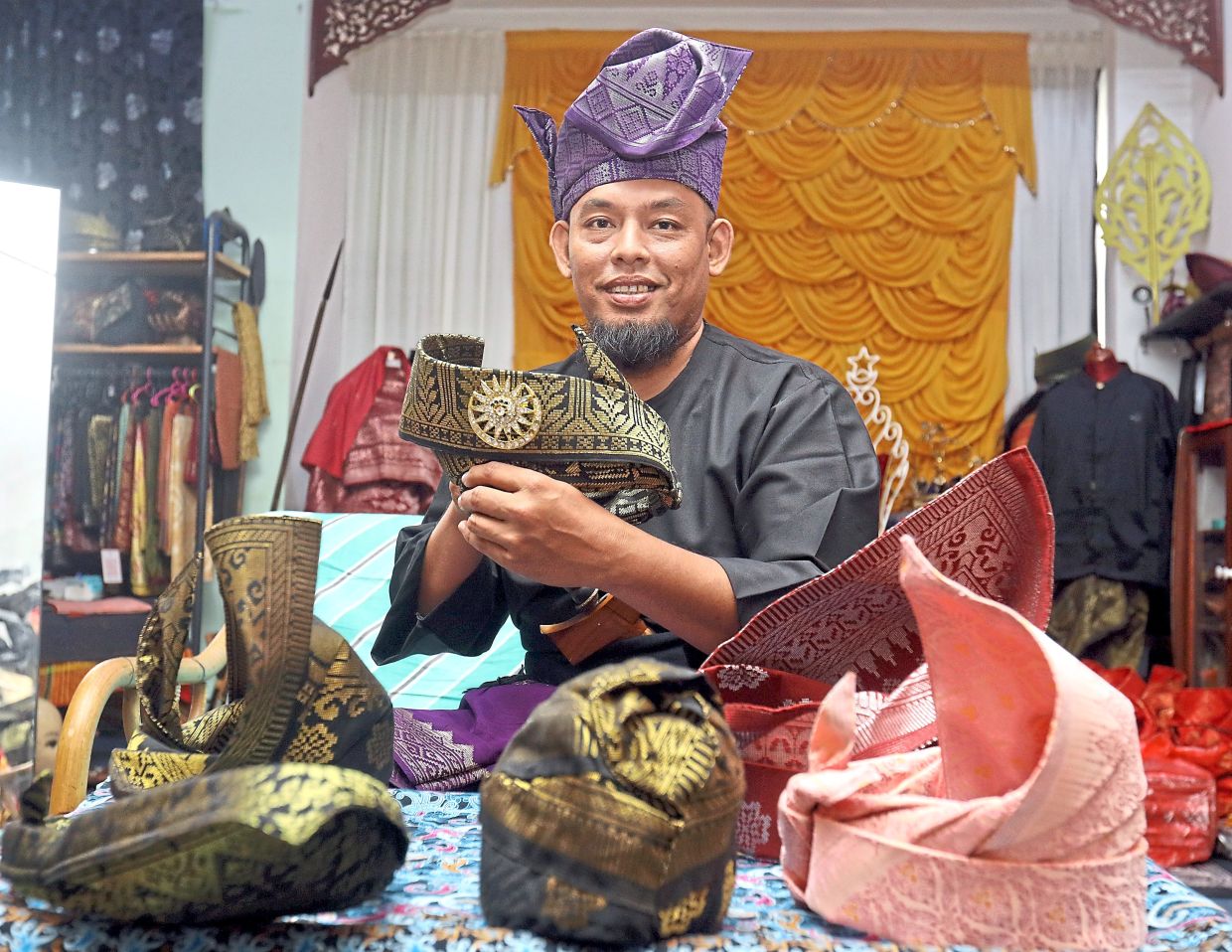
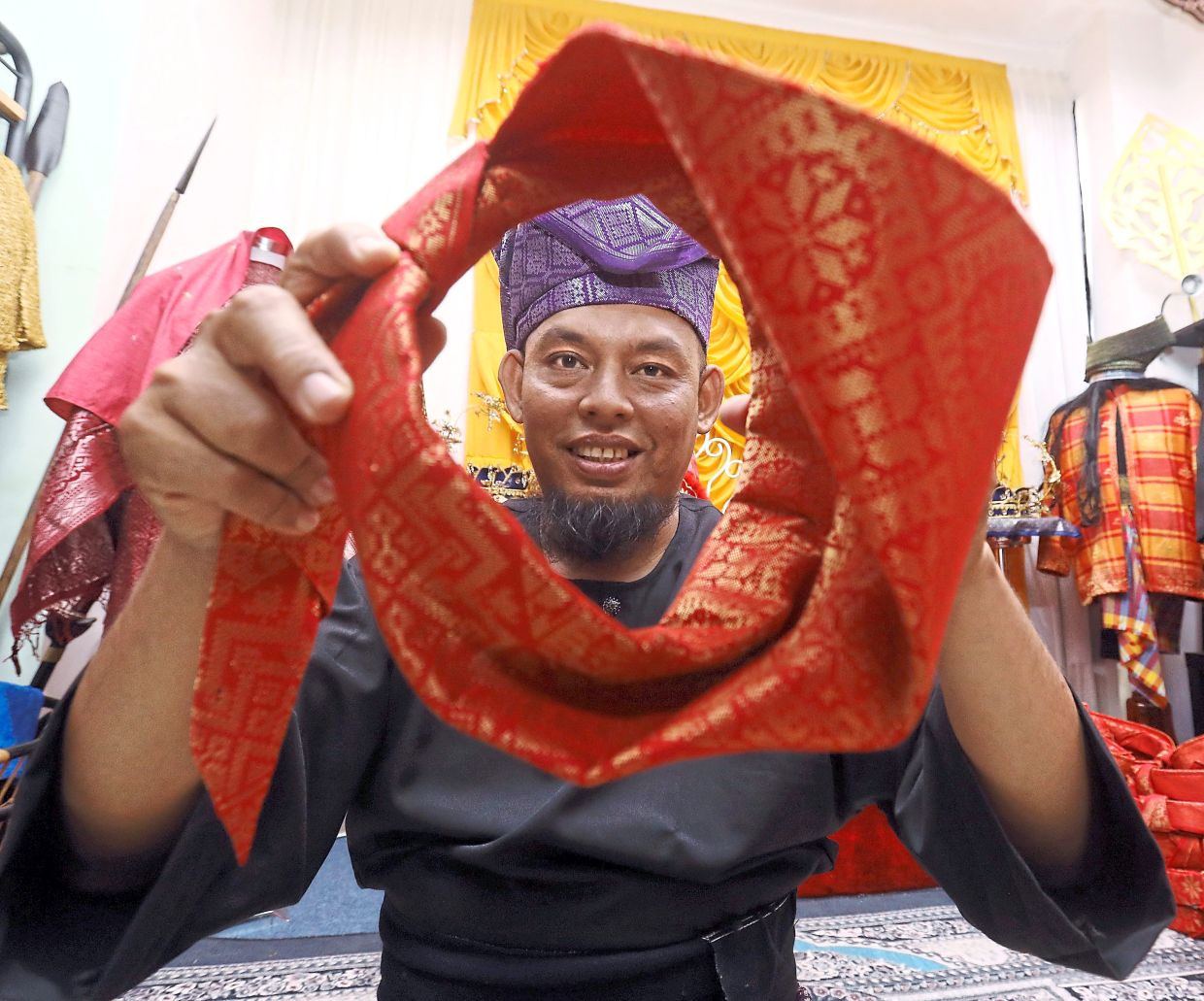
Herin wears a gajah gemulong tanjak while carrying his favourite tanjak, dendam tak sudah. Photos: The Star/Azlina Abdullah
What started as a passion for traditional headdresses led Herin to leave his full-time job and pursue a career celebrating Malay culture.
Photo: The Star/Azlina Abdullah
There are many different styles of tanjak, each with its own unique folds.
Photo: The Star/Azlina Abdullah
Herin (left), wearing a gajah gemulong tanjak, helps his son, Muhammad Haqiemi, 19, don a solok timbo tanjak.
Photo: The Star/Azlina Abdullah
Each tanjak begins as a square piece of cloth, which is then carefully folded and tied to create its distinctive shapes and peaks.
Photo: The Star/Azlina Abdullah
Herin adds the final touches to the tanjak known as ayam patah kepak.
Photo: The Star/Azlina Abdullah