
A nice drive along a river winding through the countryside has suddenly turned into a potentially fatal accident: your car is in the water. What should you do?
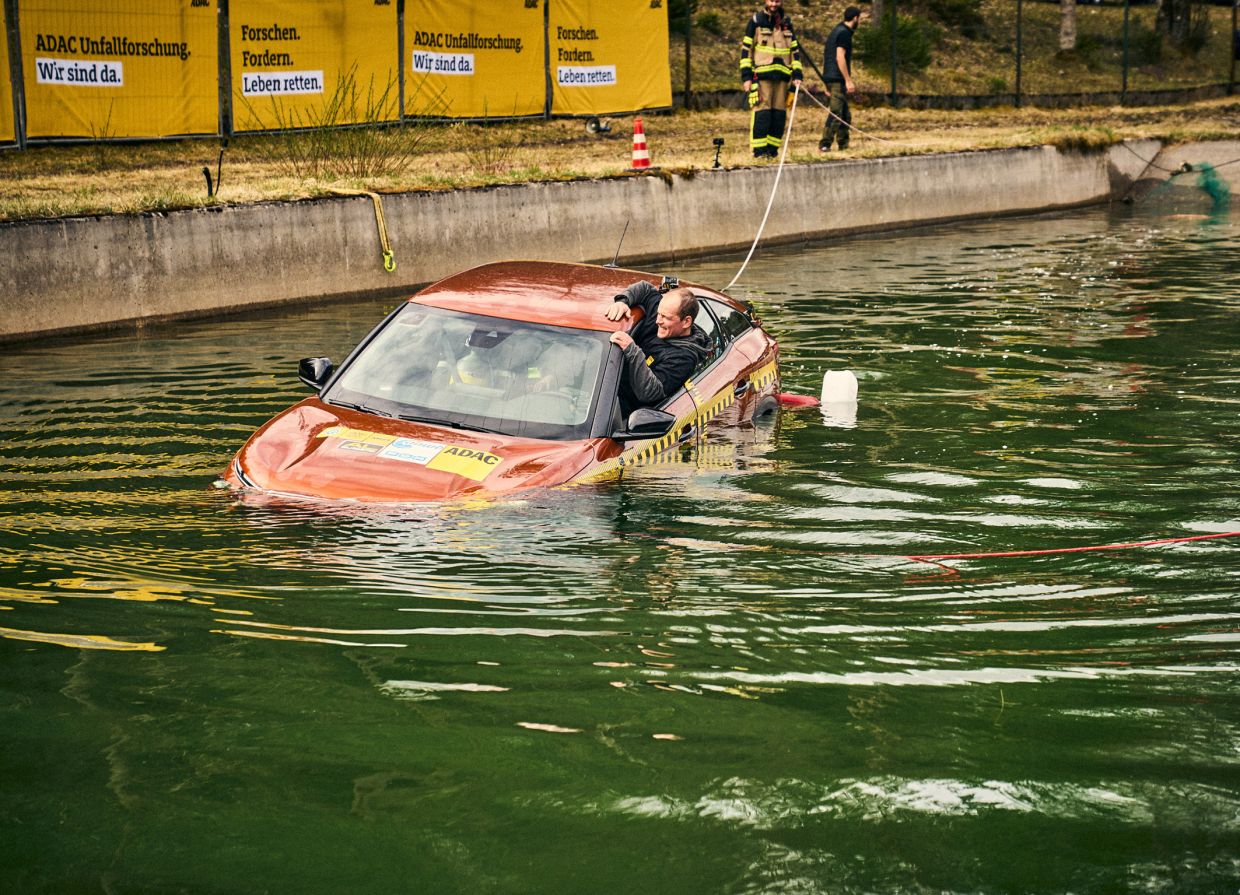
You won’t have much time to act. A submersion test by German motoring organisation ADAC at a several-metre-deep water basin used to test army tanks found that an electric Citroën ë-C4 sank in about three minutes, while an internal combustion-engined Seat Exeo took about a minute longer.
In the test, a specially trained diver stayed in the submerged cars and tried out various ways of getting out. The conclusion was that you need to stay calm, but act as quickly as possible.
Immediately after the car hits the water, you should free yourself from the seatbelt, try to open the nearest side window and then climb out that way.
In the worst-case scenario the electric window regulator in the door may fail because of the water getting at it, which will mean you can't open the window.
However, in modern cars the control systems are at least waterproof enough to keep them working for a while.
In the electric car used in the ADAC test, neither the high-voltage system nor the on-board electrical system showed any abnormalities after the first dive.
In older cars, however, a short circuit could occur more quickly, but the water still has to reach those parts so the sooner you move to get out, the better.
If the side windows won't open, you'll have to try to break them. ADAC recommends always having an emergency hammer and a seatbelt cutter in your car. If you don't have a hammer, you can try using any heavy or sharp object that’s to hand in the car.
Aim at the corners of the side windows
The test found that the best place to hit the window is in one of the corners because they’re not able to absorb an impact as well as the centre can and so break more quickly.
However, breaking the side windows only worked in the test if the car didn't have double glazing. In that case, the only alternative when the windows are closed is to smash the rear window, which is usually single-pane.
But that isn’t easy and needs to be done quickly. The car, pulled down by its engine in the front, will be sinking steeply downward so you’ll need to climb upwards to the rear window. Luggage and other objects could block your way.
Don't try to break the windscreen. "This is not recommended because windscreens are usually made of laminated glass and are therefore almost impossible to break," explains ADAC spokesperson Fabian Faehrmann.
"Moreover, if the windscreen were to shatter, a lot of water would suddenly enter the vehicle's interior, causing the car to sink even faster."
Accident researchers have previously also advised people to get any children out of the car first, since once you're out, it may be difficult to get back into the car to help them.
You sometimes hear the advice to get out using the doors but that's not advisable. In the ADAC test, the doors couldn't be opened at all while the car was sinking.
Once the interior was underwater and the pressure had equalised between inside and out, the diver was only able to open the doors with great effort.
At that point, the diver had been underwater for a minute and a half. In that scenario, ADAC said it doesn’t see much chance of survival for someone who isn’t wearing a wetsuit and oxygen tank, especially as they’ll be under stress and may even be injured. – By Peter Löschinger, dpa