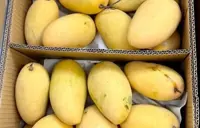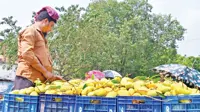
It is widely believed that the Harumanis variety of mangoes first surfaced in Indonesia in the late 1950s before its introduction to Malaysian orchards about a decade later.
The popular variant took Perlis by storm in the early 1980s when the Raja of Perlis initiated village improvement projects that saw Harumanis mango trees replacing unproductive fruit trees to enhance economic returns for the villagers and at the same time boost their living standards.
The pilot project at Kampung Santan in Padang Pauh proved to be such a resounding success that other villages in the state quickly started planting the prized mango variety as well.
Since then the name Harumanis has become synonymous with that of Malaysia’s northernmost state. In fact, from 2011 onwards, the name Harumanis can only be used exclusively to refer to the variety of mangoes grown in Perlis.
Harumanis is notable for only bearing fruit between the months of April and July, unlike most other mango varietals which grow all year round.
The fruit’s extreme sensitivity means that weather changes can affect it, and it has a high spoilage rate.
This – coupled with its relative rarity throughout the year – has contributed to its expensive price tag.
Harumanis mango farm founder Datuk Rick Cheng, for instance, sells three kilos of premium-grade Harumanis for RM300. Currently on his website, the mangoes are all sold out; such is the height of demand!
Harumanis mangoes are typically divided into two grades – grade A mangoes are sold whole, while grade B mangoes are turned into cakes, drinks and jams.
A Harumanis tree can take three to four years to mature and will often bear fruit for up to 30 years. The physical labour involved in growing premium-grade Harumanis is often laborious – at farms like Cheng’s, each fruit is meticulously wrapped by hand, a process that has to be done at precisely the right moment.
Harumanis trees also have to be pruned to maintain a height of three metres, which facilitates an easier harvest. If left unmanaged, the tree can easily grow up to 10 metres high!
On the palate, Harumanis is intensely perfumed, richly sweet in a wonderfully indulgent way with thick flesh that is juicy and devoid of fibrous entanglements. It’s a mango befitting the expense associated with it.