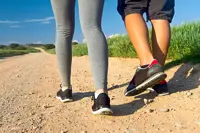
A realistic fitness target: Walking a mile a day


Once you’ve walked on a flat terrain for a while, up the intensity by adding in a few steps, or even carrying a backpack for extra weight. — dpa

An apple a day may not keep the doctor away – although it’s a healthy habit – but walking a mile (1.6km) a day may reduce your visits to the clinic.

And save you some precious ringgit.

We’re 16 days into the New Year, and hopefully, you’re still on track with your fitness intentions and haven’t lost momentum.

If you have, that’s fine; restart when you can.

One reasonably fit reader who has fallen off the bandwagon (a result of setting lofty goals) would like to switch to walking as he thinks he would be more likely stick to this attainable goal.

His question: Is a mile a day enough and how long should it take to walk this distance?

According to data gathered in a 2019 study spanning five decades, the average person should be able to do this on a flat surface in 15-22 minutes.

However, beginners will take more time, while seasoned walkers can do it between 11-15 minutes.

If you walk at a more relaxed pace, are new to fitness, are older or walking on an incline or undulating terrain, your timing may be closer to 20 minutes or more.

Depending on your speed, the average person should be able to cover four to 6.4km in an hour.

The world record for the one-mile race walk is held by Britain’s Tom Bosworth, who set the time at 5:31:08 on July 9, 2017, at the London Diamond League.

His timing is even faster than the duration it takes me to tape my ankle and put on my sports shoes!

Over time, your fitness levels will improve with practice and your timing will decrease.

You can calculate your walking pace by using a pedometer or app that tracks step cadence.

To get an accurate measurement of your pace, try to walk on the same terrain every time.

Once you know where you’re starting, making progress is easier.

Watch to see how your speed increases.

Exertion scale

Invest in a good pair of walking shoes that is comfortable, supportive and minimises the risk of injuries. — TNSInvest in a good pair of walking shoes that is comfortable, supportive and minimises the risk of injuries. — TNS

Another helpful way to track your progress is to monitor your rate of perceived exertion (RPE).

The original RPE scale was called the Borg Scale of Perceived Exertion, developed by Swedish psychologist Dr Gunnar Borg, who introduced it in the 1950s.

This older model runs from six to 20, with six correlating to no exertion at all (e.g. watching television or scrolling social media) and 20 correlating to maximum effort (e.g. sprinting at a pace you can’t maintain for more than a few seconds).

The range of six to 20 was designed that way to correspond to healthy heart rates.

The starting point, six, corresponds to the healthy resting heart rate of 60 beats per minute (bpm).

Eight corresponds to 80bpm, and so forth.

Over time, a modified version of the Borg scale worked its way to the forefront.

It’s a typical scale from one to 10, and is based on overall exertion, not heart rate.

This is the scale known today as RPE, and the one most fitness and healthcare professionals use.

As your exertion increases, so does your heart rate and breathing rate.

If you’re finding it hard to maintain a higher heart rate, adjust your pace to catch your breath, i.e. adjust your exertion level.

Remember, adults should aim for 150 minutes of moderate-intensity physical activity per week, or about 20 minutes per day.

Depending on your pace, walking daily can easily meet this criterion.

Just keep going

Factors such as motivation and energy levels can disrupt speed when you are not in the right mindset to exercise.

If you’re more fatigued than usual, feeling sick or dealing with personal issues, your speed may be slower.

We all have such days and weeks, but try to walk anyway, because getting fresh air and sunshine outdoors can put you in a better mood.

In older adults specifically, walking has been shown to help reduce the risk of illnesses such as cardiovascular and cerebrovascular diseases (e.g. heart attack and stroke), type 2 diabetes, cognitive impairment, and dementia.

Muscle mass and strength naturally decline as we get older, which can reduce the power and efficiency of each step.

Joint stiffness and decreased flexibility can also limit the range of motion.

One 2016 study published in the Archives of Gerontology and Geriatrics suggests that our walking pace drops off by around 0.0037 milliseconds per year.

In layman’s terms, this means that between the ages of 20 and 60, the average person will add around 1.2 minutes to their mile-walking time.

So, by the time you’re in your 70s, the average person will need 21 to 24 minutes to cover 1.6km.

Ageing is tough and it’s tough to achieve the same physical feats we once did.

Unfortunately, despite the many benefits of walking, it becomes harder with age, which forces some seniors to lead a more sedentary lifestyle, thereby increasing their risk of chronic illnesses and reducing their quality of life.

If seniors (and youngsters) can push themselves to walk a mile a day, that would roughly translate to 2,000 to 2,500 steps, but this varies by height and stride, with taller people taking fewer steps (around 2,000) and shorter people taking more (closer to 2,500).

Determining the optimal time of day to walk involves considering both scientific findings and individual preferences.

Research has indicated that physical performance, including muscle function, strength and endurance, tends to peak in the late afternoon and early evening.

This is attributed to factors such as increased body temperature and favourable oxygen uptake during these hours, which can enhance exercise efficiency and performance.

At the end of the day, any movement performed at whatever time convenient for you is good, but consistency is key to progress.

The more you train your body, the better it performs and serves you.

Revathi Murugappan is a certified fitness trainer who tries to battle gravity and continues to dance to express herself artistically and nourish her soul. For more information, email starhealth@thestar.com.my. The information contained in this column is for general educational purposes only. Neither The Star nor the author gives any warranty on accuracy, completeness, functionality, usefulness or other assurances as to such information. The Star and the author disclaim all responsibility for any losses, damage to property or personal injury suffered directly or indirectly from reliance on such information.

Follow us on our official WhatsApp channel for breaking news alerts and key updates!
Walking , exercise

Next In Health

Regrowing cartilage in�mice�with arthritis
Just a few puffs away from drug addiction
Weight returns four times faster after stopping weight-loss drugs
Lean fatty liver danger: Thin outside, but fat inside
Cough meds don’t really work; try this natural alternative instead�
Worried that your kid has suddenly become a bit smelly?
Actually implementing the Health White Paper
Why your weight changes throughout the day
Recognising the signs of sepsis�– a life-threatening emergency
Safety in the school is more than keeping violence out

Others Also Read