Only about 30% of Malaysian parents make their child strap into a booster seat while in the car, with those who don't citing reasons ranging from cost to an unhappy or angry child, and just making a short trip. — Filepic
It is 7.10am on a Tuesday, and the morning sun is starting to peek over the horizon.
Inside a silver Myvi, Sarah is gripping the steering wheel with the radio playing a cheerful morning segment.
The atmosphere inside the car is anything but happy though.
In the backseat, five-year-old Amin is screaming.
He dropped his favourite Ultraman toy, he feels “tight” being strapped in the child seat, and he wants to get out.
“Ibu (Mother)! It’s near! I promise I will sit still!” he wails, kicking the back of the driver’s seat.
Sarah hesitates. The traffic is crawling at a snail’s pace, the school is only 2km away, and the temptation to silence the tantrum by unbuckling him is overwhelming.
She considers the matter: “It’s just five minutes. I’ll drive slowly. Nothing will happen.”
But then she takes a deep breath and doesn’t do it. “No, Amin. We are moving. You sit still.”
Sarah’s decision in that split second is a victory against a cultural mindset that is costing us lives.
She knows that on Malaysian roads, a “short trip” can turn tragic in the blink of an eye.
While we worry about dengue or influenza, the silent killer on our doorstep is the road.
Accidents are the leading cause of accidental deaths in Malaysia, and the victims are largely our future generation.
According to the Malaysian Institute of Road Safety Research (Miros), we lost an average of 434 children each year between 2014 and 2023 to road traffic accidents.
That is more than one child dying every day.
To change this, we must confront the three specific dangers Sarah encounters on her short drive from home to school.
Battle in the backseat
Amin eventually stops screaming and settles into a sulk.
Sarah remembers when she first bought the Child Restraint System (CRS).
It cost RM300, a significant sum for her family, and her mother-in-law had teased her, saying, “In our time, we just held the baby on our laps. You survived, didn’t you?”
This survivorship bias is a massive barrier.
Despite the CRS regulation being enforced since Jan 1, 2020, usage remains critically low.
Reports indicate that only about 30% of Malaysian parents actively use car seats, and they cite reasons like cost, crying children or the dangerous justification: “It’s just a short trip.”
But physics does not care about distance.
In a collision at just 50km/h, a 20kg child like Amin becomes a projectile.
The impact forces multiply his weight by 20 to 60 times, hitting with the force of a grand piano.
No mother’s love is strong enough to hold back that kind of physics.
A properly installed CRS is scientifically designed to absorb these forces.
Studies by Miros have shown that these seats can reduce infant deaths by up to 71% and toddler deaths by 54%.
We have seen miraculous cases where a six-month-old baby survived a fatal crash specifically because they were strapped into a safety seat, while the unrestrained adults suffered severe injuries.
To help parents like those in Sarah’s community who find seats unaffordable, the government previously introduced the MyCRS programme in 2022, which offered subsidies for low-income (B40) families.
While financial aid is crucial, the hardware is only half the battle.
We need the “heart-ware” – the internal conviction to use the seat every single time, even when the child is screaming.
Sarah’s heart won the battle this morning, but thousands of other parents usually just give in.
Family on two wheels
At a traffic light, Sarah sees a “kapcai” (underbone) motorcycle.
It is a common sight: father driving, mother behind, and a young child sandwiched between them.
The parents wear helmets; the child does not.
Motorcycles are the backbone of Malaysian transport, but also the deadliest, accounting for over 60% of road deaths.
That young child is statistically at the highest risk.
Data shows that children aged six to 10 years are most likely to die as pillion riders.
If that bike skids, the child’s head is the most likely body part to be severely injured.
Even when children do wear helmets, there is a “quality gap”.
A 2023 study found that many child helmets sold in toy shops fail Sirim standards.
They are effectively plastic toys that shatter upon impact.
As the bike shoots off from the traffic light, Sarah also thinks of the older children in her neighbourhood: the 13-year-olds on modified bicycles (basikal lajak) or who sneak out on a parent’s motorcycle.
The statistics are terrifying: three in four road deaths among children aged 11 to 15 years occur when they are operating the vehicle.
Chaos at the school gate
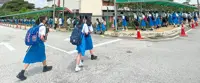
Sarah arrives at the school zone, a scene of organised chaos.
Cars double-park, hazard lights blink, and a large SUV zooms past, missing a student by meters.
School zones are tragic hotspots because children are biologically vulnerable.
Their small figure makes them invisible to high vehicles, and their developing brains cannot accurately judge the speed of oncoming cars.
They assume: If I can see the car, the driver can see me.
This is why the push for 30km/h speed limits in school zones is a matter of life and death, not red tape.
The World Health Organization (WHO) identifies 30km/h as a survivability threshold.
When hit at 30km/h, a child has a 90% chance of survival.
At 50km/h, that chance plummets to less than 20%.
But signs on a pole are insufficient.
We need traffic controllers, speed bumps, raised crosswalks and engineering that forces drivers to slow down.
We need to design our school zones so that even if a driver makes a mistake, a child does not pay for it with their life.
Arriving alive
Sarah pulls into the designated drop-off zone.
She puts the car in park, walks around to the back and unbuckles Amin.
He is no longer crying.
He grabs his bag, gives her a quick salam (farewell) and runs toward his teacher.
Sarah watches him walk in, safe and sound.
The drive was stressful and the screaming was exhausting, but she played her part.
Road safety isn’t just about avoiding a summons from JPJ.
The system relies on us.
It relies on the internal conviction of parents like Sarah.
It is the conviction to wrestle a crying toddler into a car seat because you love them too much to risk their life.
It is the conviction to buy a certified helmet for your pillion rider, even if it costs a bit more.
It is the conviction to lift your foot off the accelerator and crawl at 30km/h near a school, even if you are late for a meeting.
I often think of my own nephew, who has insisted on wearing a seatbelt since he was small, nagging anyone who doesn’t.
It would be a blessing if all adults were naggers like him.
As Sarah drives away toward her office, the radio plays a new song.
She feels a lightness in her chest.
She knows the return trip will be another battle, another negotiation with a tired five-year-old.
But she also knows she will win that battle again.
Because every child like Amin deserves to arrive alive.
Dr Naveen Nair Gangadaran is a paediatrician at Hospital Tuanku Ja’afar, Seremban, and committee member of the Malaysian Paediatric Association and Perinatal Society Malaysia. This is the last in a three-part series on child safety. For more information, email starhealth@thestar.com.my. The information provided is for educational and communication purposes only, and should not be considered as medical advice. The Star does not give any warranty on accuracy, completeness, functionality, usefulness or other assurances as to the content appearing in this article. The Star disclaims all responsibility for any losses, damage to property or personal injury suffered directly or indirectly from reliance on such information.