
Retinal detachment may sound rare, but it is a real risk, especially if you are over 40, highly myopic (short-sighted) or have a family history of eye problems.
Once it happens, time is your most critical ally.
Retinal detachment occurs when the retina – the thin layer of tissue at the back of the eye – peels away from its normal position.
It is painless, but dangerous.
Left untreated, it can lead to permanent blindness.
Consultant ophthalmologist and vitreoretinal surgeon Dr Peh Khaik Kee compares the eye to a camera, with the retina acting as the film.
A clear gel called vitreous jelly fills the eye, but it begins to shrink and pull away as we age.
This can tug on the retina, causing tears.
If fluid seeps behind the tear, it can lift the retina and cause detachment.
“Don’t wait until the shadow reaches the centre of your vision.
“This can jeopardise recovery of vision,” he warns.
What to look out for
Floaters and light flashes are key warning signs.
“Floaters may look like specks, cobwebs, or even ‘mosquito-like’ shapes drifting in your vision,” says Dr Peh.
A sudden increase in floaters or flashes, especially at the edge of your vision, should raise immediate concern.
ALSO READ: Seeing 'worms' everywhere? It's OK. It's all just in your eye
Another red flag is a shadow or curtain creeping across your view.
This could be a sign that the retina is already detaching.
“Even if part of the retina is detached, the patient can retain near-normal vision as long as the macula is still on.
“But once the macula comes off, the chances of restoring full sight drops significantly,” he explains.
Consultant ophthalmologist and vitreoretinal surgeon Dr Selva Raja Vengadasalam notes that retinal detachment is more common than many think, occurring in approximately seven to 14 per 100,000 cases.
It is not caused by lifestyle or diet, but rather structural factors.
People at highest risk include individuals over the age of 40, those with high myopia (short-sightedness), patients with a family history of retinal problems, and people who have had eye injuries or previous eye surgeries.
ALSO READ: Being shortsighted increases your risk of other eye diseases
“Retinal detachment also appears to be slightly more common among men, and in my clinical experience, I have observed a higher number of cases among the Chinese community, possibly due to the higher prevalence of myopia within this population group,” he says.
Taking timely action
“Symptoms like floaters and flashes are common, but only about 5% to 10% of these cases involve an actual retinal tear,” says Dr Selva.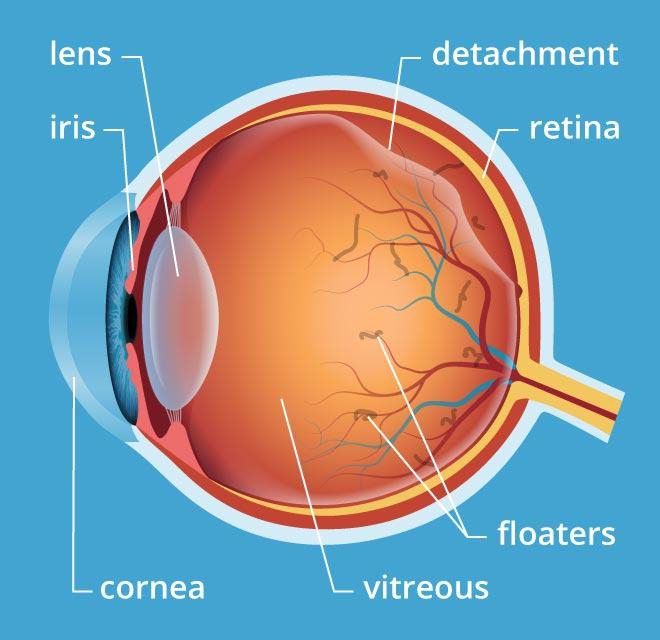
That’s why getting a dilated eye exam by a retinal specialist is crucial to confirm whether urgent treatment is needed.
He also recommends follow-up checks up to two to three months after symptoms begin.
“Initial exams may not catch a tear right away.
“This is the critical window when the vitreous is most likely to pull on the retina and create a tear,” he explains.
If a tear is caught early, it can often be sealed with a simple laser procedure called photocoagulation.
But once the retina detaches, surgery is the only effective treatment.
Depending on the case, patients may undergo vitrectomy or scleral buckling.
These are microsurgical techniques used to reattach the retina and restore vision.
The good news is, technology has made these procedures far more safer and successful than before.
“Modern vitrectomy uses instruments as small as 0.5 millimetres,” says Dr Selva.
“It’s similar to keyhole surgery, which means smaller incisions and faster recovery.”
In some cases, a gas bubble is placed inside the eye to help press the retina back into place.
During the healing process, the patient may be required to lie face-down for long periods each day for one to two weeks.
Good surgical outcome
According to Dr Peh, the success rates for retinal reattachment surgery are high, i.e. between 80% to 97%, depending on how early it is performed.
“If the macula is still attached, patients can regain full visual function.
“If the macula has detached, about 70% of patients can recover enough vision for daily tasks, including driving,” he says.
However, most patients will eventually develop cataracts within six to 24 months after the retinal surgery.
Fortunately, this can be corrected with a standard cataract operation to further improve vision.
There’s no pill or supplement that can prevent retinal detachment, but early detection can make all the difference.
“Screening is seeing!
“The earlier we detect and treat a retinal tear or detachment, the better your chances of preserving clear, functional vision,” Dr Peh points out.
“Retinal detachment surgery is not about enhancing your vision, it’s about saving your sight,” adds Dr Selva.
“It’s a time-sensitive condition.
“If you’re at risk or notice sudden changes in your vision, don’t delay.
“See a specialist immediately.”