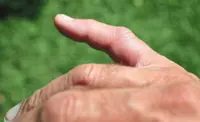
Walking barefoot, waving your hands while talking, sipping soda – you might not notice the bee or wasp nearby until you get stung.
Ow.
The venom these creatures inject into your skin not only hurts a lot but also causes a nasty swelling.
Do you know what steps to take when this happens?
First, check if you can see a stinger lodged in your skin – if yes, then it was a bee.
Remove the stinger fast.
“Attached to it is a venom sac that continues to pump venom into the skin,” says Prof Dr Thilo Jakob, board member of the German Dermatological Society.
You can prevent this by carefully scraping the sting off with a plastic card.
But do not squeeze the skin with your fingers as this might push more venom in.
Whether it’s a wasp or bee sting, cool the patch of skin with ice cubes or cold water, says Stiftung Gesundheitswissen, a foundation focused on healthcare information.
The cold will inhibit the inflammation that underlies insect stings and causes all the other symptoms.
Alternatively you can apply some antihistamine gel.
If you are not near your medicine cabinet and don’t have anything cold on hand, then in an emergency, use your own saliva.
“Spit is nothing more than a liquid that you always have with you and it cools the sting,” says Prof Jakob.
When moisture is on the skin, even a slight breeze or blowing can draw warmth away – the essence of the cooling effect.
You can also cool your skin using a sliced onion, a classic home remedy for wasp stings.
But take care, as onions contain a lot of acid which can cause skin burns.
“We have seen patients who have put onion slices on their skin with a nice thick bandage and left it on for 24 hours,” says Prof Jakob.
In two scenarios, a bee or wasp sting can become an emergency.
If the insect stings someone’s mouth or throat, the mucous membranes and the tongue can swell so much that they find it hard to breathe, the foundation says.
Call for help and in the meantime, suck ice or ice cubes and place a cold compress around the neck.
If you suspect allergic shock, call the emergency services.
In Europe, some 2% to 3% of people have an insect venom allergy, meaning they react excessively to stings.
This can lead to life-threatening allergic shock causing breathing difficulties or circulatory problems.
Particularly if it is the first time the person is affected, call the emergency services in your area, says Prof Jakob. – dpa