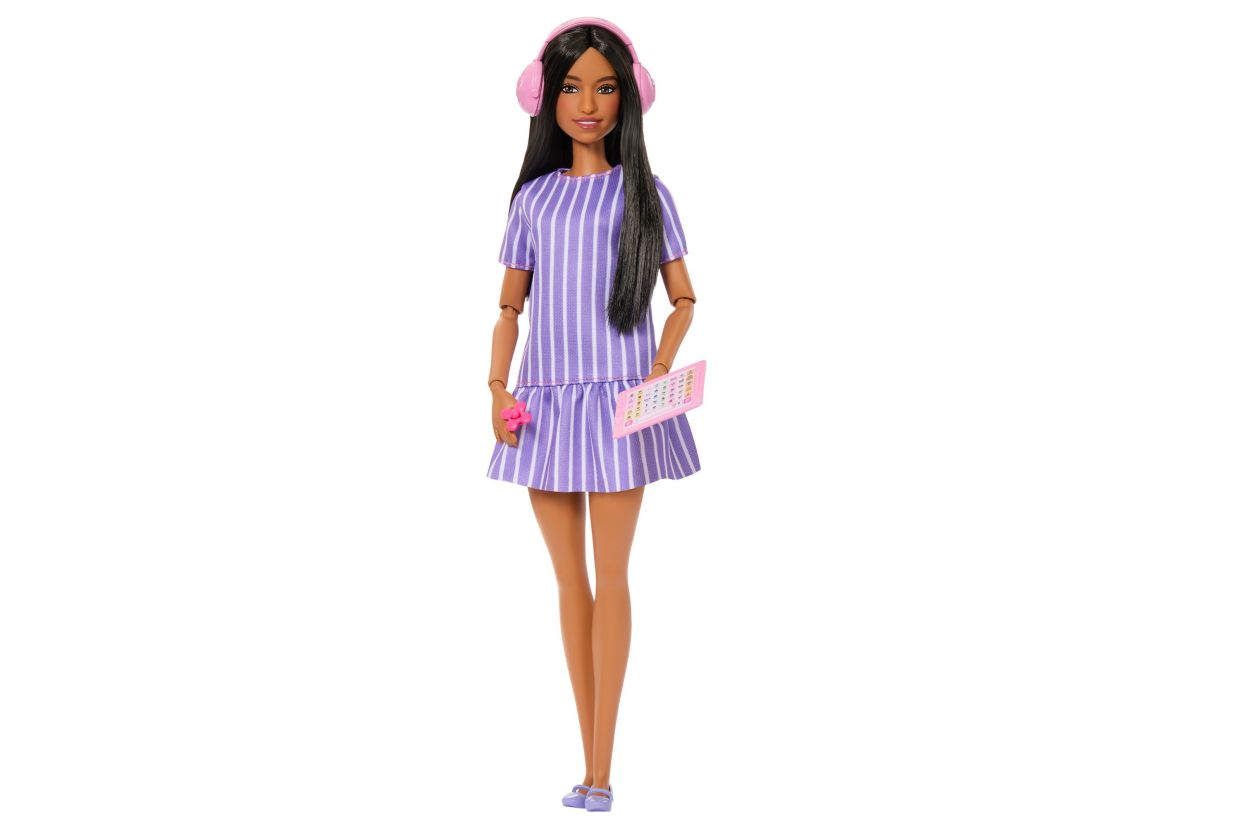
When Mattel launched its autistic Barbie doll recently, attention quickly turned to its design choices, which are meant to reflect the lived experiences of individuals with Autism Spectrum Disorder (ASD).
The doll dons a loose purple dress meant to reduce the fabric’s contact with skin and has a slightly averted gaze to represent how individuals with ASD avoid direct eye contact.
She wears noise-cancelling headphones to help with sensory overload, and holds a pink fidget spinner and an Augmentative and Alternative Communication (AAC) tablet – tools that many autistic individuals rely on.
The doll was created as a way to represent autistic individuals in a joyful and authentic manner.
While the launch has been widely praised, parents of autistic daughters and ASD advocates in Malaysia say the conversation should not stop there.
According to National Autism Society of Malaysia (Nasom) chairman Julian Wong, the doll sits at an important intersection between symbolism and real representation.
“Symbolically, it is huge – Barbie is a global icon. For a brand of that magnitude to say, ‘Autism belongs in our world’ validates the existence of millions of neurodivergent children who rarely see themselves in mainstream media or toy aisles.”

“When a child sees a doll using an AAC device like they do, it shifts the narrative from ‘Something is wrong with me to ‘This is just how I communicate, and even Barbie does it.’”
Representation in toys plays a formative role for both autistic and neurotypical children.
“Play is how children rehearse for life. If neurotypical children only ever play with neurotypical dolls, they unconsciously learn that ‘different’ is invisible,” Wong notes.
When asked if the doll runs the risk of oversimplifying ASD, he explains the danger only arises if the public assumes the doll represents all autistic people, but says this fear of oversimplification shouldn’t stop progress.
“This doll is a conversation starter, not a medical textbook. It represents some experiences of autism, which is infinitely better than representing none.”
Meanwhile, Ideas Autism Centre (IAC) assistant operations manager Illya Shaharudin admits he was initially sceptical about the idea behind the doll.
“I was curious to see how they would represent ASD given that autism isn’t always outwardly obvious,” he says.
“Once I learned about the doll’s ability to 'stim' (short for self-stimulatory behaviour), and shift its gaze, I was impressed with the thoughtful development,” he remarks, noting the doll’s movable elbows and wrists.

Toys like this can also help neurotypical kids view such behaviours as something normal, which can reduce stigma and bullying.
Still, Illya believes there is room for improvement in terms of the representation.
He suggests additional accessories to be included, such as a weighted vest, so kids can pick and choose which accessories best represent their sensory needs.
“Since the diagnosis rate in boys is significantly higher than girls, a corresponding Ken doll would be a valuable next step to ensure boys on the spectrum are also represented.”
Beyond the toy aisle
For parents with autistic daughters, reactions to the doll are more layered.
Nik Nadia Nik Mohd Yusoff, 45, whose teenage daughters Helena Aufiya and Emilea Firzana are on the spectrum, believes the doll’s impact lies more in awareness than being a form of therapy for those with the condition.
“It is impossible to educate people about autism with just a doll – but it does promote awareness and acceptance,” she says.
She views the doll as something that can normalise assistive technology used by those with ASD, particularly the AAC tablet.
“I hope it allows more families to try this method of communication for their non-speaking autistics,” she says, noting that not all families are exposed to AAC as a possible option.
She mentions that her daughters are intrigued by the doll, and although it may not represent them fully, it’s still nice to see part of them reflected in the doll.
Shao Liew Salimzi, whose 14 year-old daughter Stacia is autistic, has mixed feelings about the doll.
While she supports the embodiment, she questions whether the doll risks reducing autism to just stereotypes.
“There is a difference between cursory representation and a meaningful one,” she states, exemplifying her point with the Sesame Street character named Julia, who teaches children how to interact with autistic friends.
“If the doll is sold without awareness and teaching acceptance, then the risk is oversimplification. Representation is a double-edged sword. What the brand does next now that the doll is released will be key.”
Both Nik Nadia and Salimzi agree that toys like this alone can’t replace what families truly need, which are more toys designed specifically for sensory needs and motor skill development, proper public education regarding ASD, sensory-friendly public spaces and wider acceptance.
The autistic Barbie doll may best be seen as a starting point instead of a solution, one that opens doors to more conversations.
“Promoting awareness and acceptance among Barbie collectors and children who buy and play with them is definitely helpful. Even news of its launch created a good buzz surrounding ASD,” Nik Nadia concludes.