Even in retirement, Ramlan Abdullah is a hard man to pin down. At 65, one might imagine the former art lecturer has time to spare.
The reality is quite the opposite. Ramlan remains a busy man, dividing his time between his studio and his family.
“Life after retirement is divided into two parts,” he says with a gentle smile.
“First, I continue my work as a full-time artist in my own studio. Second, I enjoy my time as a husband, father, and grandfather, living the family life I planned – simple, happy, and loving.”
For over 30 years, Ramlan has skilfully balanced many demands. He taught at Universiti Teknologi MARA (UiTM) while also sculpting in his spare time. During his last decade of teaching, he also had the added burden of a relentless dialysis routine.
“Those days – dialysis centre in the morning, then classes, and later, my studio at night,” recalls Ramlan, who has been on dialysis for the past 12 years.
His doctors advised him to begin dialysis when his diabetes worsened to the point that he endured temporary blindness for three months.
“I even missed the sight of my son’s wedding,” says the father of three sons, aged between 28 and 35, adding that at that time, he could not even stand and had to use a wheelchair.
Determined to get better, Ramlan faithfully followed his doctors’ orders, never skipping a dialysis session and adhering to a strict diet.
“Whenever I was down, especially during dialysis, I would think of teaching and sculpting, and I got the semangat back,” he says passionately.
Within less than a year, he found himself back on his feet – determined to keep teaching and sculpting.
That same discipline and willpower still fuel him today as he steps into a new phase of life, one he describes with quiet conviction: “I finally have the time and freedom to focus on my personal journey as an artist, to explore new ideas, and to push myself further in my creative process.”
“I want to continue sculpting and producing, and stay relevant as a sculptor,” he adds.
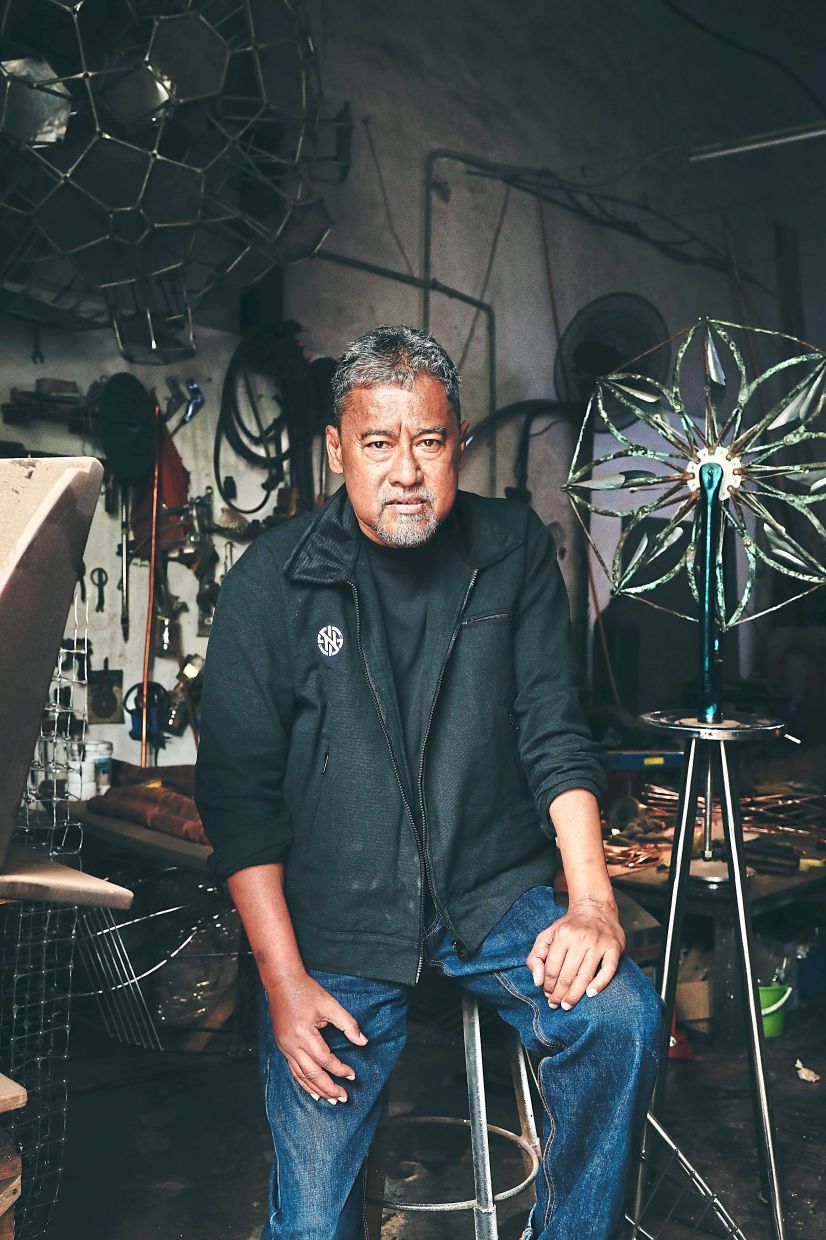
Shaping an identity
Ramlan’s journey in art began in 1978, when he enrolled as a Fine Art student at Institut Teknologi MARA (now UiTM). It was there that he discovered his true calling in sculpture, more deeply than in other mediums such as painting or printmaking.
“I had always been fascinated by three-dimensional forms and loved creating objects.
Working with shapes, structure, and space gave me the freedom to express myself in a more physical and creative way,” he says.
After completing his diploma, he spread his wings to the United States, earning a Bachelor of Fine Arts at Wartburg College in Iowa, followed by postgraduate studies at the School of the Art Institute of Chicago and, finally, a Master of Fine Art in Sculpture at Pratt Institute in New York.
“But I already knew I would be an artist from the age of nine, when my art teacher kept telling me that I could be one,” chuckles the grandfather of two, who most recently added a Doctor of Philosophy (Art & Design) from UiTM to his list of achievements, graduating last June.
In 1990, Ramlan returned to Malaysia and rejoined his alma mater as a lecturer teaching sculpture in the Faculty of Art & Design, where he would remain for the next 35 years.
“Teaching gave me fresh inspiration,” he recalls. “Working with young creative minds pushed me to explore new ideas and helped shape the direction of my own art practice.”
Exposure to contemporary approaches overseas, combined with years of academic discipline, gave him a strong technical foundation in three-dimensional art and public sculpture.
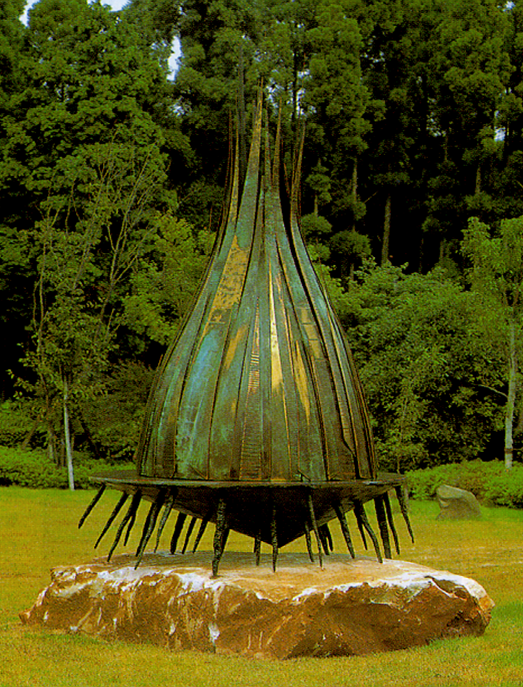
The experience honed his own vision – to connect nature, Islamic values and Malaysia identity through shapes and structures.
“My sculptures are based on geometric forms because I see them as a strong language to express my ideas,” he says.
“It reflects the patterns we see in nature and in Islamic art it represents unity and infinity. By combining these inspirations, I could create works that were both abstract and spiritual, modern and rooted in who we are as Malaysians.”
Even as he kept up with the demands of academia, Ramlan managed to build an impressive portfolio of sculptures that would become landmarks across the country.
His works can be seen at KLCC Park and Bukit Jalil National Stadium in Kuala Lumpur, Dataran Lang in Langkawi, Puteri Harbour in Johor, UiTM campuses nationwide, and even abroad, in Japan, Korea, Vietnam, Zambia, and Australia.
Some of his most recognisable works are Wahdah at the ASEAN Sculpture Garden in Kuala Lumpur, Keris at Bukit Jalil, and Nexus at UiTM Shah Alam, which Ramlan says was inspired by the growth of a seed and the interconnectedness of a community.
Recognition came early and often.
In 1995, Ramlan made history as the first Malaysian to win the Grand Prize at the Oita Asia Sculpture Competition in Japan.
“This studio was bought using the prize money that came with the award,” he says with a proud smile.
Yet beyond the awards, what gives him the greatest satisfaction is the public’s interaction with his art.
“It is very rewarding to see people engage with my work – whether they stop to observe, take photos, or simply reflect on it,” he says.
“Knowing that my sculptures can evoke thought, emotion, or even curiosity in everyday spaces gives them purpose beyond the studio.”
And it is only natural to wonder: If he could produce an extraordinary body of work that has earned national and international recognition while juggling teaching and dialysis, what might he achieve now that he is devoting himself fully to his art?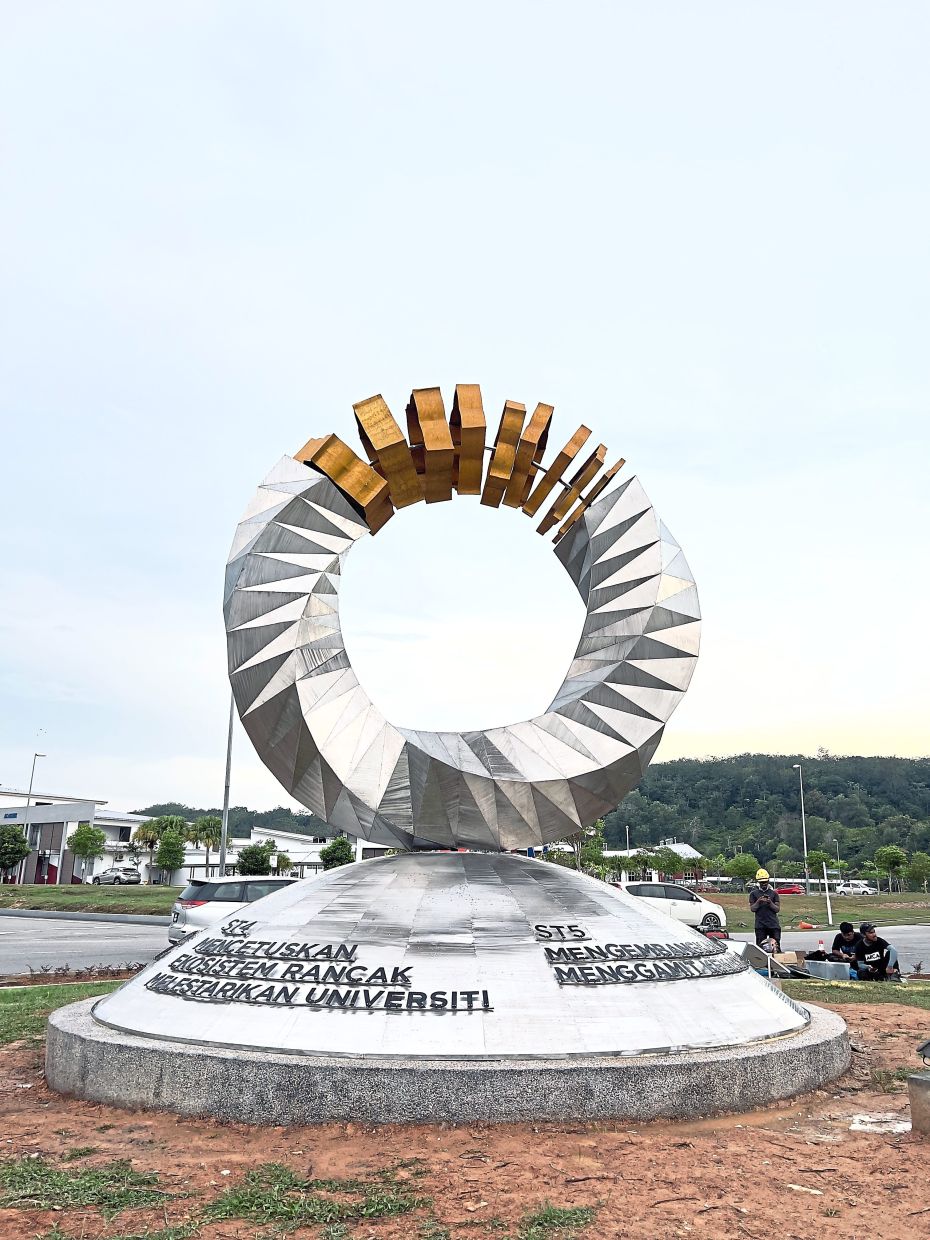
A new chapter
Leaving his teaching years behind, Ramlan entered this new phase of life with focus and renewed energy, opening up time and space to devote entirely to his art.
He wasted no time, producing several significant works. Two years ago, he completed Kesidang Mas at Universiti Teknikal Malaysia Melaka (UTeM), a sundial for Institut Tanah dan Ukur Negara (INSTUN) in Perak, and Waktu in Tanjung Malim.
Last year, he unveiled Movement In Stillness – Dedaun, a monumental installation at the Penang State Museum.
On top of large commissions, Ramlan has also chosen to return to quieter explorations.
“I’m focusing more on personal drawings and sketches, working on paper with graphite pencils,” he says.
“This simple medium allows me to explore the pure essence of line and form. Experimentation and exploration open the door to new ideas.”
His perspective on creativity has deepened with age. “With maturity comes patience and thoughtfulness,” he reflects.
“Each piece I create now carries a sense of purpose, shaped by my life experiences and the lessons I’ve learned along the way.”
Far from slowing down, Ramlan keeps busy in his studio, where several projects are in progress, including new commissioned sculptures.
“In addition to these, I am developing works based on fresh ideas and thematic concepts, which I hope to share in upcoming exhibitions,” he adds.
His goal is not only to create, but to remain relevant – an artist who continues to speak to his time, his culture, and his community.
“I don’t see retirement as the end,” he says. “It is a chance to go further. Sculpture has given me a voice all these years, and now I finally have the freedom to let that voice grow louder.”
He concludes with quiet conviction: “At this stage of my life, I feel more energetic and curious in my artistic practice. With greater opportunities, improved methodologies, and access to technology in my studio, I can explore and create with renewed enthusiasm.”
At this stage of my life, I feel more energetic and curious in my artistic practice. With greater opportunities, improved methodologies, and access to technology in my studio, I can explore and create with renewed enthusiasm.