

For retiree Mary Margaret Mirandah, 68, her tableware collection is precious; their value is more than any plate and bowl could ever hold.
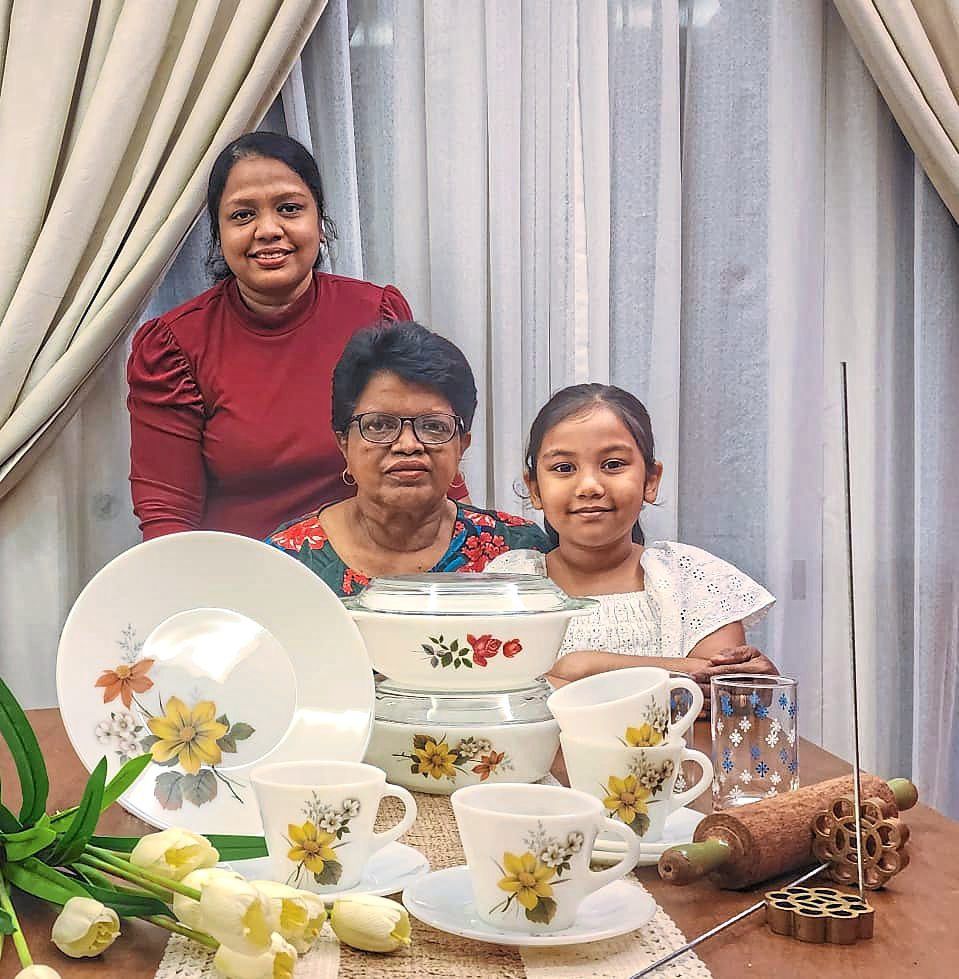
“They are mostly items from my mother’s kitchen, which I have inherited,” Mary says, carefully lifting a piece from her vintage Pyrex Autumn Glory set.
But what is closer to her heart are not these milk-white serving ware adorned with their signature autumn-coloured dahlia motif.
Her true favourites are the traditional moulds used to make festive delicacies like kuih loyang, or honeycomb biscuits, and achu murukku, or rose cookies – cherished tools that come out every December in preparation for Christmas.
“These items are very sentimental to me. They remind me of the happy moments my mother and I shared, cooking together,” says Mary, who lives in Kepong, Kuala Lumpur.
Like Mary, many Malaysian mothers place high sentimental value on their heirloom tableware.
More than practicality, these tableware collections carry a social meaning: they are tied to rituals like weddings, festivities and family gatherings; events that reinforce family cohesion and social networks.
These items, often collected through hard-earned money, symbolise tradition and continuity, and they link generations through heirlooms.
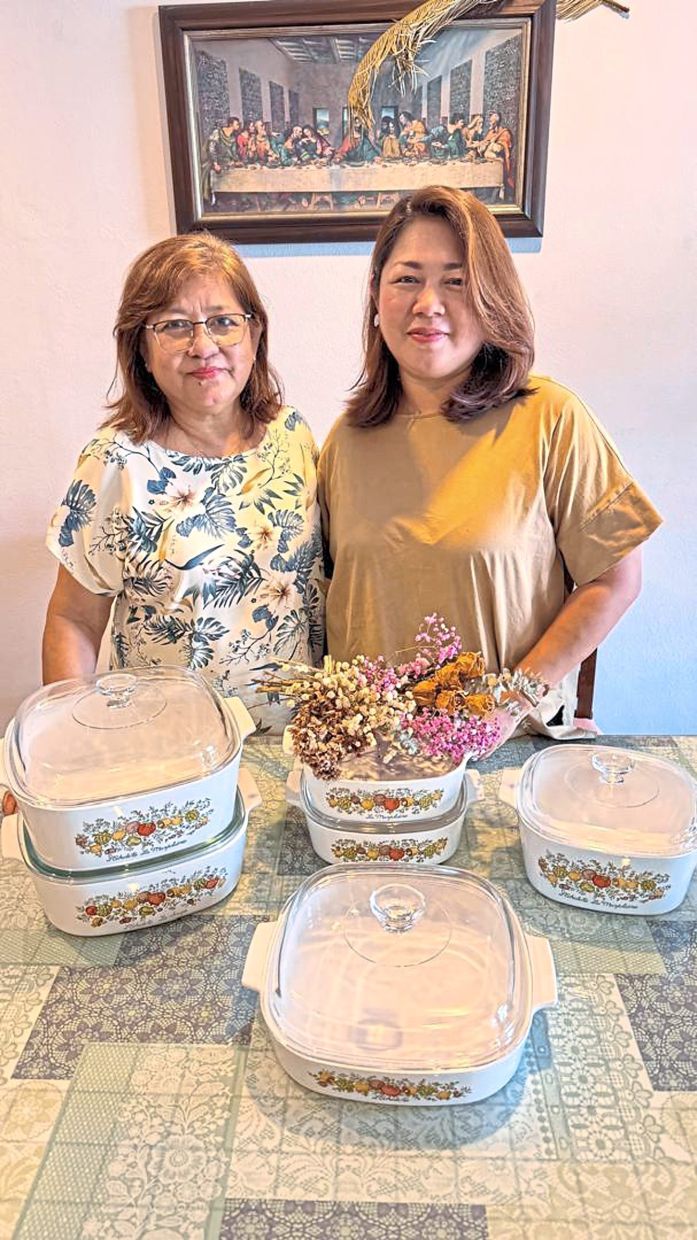
Site acquisition consultant Rachel Singam vividly remembers her mother’s pride in her CorningWare set. She recalls how her mother, Edwina Monteiro, 69, would tell her how hard she worked to buy the set.
“I did see my mum use it a lot. She was very proud of it not only because it was hard-earned, but because it was pretty,” says the 46-year-old, the older of two siblings.
When Rachel received her mother’s cherished Spice of Life collection as a housewarming gift, she was honoured and happy.
“That meant so much to me,” Rachel says, adding that she was keenly aware of the brand’s standing in the market.
Extensive collection
Noraini Mohd Nor, a 55-year-old retiree, knows very well how hard it was to collect what she has today at her home in Ampang, Selangor.
“I started collecting Tupperware when I first started working,” she recounts her journey. “Then, in my 30s, I moved on to Corelle, and by my 40s, I was in love with Portmeirion.”
Her collection grew slowly, almost piece by piece, often using her annual bonus or joining kutu savings circles to fund her purchases.
“The most meaningful to me is definitely my Tupperware collection. In the early 1990s, owning those plastic storage and serving containers meant you were pretty well-off,” says the mother of four children, aged between 33 and 20, with a chuckle.
These collections are on top of what she had received from her own mother. As the only child, Noraini had the privilege of inheriting everything her late mother had.
But when it is her turn to continue the family tradition, Noraini says she has faced some resistance.
“My children don’t want them. They prefer electrical appliances as wedding or housewarming gifts. They say those item are more useful,” Noraini shares.
“As for dinnerware, they prefer something simple and plain, my collection is seen as ‘vintage’,” she says.
Noraini was sad at the response at first, but she also accepts generational preferences in style and taste, and acknowledges their reasons.
“For them, the collection takes up space. They live in condominiums with limited storage areas. And these days, young people lean towards modern designs that are lighter and simpler,” Noraini says.
Still, the grandmother of five remains hopeful. “I told my youngest that I will pass down every dinnerware collection to her when she gets married. Pick what you like, take care of them and donate the rest if you must,” she adds.
Timeless treasure
Mary says it’s completely natural for each generation to evolve in terms of taste.
“My daughter’s preference in tableware is different from mine, and there is access to a wider selection now,” says the mother of two, aged 42 and 37.
For her, the shift is simply a matter of aesthetics, with younger generations favouring plain and minimal design over the popular floral prints of the 1980s.
However, Mary is happy that her classic tableware collection still makes a special appearance during family functions and festive celebrations.
Despite the difference in tastes between her and her children, Noraini strongly believes tableware collections like hers are still relevant in modern homes.
“These collections still have their loyal fans, and have been attracting new fans from the younger generation too,” she adds, “especially for those who take them as more than just crockery.”
Rachel agrees that heirloom tableware still holds significant relevance, “especially because I am really close to my mum, and I inherit a lot of her cooking recipes too.”
For her, the pieces are sentimental collectibles which are also functional. As a collector of glassware herself, specifically Visions Cookware, Rachel says her mother’s CorningWare fits perfectly into her home.
“It complements my collection of Visions and Noritake, to be honest, and it will be a conversation topic at the table,” says the mother to an 18-year-old daughter.
And when it comes to passing on the collections to her daughter, Rachel replies with a conviction: “Yes, that’s the plan.”
At Mary’s home, the tradition continues, starting with making traditional festive treats together with her daughter, using the moulds.
“I hope my granddaughter continues this (tradition) as well,” Mary says, adding that her two children accept her heirloom tableware wholeheartedly.
“I hope the collections remind them of our times together and that they continue to create happy memories with generations to come,” she concludes.
