



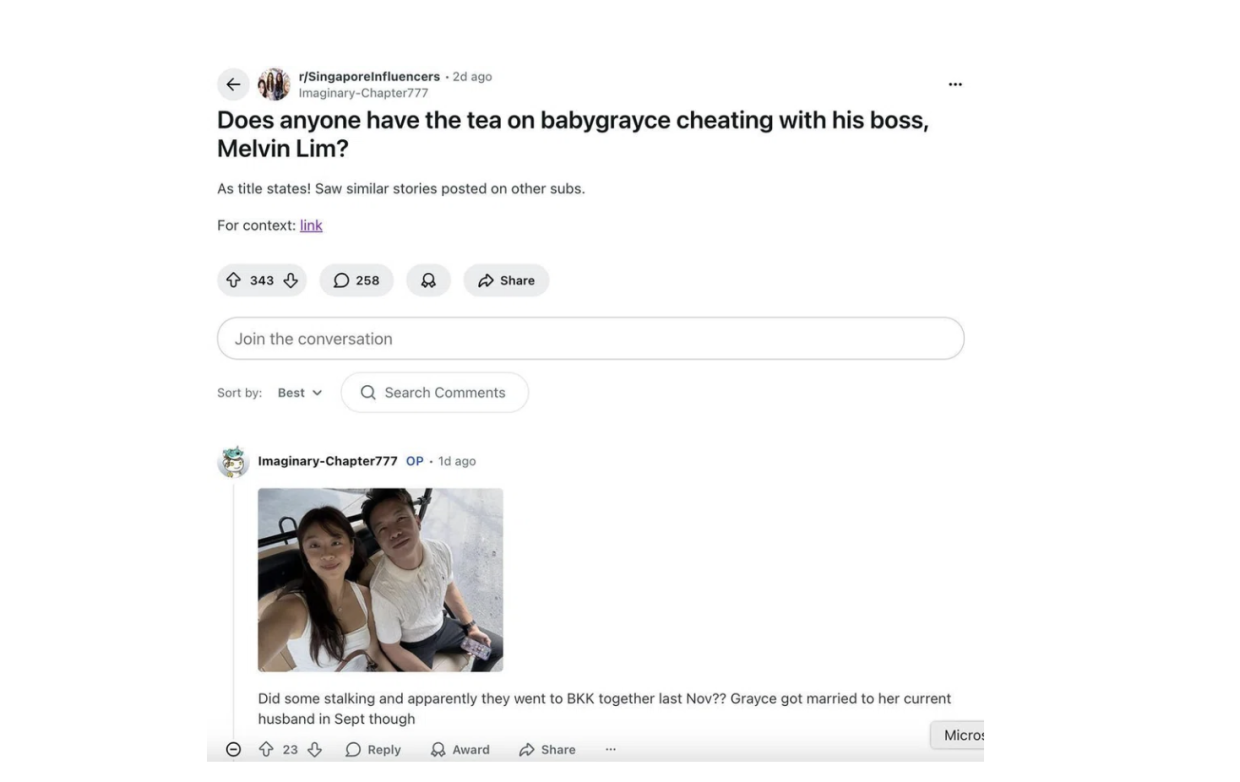
On Jan 25, a user on Reddit’s r/SingaporeInfluencers forum posted about speculation they had seen on other forums, asking: Are property agent Melvin Lim and influencer Grayce Tan having an affair?
Within hours, users had pored over every detail of their extensive online presence.
Users posted pictures of the pair on holiday. Some dug up negative Glassdoor reviews for their company – Lim is co-founder of real estate agency PropertyLimBrothers and Tan is the company’s vice-president for strategy.
Lim’s showflat videos often garner more than 20,000 views. Tan has over 190,000 followers on Instagram.
Others posted pictures of their spouses, links to Lim’s past preaching on a local Christian blog and Tan’s wedding photos. A few pointed users to a six-minute video that ends with Lim and Tan leaving an office together.
A day later, a user posted a screenshot of a private WhatsApp message allegedly sent by Lim to his company workers. By Jan 27, speculation and criticism had spread well beyond Reddit and onto the HardwareZone Forum, Facebook pages and Mothership.
The Straits Times has reached out to PropertyLimBrothers for comment.
Influencer cheating scandals, overinflated claims of wealth, out-of-touch language and whether influencers behave in private the same way they do in public.
These are just a few of the many concerns that occupy the users of r/SingaporeInfluencers, a Reddit forum self-described by its creators as “a real look at Singapore’s influencer culture”, which has 46,000 weekly visitors.
This is also snark and tea-spilling culture in action, a growing sub-genre of social media content that is increasingly where controversies around influencers and celebrities surface, before they enter the mainstream.
Tea-spilling refers to sharing gossip, and not always in ways related to celebrity culture.
In 2021, a short-lived tea-spilling Telegram group was created by Singapore women to warn one another about errant men in the dating scene, before it was deleted after backlash.
In contrast, snark communities centre on gossiping about the lives of celebrities.
While criticism of influencers exists on every social media platform, snark communities often arise on Reddit as there are few other alternatives for discussion-oriented communities to form at scale.
In the United States, Los Angeles-based r/LAinfluencersnark and New York City’s r/NYCinfluencersnark communities have 1.5 million and 445,000 weekly visitors respectively.
Some snark communities also form around specific individuals.
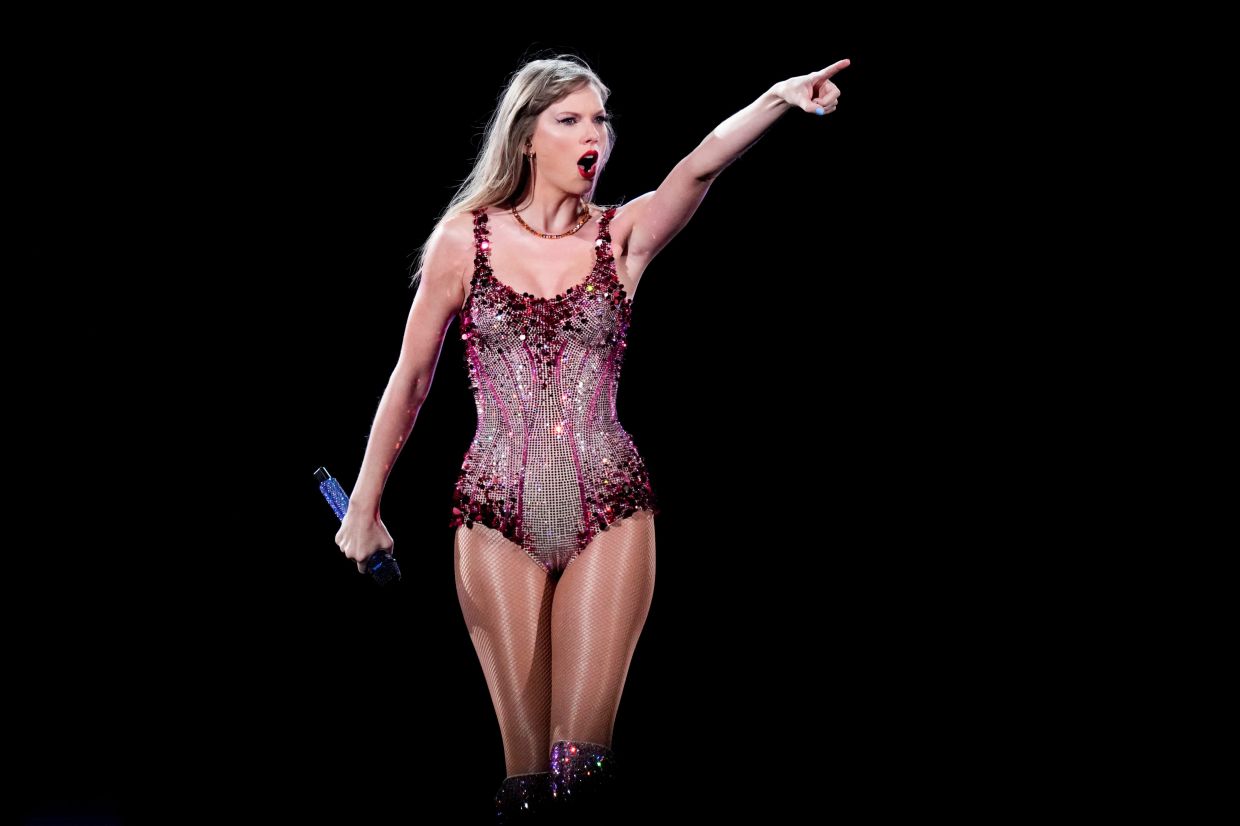
Haters of American pop star Taylor Swift assemble on r/Travisandtaylor, while critics of the Kardashian-Jenner celebrity clan – who describe themselves as “Kardashian Jenner Cynics” and “Kritics” – post on r/KUWTKsnark.
Even niche creators on TikTok and YouTube can have their own dedicated snark communities.
Although gossip is often described in feminine or subversive terms – for example, “spilling the tea” is a phrase that originates from queer black culture – it is also a universal social experience.
Evolutionary psychologists have long argued that gossip is a useful form of social bonding, by enforcing social norms, building trust between members of an in-group, and identifying free riders and bad actors.
“Were we not able to engage in discussions of these issues, we would not be able to sustain the kinds of societies that we do,” writes British psychologist and anthropologist Robin Dunbar in a 2004 study published in the Review of General Psychology.
He adds: “That it can be carried to extremes may be a matter for regret, but this should not distract us from the central issue that gossip (in its broadest sense) is the central plank on which human sociality is founded.”
An analysis by Columbia Journalism Review in 2024 finds that snark communities often call out influencers for deceptive marketing, undisclosed financial interest in the products they are selling, and shallowness and superficiality.
These are questions that increasingly occupy the minds of social media users, at a time when influencers are at their cultural peak. A 2023 analysis by Goldman Sachs estimates that the global creator economy was worth US$250bil. Brand deals are the largest source of income for creators.
However, snark culture often has a darker edge. Criticism frequently veers into cruelty, as users pick apart a public figure’s weight, dating life and family – in ways that disproportionately target women and their appearance.
“That is one ugly chick,” writes one user in response to a post on r/SingaporeInfluencers. “Fat and flat,” writes another.
On Singapore’s snark community, the most-upvoted posts are those asking for tea (gossip) about specific influencers, and there is often an invasive quality to the way such information is solicited.
“Asking out of genuine curiosity, not trying to start drama or accuse anyone,” writes one user. “Does anyone have first-hand impressions or publicly observable tea about” person A and person B, “especially regarding how private they are off-screen?”
Snark communities are also far from rigorous.
“They rarely do more than surface-level investigation,” writes the Columbia Journalism Review.
“Users don’t often dig up new information; instead, they practise a kind of open-source inquiry, finding things an influencer might have said once before but not regularly acknowledged in their public profile.”
While real-life gossip entails an exchange of information between people who know each other and can evaluate the credibility of claims based on personal history, the online world is a different story. Personal anecdotes are often posted by anonymous users that are impossible to verify.
The result often emphasises spectacle and personal projection.
In the wake of the alleged Lim-Tan scandal, Reddit users have been picking apart and discussing the appearance of Tan’s husband, relative to Lim.
Some have pulled up past videos from the pair to dissect further, while others use it as a launching point to discuss the prevalence of infidelity and dishonesty.
For snark communities, anything – and everything -– is fodder. - The Straits Times/Asia News Network
