Beyond the festive flourish of red paper couplets bearing auspicious characters, Chinese calligraphy is anchored in rigour, patience and sustained discipline.
Each brushstroke shapes a character, yet the act extends far beyond manual movement. It demands control of breath, steadiness of posture and acute sensitivity to structure; a single lapse can unsettle an entire composition.
Ng Swee Kheng, the president of the Federation of Calligraphy Society Malaysia, said mastery rests on consistent training and long-term dedication, as every character carries its own architecture and technique.
“Calligraphy must be practised regularly. If you stop for a long period, the hand loses its fluency. I began learning at 15 and, to this day, still devote four to five hours daily to practice,” he said when met at a demonstration session during the 2026 Titih Pusaka Festival organised by the National Academy of Arts, Culture and Heritage (Aswara).
He emphasised that discipline is essential to ensure the art form endures and remains meaningful within Malaysia’s multicultural society. Growing interest, he noted, is reflected in large-scale gatherings such as the Kuala Lumpur World Calligraphy Carnival 2024 and the 2026 National Huichun Calligraphy Convention, which drew thousands of enthusiasts from diverse backgrounds.
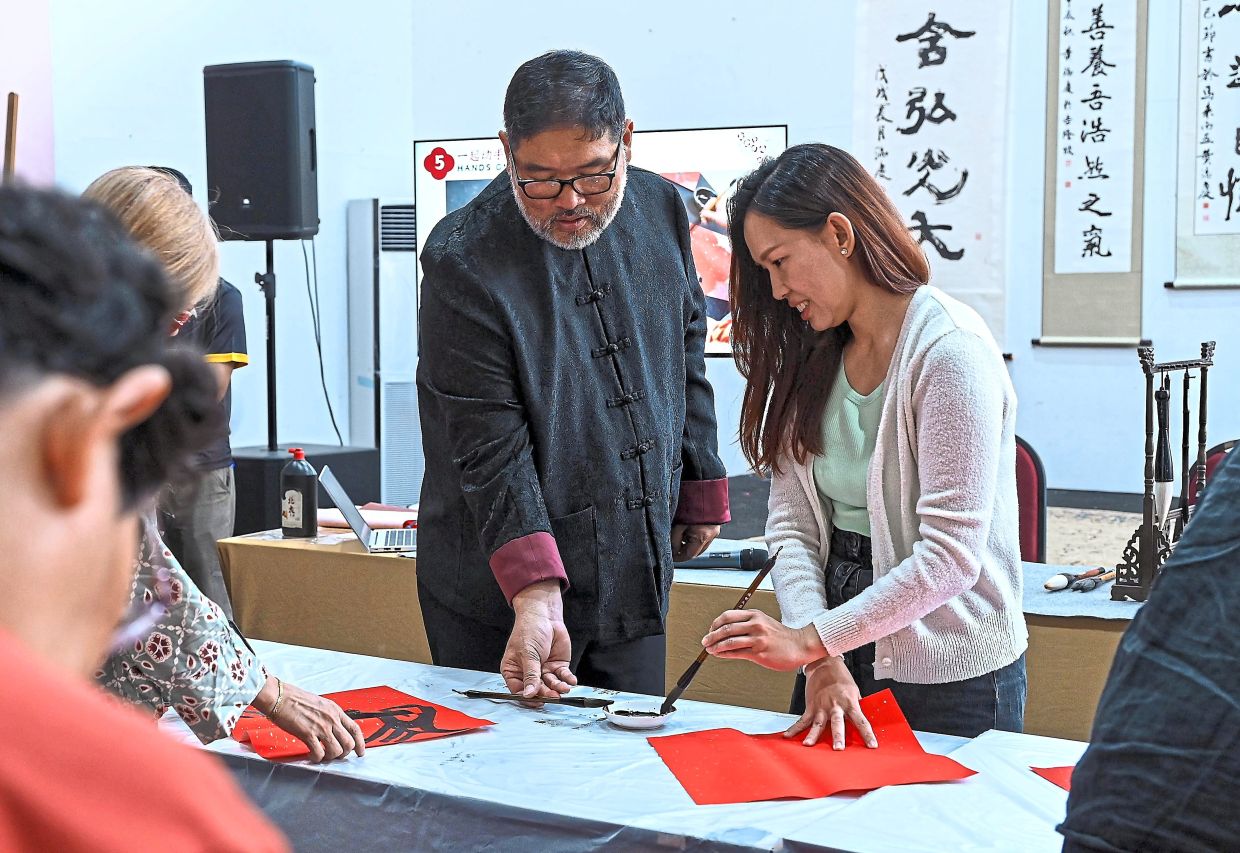
“Our aim is to position writing – whether Chinese, Roman, Jawi or Tamil – as a shared heritage for all Malaysians,” said Ng, who has more than four decades of experience.
Encouraged by the response, his team plans to stage a special exhibition in conjunction with the nation’s 70th National Day to highlight calligraphy’s diversity as a symbol of unity.
“I hope people of every race will come together to write the Merdeka theme. Calligraphy no longer belongs to a single community, it embodies the Malaysian spirit,” he said.
Chinese calligraphy in Malaysia, he added, has developed a distinct identity through the integration of local elements such as batik motifs and Malay poetry. He once translated works by the late National Laureate Datuk Usman Awang into Chinese and rendered them in calligraphic form for overseas audiences.
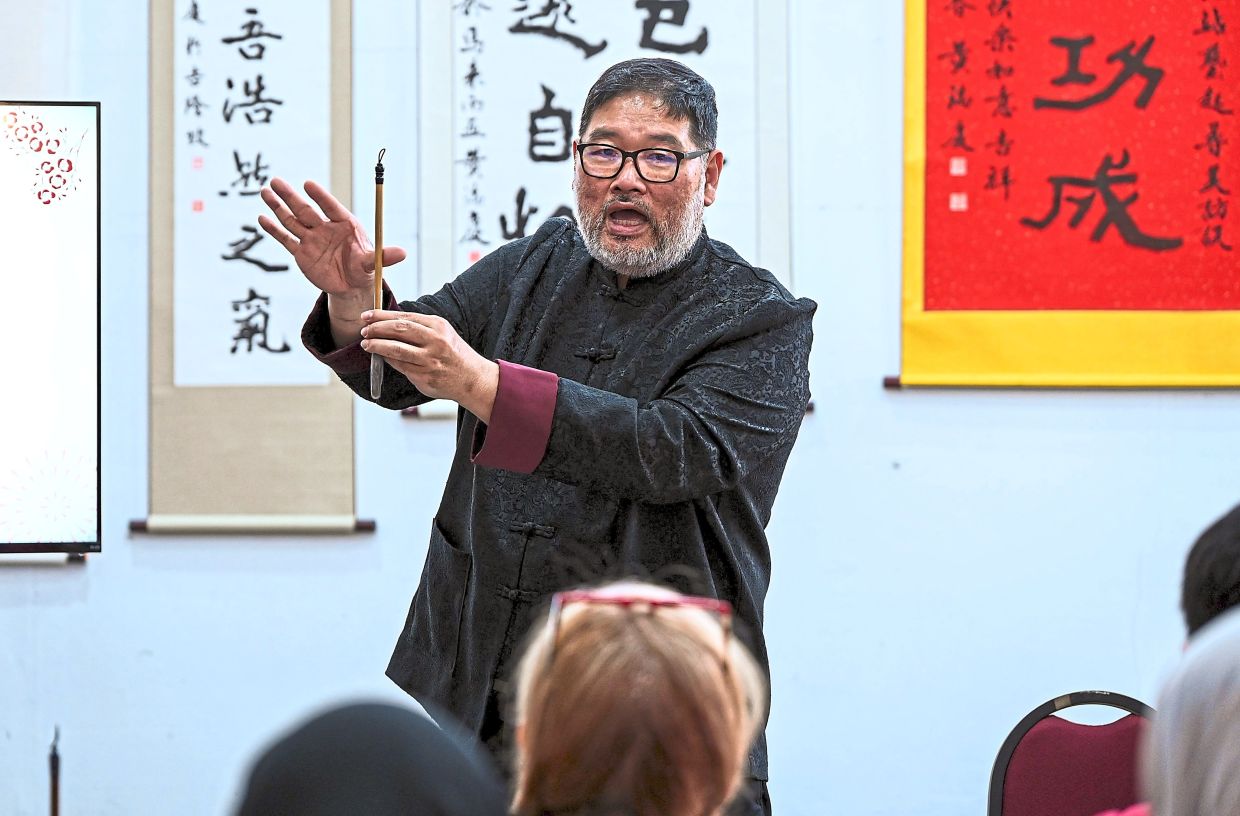
“When the pieces were exhibited in China, viewers asked why the style differed from that of the Qing or Tang dynasties. I explained that the text was a Malay poem in translation – that difference is precisely Malaysia’s identity,” said Ng.
Workshop participant Gunasegar MKK Wologanathan, 61, described his involvement as an opportunity to engage with another cultural tradition.
“This is my first experience with Chinese calligraphy, and I am pleased to learn something new. It can be embraced by anyone and serves as a bridge for cultural understanding,” he said.
Amina Alia Mohd Syukri, 21, a student at the Malaysian Institute of Art, said the practice warrants preservation for its heritage and aesthetic value.
“I was drawn to calligraphy as a child while studying in a Chinese school. When I saw the workshop, I felt compelled to return to it after many years,” she said. – Bernama