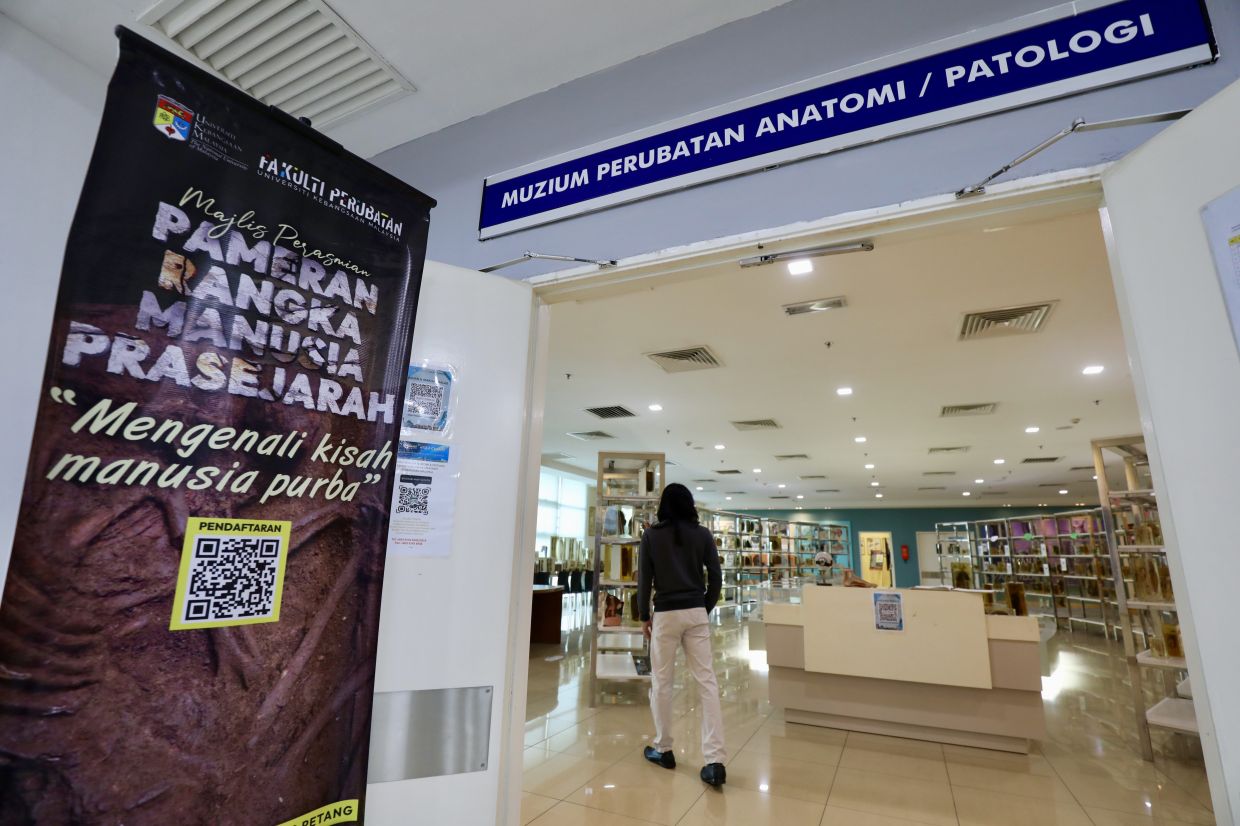
Prehistoric skeletal fragments dating back nearly 10,000 years have been unearthed, offering valuable insight into the earliest chapters of human history in Malaysia. Meticulously cleaned and studied, these remains are now presented to the public at the Museum of Anatomy and Pathology, Faculty of Medicine, UKM building, which is located in Hospital Canselor Tuanku Muhriz (HCTM) of Universiti Kebangsaan Malaysia (UKM), Bandar Tun Razak, Cheras in Kuala Lumpur.
The exhibition Prehistoric Skeleton Exhibition (Pameran Rangka Manusia Prasejarah) is free admission and open week days from 9am to 4pm, with visitors encouraged to make an appointment via the website.
Designed as an educational platform, the exhibition provides visitors with the rare opportunity to examine the remains at close range and to reflect on what they reveal about prehistoric life and the development of the land we now know as Malaysia.
Head of the Research Team at the Faculty of Medicine, UKM, Professor Dr Ima Nirwana Soelaiman, together with her team, found that there are few anatomical differences between the prehistoric remains and modern humans, noting strong similarities in their morphological features.
“We conducted our analysis using non-destructive imaging methods to ensure the optimal preservation of these invaluable remains. Techniques such as Dual-Energy X-ray Absorptiometry, Computed Tomography, and micro-CT enabled us to examine the internal structure of the bones without causing any damage,” said Dr Ima at the exhibition’s opening earlier this week.
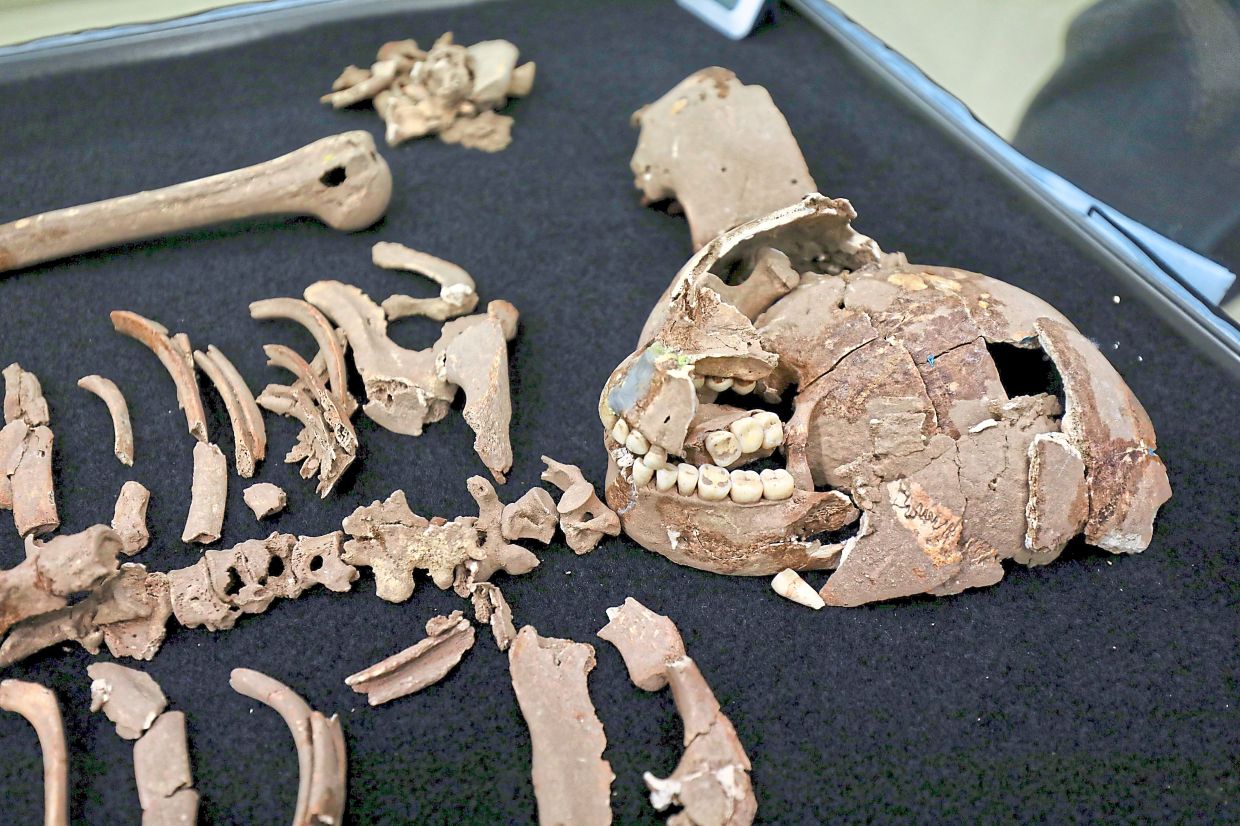
“The work was not without its challenges; some skeletons were incomplete, and fragments were too damaged for certain tests. However, the density and internal microstructure of the bones of these prehistoric humans were comparable to modern humans in the region. Their size, shape, and estimated height also showed strong similarities with the current local population," she added.
Building on this physical profile, further analysis was able to pinpoint when these individuals lived.
“Carbon-14 dating analysis revealed that the remains on display date back between 7,000 and 9,200 years. The determination of gender and estimated age at death was conducted by Dr Nor Atika Md Ashar, a forensic odontologist from the Faculty of Dentistry, UKM. Her findings indicate that the skeletons comprise one woman and three men, all aged between 25 and 40 years,” she said.
The exhibition is currently displaying the remains of the female and two males.
A race against time
The skeletons on display represent a portion of a significant archaeological assemblage recovered from the Nenggiri Valley in Kelantan under urgent circumstances.
These remains were retrieved through rescue excavations initiated in 2022, ahead of the construction of the Nenggiri Hydroelectric Power Plant reservoir, scheduled for completion by mid-2027.
The creation of the reservoir will flood the valley, permanently submerging numerous caves of archaeological significance.
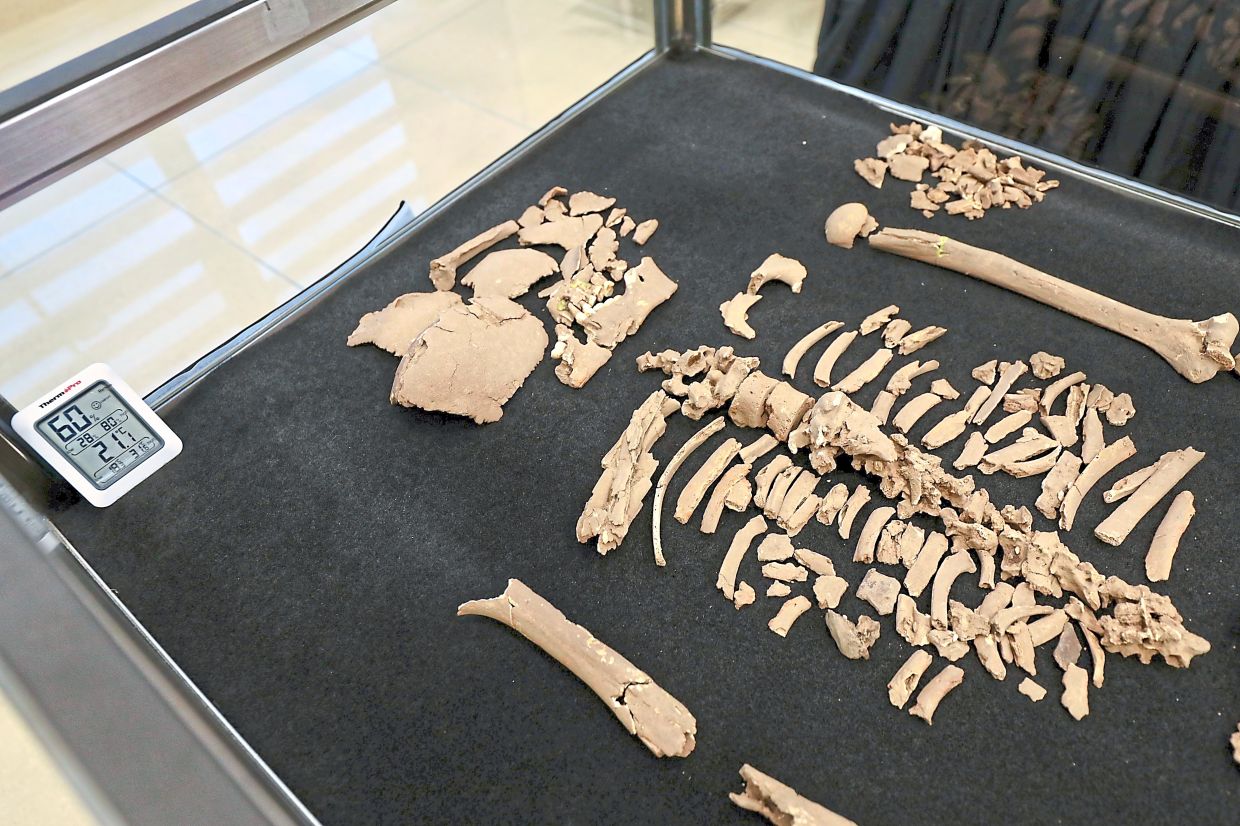
The recovery efforts were led by Assoc Professor Dr Zuliskandar Ramli of UKM’s Institute of Malay Nature and Civilization, in collaboration with the National Heritage Department. The teams successfully recovered a total of 16 individuals from four caves: Gua Cha, Gua Peraling, Gua Keledung Kecil, and Gua Chawan.
Dr Zuliskandar notes that the recovered remains provide important evidence that the Nenggiri Valley was part of the broader Hoabinhian and later Neolithic cultural traditions of South-East Asia.
“Most skeletons were buried in a fully flexed position, typical of pre-Neolithic hunter-gatherer groups. One skeleton, however, was found in an extended position and is stratigraphically dated to a later Neolithic period, approximately 6,000 years ago. The oldest burials in the valley are estimated at 14,000–16,000 years old, ranking them among the earliest known human remains in Peninsular Malaysia,” said Assoc Professor Zuliskandar.
In addition to skeletal remains, ancient artefacts – including stone tools, pottery fragments and ornaments – were recovered, indicating deliberate intra-cave interment practices.
“The presence of worked stone fragments and chipped artefacts points to tool production and use consistent with hunter-gatherer economies. The inclusion of items such as red ochre (hematite) and crystals in graves suggests symbolic or ritual practices associated with burial rites. Neolithic burials, which included pottery and polished tools, reflect technological shifts aligned with emerging sedentary or semi-sedentary lifestyles,” he said.
From an archaeological perspective, these discoveries are pivotal, providing insights into the Nenggiri Valley region as a significant and long-inhabited prehistoric cultural zone in South-East Asia.
While Perak Man, discovered in the Lenggong Valley in Perak in 1991 and dating back over 11,000 years, remains the oldest and most complete skeleton in the region, the Nenggiri Valley findings add crucial depth and breadth to the narrative. They demonstrate that human activity in Peninsular Malaysia was not isolated but part of an enduring cultural continuum, offering a view of the region’s ancient inhabitants.
“Given the reservoir’s construction timeline, ongoing efforts focus on the conservation and analysis of the recovered remains and artefacts, as well as the publication and academic interpretation of the findings.
"A gallery in Gua Musang will be established to exhibit artefacts from all 13 sites, ensuring these discoveries are accessible to both the public and researchers,” he concluded.