The British Council’s Connections Through Culture (CTC) programme has named eight Malaysian arts projects among its 2025 grantees.
Aimed at supporting a new wave of artistic collaborations between Britain and international partners, the programme is funding 127 projects in total globally this year, channelling over £1.1 million (RM6.2mil) to the selected projects.
Last year, the programme awarded over £741,000 (RM 4.1mil) across 11 countries in the Asia Pacific region, supporting 84 collaborations.
Among the Malaysian projects picked are Cipta Seni Incubator: Untold Stories, a mentorship programme empowering performance artists from Malaysia’s marginalised communities to develop and showcase their work, Disappearing Voices Of The Lotud High Priestesses, a bilingual short film preserving the endangered ritual poetry of the Lotud indigenous group in Sabah, and Sabah’s Future Climate Chronicles, a digital simulation merging climate data with indigenous storytelling to raise awareness of climate change.
On the subject of heritage trades, a collaboration between Kuala Lumpur’s Lostgens’ – a vintage printing press studio and art space – and Sheffield’s C & G Artpartment offers an exchange-residency connecting artists and communities through printmaking.
"Each of the 2025 projects tells a story of artists finding common ground, experimenting, and creating something new together.
These collaborations remind us that the arts thrive on mutual exchange and that when people connect across cultures, they create work that resonates far beyond their own communities," says Florence Lambert, Head of Arts, British Council Malaysia.
First launched in the Asia Pacific region, the CTC programme’s 2025 cohort welcomes grantees from Europe and South Asia, with Nepal joining the programme for the first time this year. This expansion means more artists than ever can connect with, exchange knowledge, and co-create projects with British partners that celebrate cultural diversity and explore shared futures.
"What makes Connections Through Culture so special is the diversity it brings together. Different traditions, ideas, and artistic practices converging to create something new," says Ruth Mackenzie CBE, British Council Director of Arts.
"With its expansion, the programme connects even more voices and communities, strengthening the role of arts in fostering peace, trust, and prosperity across borders,” she adds.
Fringe communities to skateboarding
One of the grantees from this year’s cohort is Cipta Seni Incubator: Untold Stories, where performance artists selected through an open call will go through a five-month programme developing one work/performance each, while networking and learning from global arts experts.
Launched last September, the inaugural Cipta Seni Incubator saw four Malaysian arts practitioners present their works-in-progress at Five Arts Centre, GMBB in Kuala Lumpur. Over four months, they took part in workshops and group as well as one-on-one virtual mentoring.
Cipta Seni Incubator co-founder Sharmilla Ganesan says she and fellow co-founder Tom Curteis, based in England, are thrilled to continue the programme.
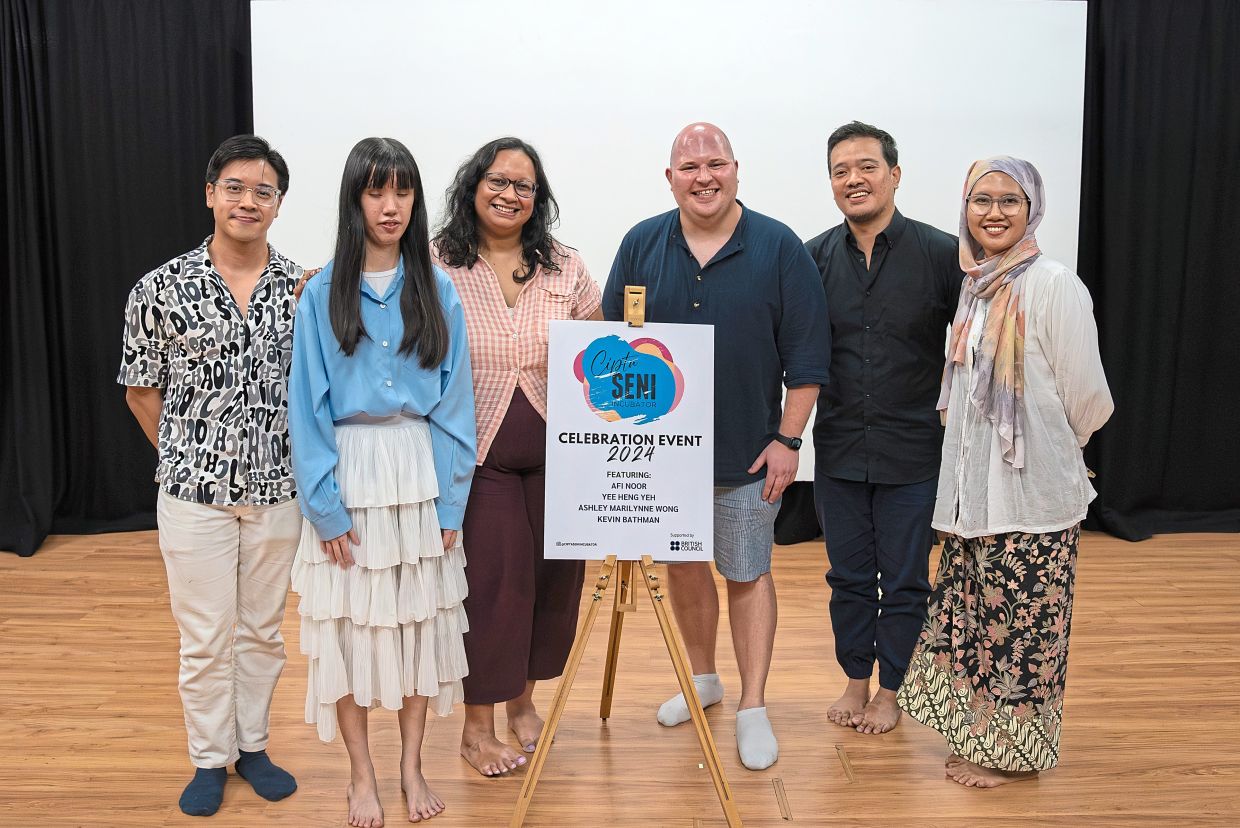
“We're really excited to receive this grant because it's validation that we did something right with the first edition of the Cipta Seni Incubator. Now, we're keen to take the incubator in a new direction, by focusing on artists and collectives working from marginalised positions – hence the name ‘Cipta Seni Incubator: Untold Stories’,” says Sharmilla.
The issue of continuity has been central to the Cipta Seni Incubator’s journey.
For Curteis, the support opens new ways to shape the programme’s second edition – nurturing emerging performance artists and strengthening exchanges between British and Malaysian partners.
"This year, we’re especially excited to engage artists who are creating and making from the margins, and we’ll be exploring what that means across different contexts and communities,” he adds.
Another project, "Bridging Futures for Skateable Cities – Civic Space", explores how skate culture connects to the regeneration of the city centre and the future of skateable urban spaces through conversations with the skateboarding community in Plymouth, England.
Sabahan artist-researcher Harold Egn Eswar, or better known as Egn, is partnering with Plymouth’s community arts group Take A Part to reimagine cities as open, playful spaces shaped by their residents.
Egn, an early member of the Kota Kinabalu street art collective Cracko Art Group and recognised for blending architecture and contemporary art, says the project aims to map skaters’ daily lives and highlight the challenges faced by them and other wheeled users navigating the city.
“The mapping project will then be submitted as a memorandum to the Plymouth city council to get their attention and hopefully address the issues highlighted. The project will need a lot of interviews to collect data, so a by-product of the data-collecting process is a podcast, which will be published as a means of documenting this oft-misunderstood urban culture," says Egn, a town planner with the Kota Kinabalu City Hall (DBKK).
Last year, he exhibited his Spatial Biography Documentation series at the 11th Asia Pacific Triennial of Contemporary Art in Brisbane, Australia.
“I grew up in a small community (Keningau) that’s located far away from the big city of Kota Kinabalu, so I felt like I had very little space to express myself in a social context. But when I started hanging out with skateboarders, I felt accepted, like there was no judgement," says Egn.
"This is why I wanted to document their existence in an art form that can also be an academic document, to make it clear that the community is just another part of society and that they mean no harm,” he concludes.