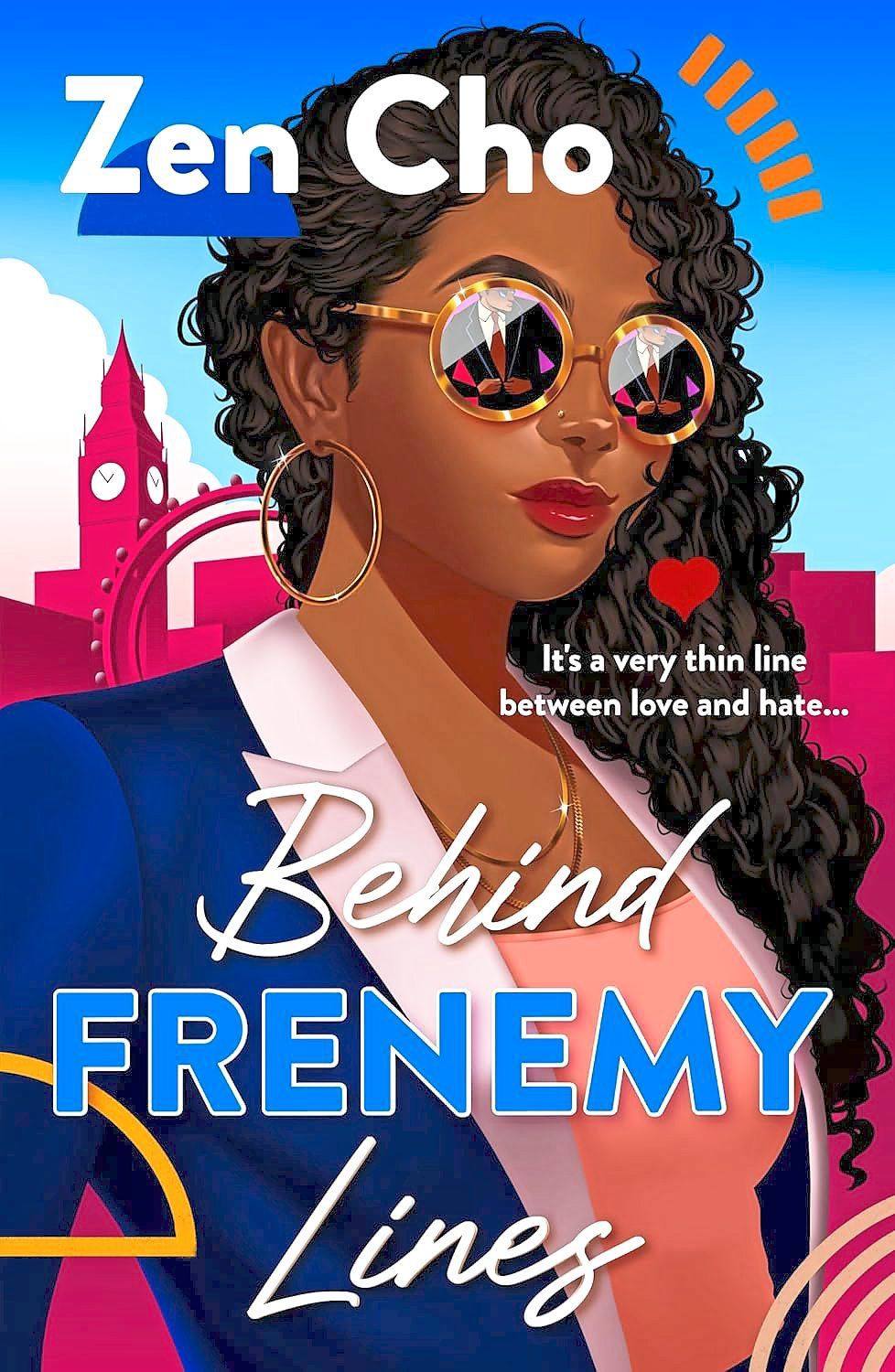
What would you do if your so-called “bad luck charm”, who always happens to be present whenever something embarrassing happens to you, suddenly becomes your office mate?
That’s what London-based lawyer Kriya Rajasekar faces on her first day at a new law firm. The office mate in question, Charles Goh, isn’t exactly pleased, either. Staid and by-the-book, Charles finds his carefully balanced life upended with Kriya’s appearance.
When her recently divorced boss begins to make unwelcome overtures, Kriya enlists Charles’ help to fend him off – by pretending that they’re dating. As they’re forced to keep up the pretence around friends and family, Kriya and Charles grow closer and the line between them becomes blurred.
Are they rivals, colleagues, friends ... or something more?
Malaysian author Zen Cho, who resides in Britain, spills all the details about her latest book, Behind Frenemy Lines, in a recent interview in Petaling Jaya.
Behind Frenemy Lines is your second romantic comedy, following last year’s The Friend Zone Experiment. Did you find the writing process easier this time around?
Every book presents its own challenges, but I think I had a better grasp on the genre conventions and reader expectations this time around, so you could say it was easier.
The Friend Zone Experiment was inspired by popular K-drama tropes, whereas Behind Frenemy Lines follows more classic rom-com tropes. I’ve always thought that a rivals-to-lovers romance would be fun to work on. And as someone who’s worked in a London law firm before, I figured it would be easier to write one in the same setting.
That said, both books are set in the same “universe”, so those who’ve read The Friend Zone Experiment will find some familiar plot points and characters. There’s a subplot in the book involving a political scandal that was partly inspired by a case I worked on where a Central Asian bank was suing its former chairman for the billions of dollars that he had embezzled from them.
Then when the 1MDB case broke out, it led me to think, “What would I do if someone involved in such a case approached my firm and wanted us to represent them?” So that part of the plot came about because of that question.
Your lead character, Kriya, is a Malaysian Indian. How did you approach writing from her point of view?
From the start, I knew I wanted the story to focus on minorities working in London. I decided that one was going to be of British Hong Kong background, and the other would be Malaysian Indian. I know people from both backgrounds, so they felt familiar in a way, but they also felt a bit different from what I’ve done before in my books.
Kriya is Indian and I’m not, so while there were concerns about whether I was going to get something wrong or offend someone, I believe that you can’t approach writing a character from a place of fear. Instead, I drew from my own experiences and found common ground between that and the character, putting myself in their shoes. I basically wrote Kriya as though she’s one of my friends.
Another thing that was different from what I’ve done before was that I had beta readers, because I wanted to make sure I got Kriya’s perspective right. Their comments and feedback were very helpful.
For example, in the original draft, I made a classic error where I kept going on about Kriya’s minority status and how she felt about it.
So one of the beta readers made a comment along the lines of, “While this is well-intentioned, it doesn’t have to be a manifesto of the wrongs done to minorities. It can just be a fun book and Kriya can just be a person.” So I scaled that element down in subsequent edits.
You mentioned that you drew inspiration from your experience as a lawyer. How true to life is the new book?
I drew directly from my experience as a lawyer in London, where I worked for 11 years. Part of it was because I’m not a very fast writer and had a really tight schedule that I wanted to stick to, so it was simply easier to pull from my real-life experiences, where I didn’t need to do research.
Several things that happened in the book actually happened to me, like in Kriya and Charles’ first meeting, where she falls on her behind in front of the firm’s offices on the way to an interview and it turns out she was at the wrong building. Or the time she accidentally rolled a cart laden with documents over someone’s foot in court. There’s also an incident where Charles bluntly delivers bad news to a client, almost like an afterthought, but it shocks the client to the point that they almost crash their car.
Let’s talk a bit about Charles, Kriya’s love interest.
A lot of people who have read the book have come up to me and said that they really liked Charles. He was a fun, quirky character to write. It wasn’t explicitly stated in the book, but several people have commented that Charles is clearly on the spectrum.
Where that comes from is the fact that I’ve been a part of the sci-fi-fantasy fandom for quite some time – I go to conventions and I used to write fan-fiction – so I’ve got quite a few autistic friends, and I wanted to include bits and pieces of them.
Another part is that Charles reflects my own pedantic, lawyerly side, so I wanted to put that in contrast to Kriya, who’s not such a stickler for rules and is way more socially confident. They’re kind of an odd couple, and while they have different personalities, once they get to know each other, they discover that they also have a lot in common.
One commonality they share is that they grew up in environments where they were kind of devalued.
Charles went to this posh boarding school, but he was bullied because his background wasn’t quite the same as his schoolmates, while Kriya, who is dark-skinned and curvy, grew up in Ipoh, where there are mostly Chinese people, and had to face a lot of negative comments about her body.
I wanted to show two people finding each other and seeing the best version of themselves despite having come from environments where they weren’t really seen or accepted.
Though it’s set in London, the book is very Malaysian, from the references it makes to the language it uses. What do you think about South-East Asian representation in rom-coms?
When it comes to internationally published books, it’s a small field, but it’s growing. There’s Lauren Ho and Jesse Q. Sutanto, for example. I think the popularity of Crazy Rich Asians helped open up a space for more stories coming from South-East Asia.
But there’s definitely still room for the genre – and for every genre, really – to represent the full diversity of the region. I suppose one thing that sets Behind Frenemy Lines apart is the foregrounding of a non-Chinese South-East Asian.
Are you planning to do more rom-coms?
This was a two-book deal and I’m currently working on a historical fantasy, so not at the moment. These books were actually an unexpected diversion, but they were a nice break from writing fantasy, which typically requires a lot of research. During the pandemic, I was busy juggling young kids and still working as a lawyer, so writing-wise, I needed something that wouldn’t take up as much time. But I’d definitely like to write more romances in the future.
Behind Frenemy Lines can be found in all good bookstores. More info: zencho.org.