This weekend marks the last chance to catch Reframe And Resist: Decolonise Here And Now! at Harta Space in Ampang, Selangor. Closing tomorrow, the exhibition offers a thought-provoking exploration of what decolonisation means in the context of everyday Malaysian life.
Backed by the British Council and The Living History Project, the exhibition – with six local artists – brings together installation, painting, collage and mixed media works – each shining a light on different aspects of the postcolonial experience.
For curators Rebecca Yeoh (Malaysia) and Leon Wainwright (Britain), the project is about the power of small gestures – gentle prompts that encourage visitors to pause, look, and listen a little differently.
“Decolonisation is a word that carries heavy histories and assumptions, yet it remains urgent. Reframe And Resist: Decolonise Here and Now! is our way of living with its complexity, allowing it to shape us rather than simplifying it,” outlines an exhibition statement.
“This is not a manifesto. It is an invitation to slow down, to feel, to learn, and to imagine new histories together. If that modest approach can begin to reshape how we care for our stories, our land and our communities, then it will have already succeeded.”
Earlier this month, dancer and choreographer Aida Redza staged Ilmu, a performance inspired by traditional healing practices. She’ll return to Harta Space tomorrow (Sept 28) at 4pm to close the exhibition with another presentation of Ilmu – a work that reflects her love for drawing the audience into the performance and creating moments of shared experience.
Aida’s performance material, now showing at Harta Space, asks how we value knowledge – placing indigenous and lived wisdom on equal ground with formal systems of certification.
Anas Afandi, who hails from Taiping, Perak, has kept the momentum going since his debut solo show I Love God, Gold, & Glory in Kuala Lumpur last year. His latest series, Satu Cinta Satu Jiwa at Harta Space, pulls together paintings, digital prints and collages that mix critique with playfulness.
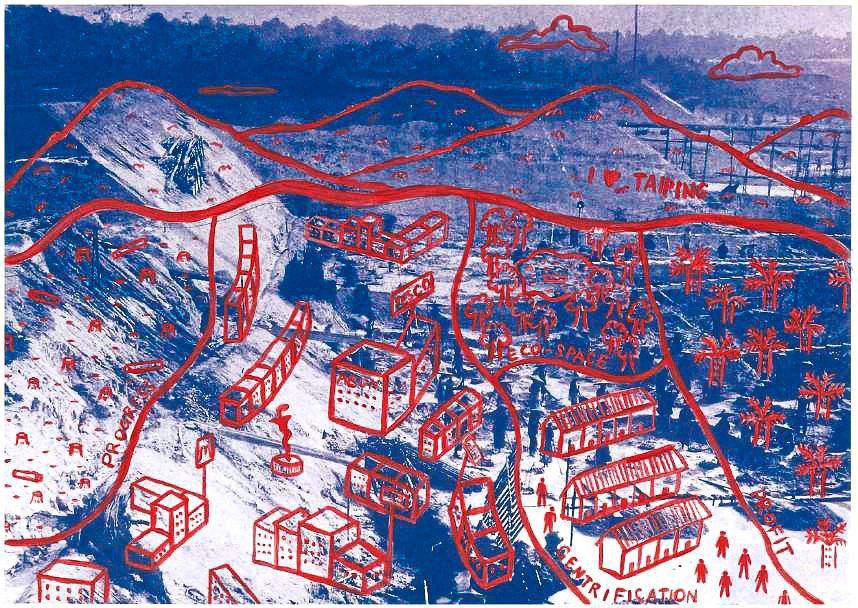
Looking at the “I Love ...” signage series scattered across small towns, Anas reimagines them as symbols of a society caught up in branding, consumer culture, and the rush of development – where everything, from love to identity, risks becoming just another commodity.
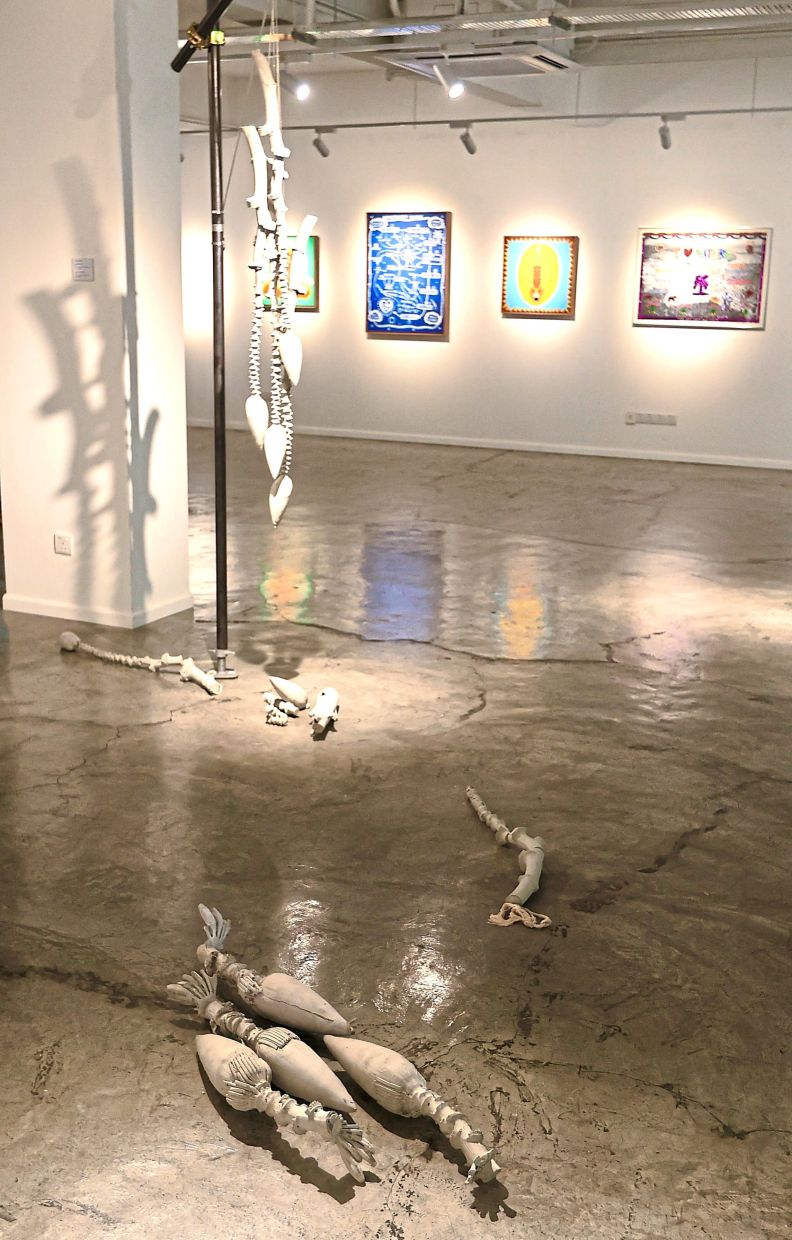
Multidisciplinary duo Koh Kai Ting and Aw Boon Xin – often known for their tech-based work – take a more grounded approach here, setting aside augmented reality to revisit the folklore of banana trees.
In their installation Post-Myth: Revaluation Of The Banana And Its Cultural Entanglements, they cast banana blossoms in cement, a gesture that speaks to the displacement of the Orang Laut community in Batu Pahat while linking local stories to wider struggles against domination and erasure.
Before the show ends, visitors can also spend time with artist/cultural activist Jakob van Klang’s Water Bodies 1-6 paintings, where he uses flowing patterns of ebru marbling.
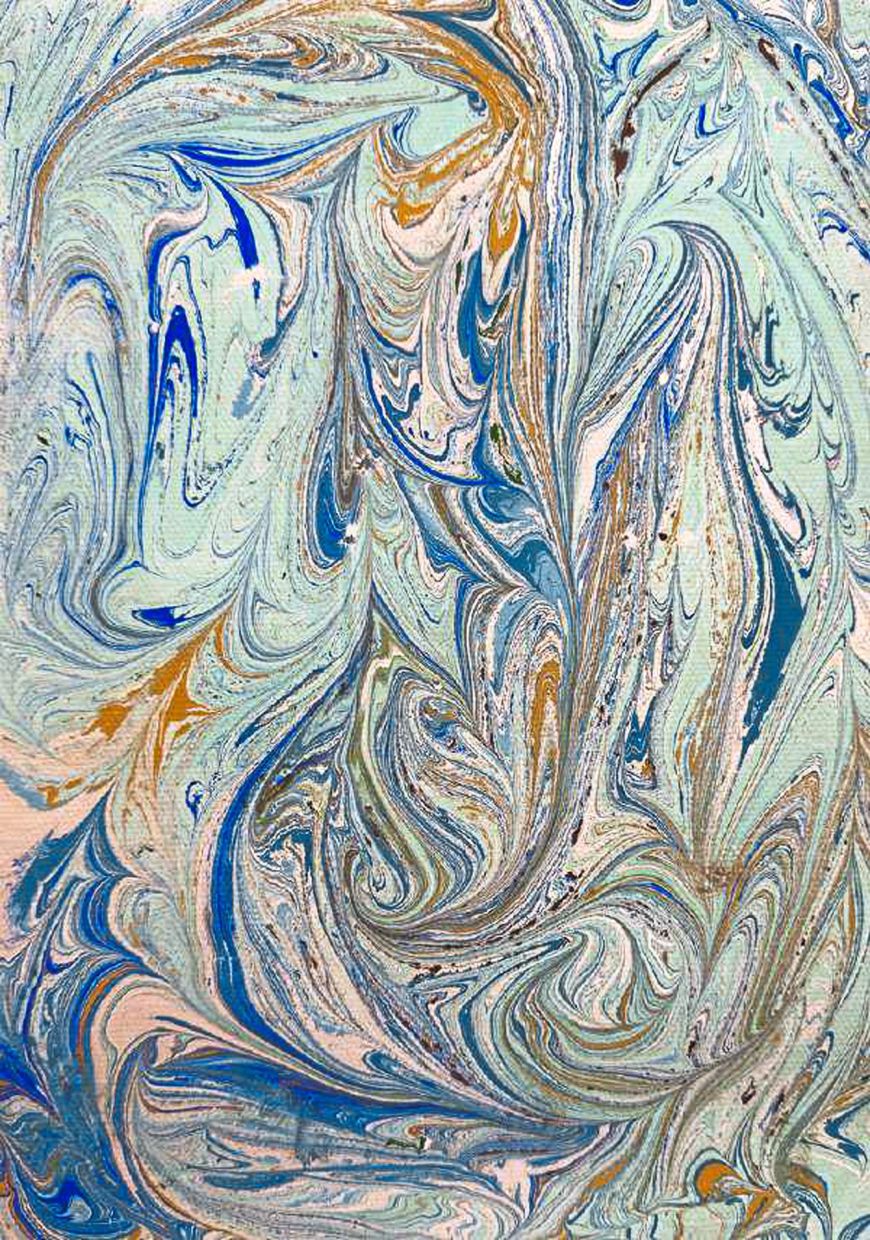
Van Klang’s series continues an exploration of rivers as living archives, carrying traces of both ecological change and colonial history. Originally proposed with pigments from polluted water, the works instead approach the idea through a process that embodies fluidity itself.
On the exhibition’s “small interventions” theme, artist-academic Roopesh Sitharan’s Qualifications takes a wry look at higher education by framing postgraduate certificates, prompting us to think about how colonial-era academic systems still shape what we see as success and cultural value.
Insightful and multilingual, his accompanying essay – written in English, Bahasa Malaysia and Tamil – is a highlight in itself, well worth a stop-and-read moment.
“I learned the very same alphabet during my formal education in Bahasa Melayu. At the same time, I was never exposed to the writing and reading of the Tamil script. In this ironic turn of fate, I cannot see outside the English alphabet. Consequently, it is not possible for me to read anything that is not in Latin letters, for it is the only marking I recognise,” writes Roopesh.
Like many of us, he admits he isn’t rejecting the qualification he earned – it’s simply the only one he has, and the only system he knows how to move within.
“Qualification – oh, how difficult you are. I cannot operate without you, yet I am bound by you,” he adds.
At Harta Space, the post-colonial tango and tangle is in full swing – and this dance isn’t stopping anytime soon.