Equipped with an infrared thermometer, Austrian artist Jonas Griessler measures the sweltering heat in an inner courtyard in the centre of Vienna.
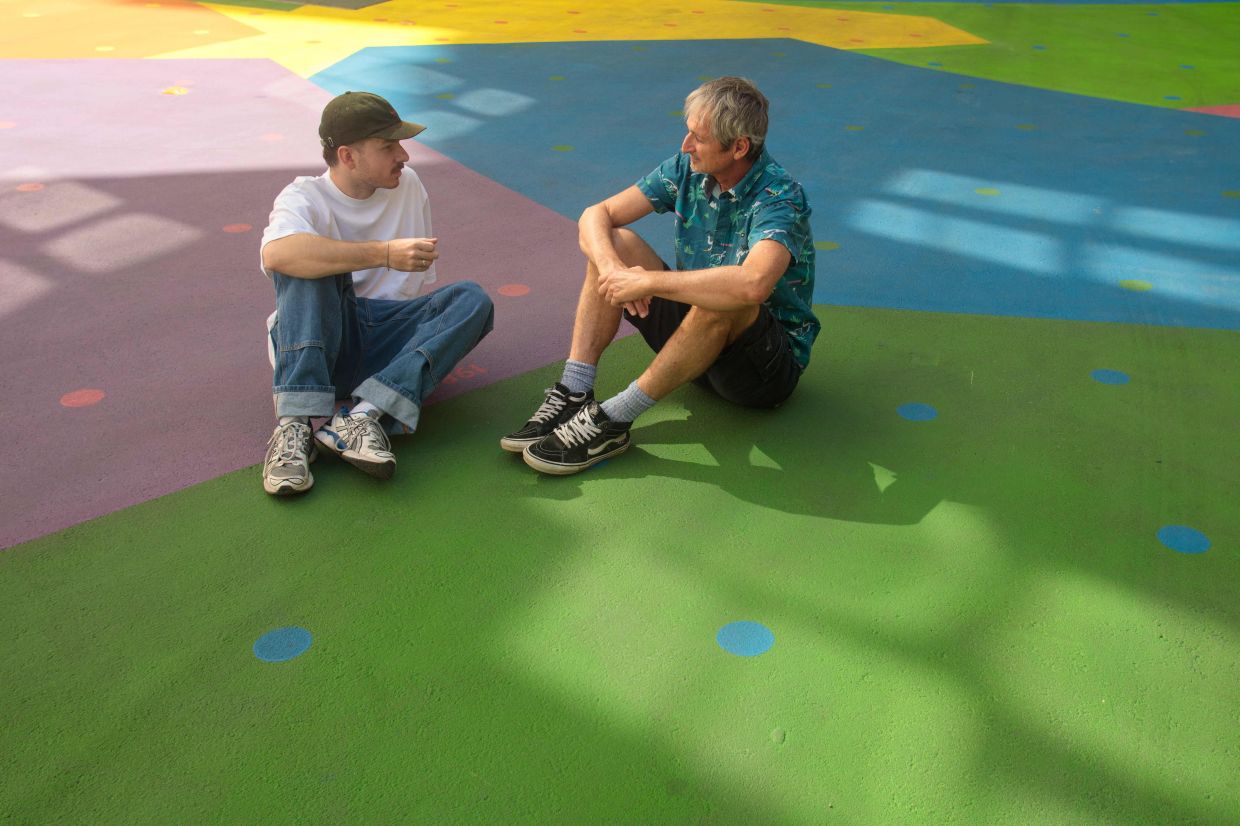
Thanks to his collective's art work covering the black asphalt with a multitude of bright colours, the ground temperature has dropped from 31C to 20C.
Initiated by the museum showing the private collection of late Austrian billionaire Heidi Horten, the project combines creativity, science and urban planning as Europe suffocates under the latest heatwave.
"The childish tones reflect the lightness and inconsistency with which our society addresses this issue" of climate change, said Griessler, 25, an artist with the Holla Hoop collective.
With more intense, longer and more frequent heatwaves a direct consequence of climate change according to scientists, European cities are trying to change their urban planning.
Many have been opting for more greenery and also lighter paint that reflects solar rays, trying to avoid dark material, which retains heat.
"We wanted to slightly improve the quality" of visitors' stays and "promote awareness," said curator Veronique Abpurg, happy that tourists are "attracted by this visually pleasing palette".
While each coloured surface represents a year, they each contain small dots. Each dot represents a billion tons of CO2 emissions, and the number of dots on each surface are equivalent to the worldwide emissions of that year.
This way one can visualise the increase in emissions due to human activity between 1960 and 2000.
"The blocks gradually fill up," lamented the artist, whose background is in graffiti art.
"It starts with nine dots, and at the end, there are three times more," he said.
"It's a piece of the mosaic for adapting to urban heatwaves," said Hans-Peter Hutter, an environmental health specialist at the Medical University of Vienna, who supports the initiative.
A lower temperature on the asphalt means that buildings surrounding the courtyard will need less cooling, reducing air conditioning usage, Hutter said.
"We need to communicate better on the subject (of climate change) so that people don't lose hope" and see adaptation measures as a fun activity, he added. - AFP