The 'lost' story of Enrique de Malacca, an enslaved Malay sailor, interpreter


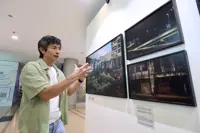
The exhibition 'Skola Gambar Enrique de Malacca' by artist Ahmad Fuad Osman reflects on the first circumnavigation around the world by the Magellan-Elcano expedition in 1519. The expedition has, over time, gained allegorical significance, marking the start of the age of globalisation. Photo: Ilham Gallery

Five hundred years ago, Portuguese explorer Ferdinand Magellan embarked on a historic journey to circumnavigate the globe.

Five ships with 270 crew members set sail on this perilous three-year expedition from Spain, among them an enslaved Malay sailor and interpreter named Enrique de Malacca, whom Magellan had acquired during the Portuguese conquest of Malacca in 1511.

In the Skola Gambar Enrique de Malacca exhibition at Ilham Gallery in Kuala Lumpur, Ahmad Fuad Osman revisits this historical event through the perspective of a person from the Malay Archipelago, by creating a fictional memorial based on historical evidence, scholarly interviews and oral religious records.

This staging of the Enrique de Malacca Memorial Project, curated by Simon Soon in conversation with historian Felice Noelle Rodriguez, is the project’s fourth iteration.

Previous versions were shown Ahmad Fuad’s mid-career solo exhibition at the National Art Gallery (2019-2020), the Sharjah Biennale (2019) and the Singapore Biennale (2016).

“Aside from a few eyewitness accounts, Enrique’s existence is known through two main records of the voyage written by Ferdinand Magellan and Antonio Pigafetta. Though enslaved, Enrique was acknowledged as an important interpreter and guide who would play a crucial role in helping the expedition reach the Spice islands of Maluku,” says Soon.

Magellan’s route around the world, in a 1544 copy of the Agnese Atlas. Magellan’s route is shown as a dark line. Ferdinand Magellan (c.1480-1521) set sail from Seville, Spain, in August 1519 with five ships. Photo: Ilham Gallery

“In his last will, Magellan declared that Enrique should be made a ‘free man’ upon his death and according to historical records, Enrique was last sighted on Mactan Island, shortly after Magellan’s passing. No other records have been found that might give us an indication of what he did after this. Hearsay, legend and inferences came to shape how we choose to write Enrique’s fate,” he adds.

Drawing on the historical and presently unused Malay terminology for “museum”, Skola Gambar or “picture school” repurposes a local interpretive frame to question the standard museological process, its authority over interpretations of the past, and the legitimisation of grand historical narratives.

“While a large part of the Enrique de Malacca project is informed by historical thinking, the creative dimension of Ahmad Fuad’s contemporary artwork takes off at the point where historical methods have reached their limits to understanding the past. The limited range of historical sources on Enrique de Malacca means that historians are constrained by what they are able to speculate.

Ahmad Fuad Osman's 'Enrique De Malacca' (UV print on paper, 2019). Photo: Ilham Gallery

“In the creative space, one is open to asking questions that might otherwise sound ridiculous, exploring connections that are absent, and speculating about possibilities that haven’t been ventured. When informed by historical thinking, artists exercise their artistic license through their artwork to enrich, broaden and enliven our historical imagination,” he says.

The artefacts on display possess diverse provenance – some historical, some tenuously linked, some reproduced, some functioning as stand-ins and some that are simply fabricated, speculative and fantastical.

As much as this is an invitation to ask “what if”, Soon notes that it is also an opportunity to find new perspectives, discover new voices and animate the lessons of history that remain relevant today.

“There is nothing in our known historical record that provides us with an inkling as to what Enrique thought about the voyage. Yet this point of view of someone who originated from the Malay archipelago would have given our story about the beginning of globalisation a different flavour and colour.

“This is why there is so much fascination in the possibility of Enrique being the first person who circumnavigated the world. Whether his original home was in Sumatra or Melaka, the close distance that separates Enrique in Mactan island from his place of birth is magnified, appearing as a chasm in the history of globalisation.

Ahmad Fuad Osman’s oil on canvas Portrait of Ferdinand Magellan (c.1480 - 1521). Photo: Ilham Gallery

“What if Enrique did make it back home? What are the implications if he were the first person to have circumnavigated the world? This chasm between veritable historical record and speculative conjecture, opens up new possibilities for us to revisit the history of globalisation,” says Soon.

Magellan himself did not actually complete the full circle as he was killed on Mactan Island in the Philippines. Only one ship eventually completed the journey, returning to Europe with 18 men on board.

“I like to think that Enrique gained his freedom from slavery by disappearing from historical records altogether. More than determining the right historical answer, the exhibition invites us to entertain all plausible outcomes and scenarios. In doing so, we might be more open to the perspectives from different subject-positions, and this could alter the very meaning we gain from a historical narrative.” he adds.

Skola Gambar Enrique de Malacca is divided into four chapters – Creole, Picture, High Seas and Afterlife – with each chapter containing three sections that address some of the important themes and issues that the artist and curators explored over the course of their conversations.

“What we did in this instance is to draw out certain features that respond to the recent 500-year-anniversary celebrations of the Magellan-Elcano circumnavigation. To say the exhibition is text-heavy is an understatement. We have disregarded every contemporary museum best-practice convention on word-limit in wall texts there is in this show.

“Part of this includes an excellent range of learning materials and object lesson activities put together by Khat Mirzan and Rahel Joseph so that the exhibition fulfills the pedagogical function of being a ‘sekolah gambar’. In a sense, it is a show that takes visitors on a learning journey and demands the visitor’s willingness to engage not only intellectually but also playfully.”

Soon also notes that Enrique de Malacca is not of titled origin, but an everyman whose fortunes changed overnight when the city he grew up in was razed to the ground. As Panglima Awang, he may appear to be the ideal Malay hero – the polymath, the warrior, the cosmopolitan explorer, the prodigal son.

“However, we need to remember that Enrique was a cultural go-between who necessarily moved between cultures. His enslavement had long historical roots in the Indian Ocean world during a time when great inequalities existed. Moreover, Enrique converted to Christianity. We do not even know his original name.

"In this sense, Enrique as a go-between has attributes that we recognise as important in today’s society – he was a cosmopolitan journeyman who translated across cultures. He challenged his fate in life, expanded the horizon of his mind through travel, and ultimately earned his freedom in the world. It is the story of modernity. We are heirs of Enrique,” he concludes.

Skola Gambar Enrique De Malacca is on at Level 3, Ilham Gallery in KL till June 12. Opening hours: 11am-7pm (Tuesday to Saturday), 11am-5pm (Sunday), closed on Mondays and public holidays. More info here.

Get 20% OFF The Star Digital Access

Monthly Plan

RM 13.90/month

RM 11.12/month

Billed as RM 11.12 for the 1st month, RM 13.90 thereafter.

Best Value

Annual Plan

RM 12.33/month

RM 9.87/month

Billed as RM 118.40 for the 1st year, RM 148 thereafter.

Follow us on our official WhatsApp channel for breaking news alerts and key updates!
Ahmad Fuad Osman , history , fiction , art , Ilham Gallery

Next In Culture

Hemingway classic still inspires Americans to run with bulls in Pamplona
Welcome to 'FIFA Gully': the Kolkata lane transformed by a love for football
Asia’s first Durian Experience Centre opens in KL, featuring museum, theatre
HK bookseller, seized by Chinese authorities in 2015, dies in Taiwan at 70
Haruki Murakami says his novels are 'different' from AI literature
In Melaka, Peranakan heritage gets a killer twist with murder mystery weekends
Malaysian photographer-turned-artist gives the forest a voice
New Haruki Murakami novel 'The Tale Of KAHO', goes on sale in Japan, his first with female protagonist
Weekend for the arts: BookStreet hits 5, Seni Reog in KL, 'Jom Kita Ke Laut'
Tens of thousands queue for the Bayeux Tapestry’s rare England show

Others Also Read