Refugee poets and artists in Malaysia reflect on hope, loss and the possibility of freedom


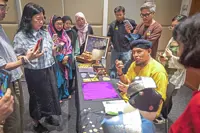
The George Town Literature Festival participants for the 'Poetry & Exile' session (from left) Abdulsalam, Amin Kamrani, Masuma Tavakoli, and Mwaffaq Al-Hajjar, who are all based in Malaysia. Photo: George Town Literary Festival

Acclaimed Palestinian poet Mahmoud Darwish once wrote: “I went north, I went east and west but I could not go south because south is my country."

Reflecting on a distant homeland, three Middle Eastern poets/translators and one Afghanistan poet, who all now live in Malaysia, sat down during the recent virtual George Town Literary Festival (GTLF) 2020 in a sharing session entitled “Poetry & Exile”. The podcast was the second most popular session in the GTLF programme, behind "The Malay In Me - Covid 19 And Identity."

Pulling on recollections from their journeys from Syria, Iran and Afghanistan, the poets and artists in "Poetry & Exile" reflected on the diverse ideas of language, identity and a longing for the beloved.

The land under my feet

The thing about exile, Iranian writer and photographer Amin Kamrani expounds, is how "constant" it is to those who live it.

“When you are talking about exile, you are talking about the forced movement of people. Things that ordinary citizens of the world perhaps take for granted become emboldened in your life: in the country that I am staying in, in the place that I am staying in, how many days are left for me to stay here?" says Amin.

"Where you are breathing in one part of the world ... you are thinking about it actively. Exile becomes an element in our thoughts, always, ” he adds.

Citing renowned Persian scholar Rumi as an example, Amin notes that even the name of the poet reflected his physical journey from his homeland.

“Rumi was born in where modern day Afghanistan is today. Because of the attack of Mongols from Central Asia, he was forced to go all the way to Damascus and met Ibn Arabi and then from there, he went up to Turkey.

"And then, he got the name Rumi which basically means 'foreigner', ” Amin says.

(‘Rumi’ is known to be the scholar’s Arabic nisba – an adjective that indicates a person’s place of origin – and is translated as ‘from Rûm’ or loosely, the Eastern Roman empire.)

“He became known as Rumi. It wasn't his name but because of the place that he was in, he took that as part of him.

"So, exile is an opportunity but it always comes with hardship. Exile can also be that separation for the beloved and it is in the distance (between) that the pain is,” says Amin.

Assimilation to a new place, to a certain degree, is necessary and inevitable but the tug-of-war between a new home and a distant homeland constantly rages.

Mwaffaq Al-Hajjar, an engineer and writer who fled civil war in Syria in 2016, says part of this battle is reflected in language.

“I'd (previously) never written in English. I've learnt English and French but I have never thought in English or French.

"There is this idiom that says only when you start living in a language can you start writing in a new language. And this new language will reveal new aspects of your identity; who you are and how you think, ” says Mwaffaq, who launched his first book – Poetic Entropy – at the GTLF last year.

A stranger at home

Mwaffaq, who in 2017 won the Migrants and Refugees Poetry Competition that is held annually in KL, says fear and pain is also often laced into the equation.

“I think that pain is a state of continuous revelation. It is like revealing curtains and you see more clearly so you can touch on things that you never thought you can reach.

"We talk about how exile can open new, different paths and roads but there is also a fear of losing your own cultural identity. How do you balance that? What do you get, what do you lose?” he asks.

Exile is also not confined to being physically banished from a place, Mwaffaq notes, as it is possible to be exiled within your own homeland.

To this, Afghan poet Masuma Tavakoli attests to.

Masuma was born in Isfahan, Iran, and spent much of her childhood there before her brother took the family back to their homeland of Afghanistan.

“I went from a place where a woman had value, to Afghanistan where nobody would even call a woman by her name.

"Women did not have the right to study and it went as far as I couldn't even express a simple opinion. I didn't have the right to do even that,” she says.

The mother-of-two, who was forced into marriage at 15 years old, says the pressures of the situation put her entire identity into question.

“I had the feeling of being a stranger thoroughly. Everything about me was under question; my identity as a woman was being challenged, aside from all other parts of my identity.

"All of those experiences of forced migrations have impacted my writings and the depth of my perspective on different subjects such as pain, homesickness and separation, ” says Masuma, whose book Life Under Taliban was released in June last year.

On the same issues, poet and photographer Abdulsalam notes that exile is often not only a physical journey but an arching emotional state.

“When I left Syria, it wasn't knowing that I was going into exile. I think most who have been exiled, when they were going, they were still having hope that they will go back soon.

"So, in the beginning, you still have this feeling that you are going to return soon. Then, slowly, the idea of exile starts to form, ” he says.

For writers and artists, this is often reflective in their work.

“It's interesting to stay on this journey and see how your writings are changing in this period of time. Most of the time, we feel lost between here and there.

"Where do I belong? I don't belong here, I don't belong there. I don't belong anywhere,” says Abdulsalam.

Get 20% OFF The Star Digital Access

Monthly Plan

RM 13.90/month

RM 11.12/month

Billed as RM 11.12 for the 1st month, RM 13.90 thereafter.

Best Value

Annual Plan

RM 12.33/month

RM 9.87/month

Billed as RM 118.40 for the 1st year, RM 148 thereafter.

Follow us on our official WhatsApp channel for breaking news alerts and key updates!

Next In Culture

Threads carry diverse Palestinian stories in a new exhibition at IAMM
Sticker frenzy: Panini packs sell out as fans race to fill collectible albums
Dataland: a pioneering AI museum awakens art through light, sound and scent
Bible stories are approved as required reading in Texas public schools
Wole Soyinka university theatre: a talent factory for Nigeria and beyond
Weekend for the arts: Palestinian 'Tatreez' at IAMM, KL Reading Festival
AI name is Michael Caine: 'The Odyssey' gets digital narrator
A chilling Romanian exhibition replays videotaped secret police interrogations
Legendary Radio Malaya composers celebrated with archival vinyl releases
A Miami art exhibition is celebrating Africa’s rich football legacy

Others Also Read