WHEN you flip on the light switch in your home or turn on the heater for your shower, there is a high chance that the technology that powers that electricity originated from Japan.
For more than 60 years, Mitsubishi Power has been at the heart of Malaysia’s energy journey, shaping the nation’s progress through reliable, efficient and forward-looking power solutions.
From supporting the country’s early electrification drive to developing cutting-edge hydrogen-ready technologies, the company’s partnership with Malaysia is one forged in trust, innovation and shared purpose.
Trusted partner in nation building
Mitsubishi Power’s story in Malaysia began in the 1960s, during the country’s early industrialisation. When Malaysia embarked on its path toward modernisation, the company played a significant role in strengthening the nation’s energy backbone. From supplying advanced turbines to supporting plant operations, the company became synonymous with dependable electricity that fuelled industries, businesses and communities alike.
One of its notable contributions includes equipping the Tuanku Ja’afar Power Plant in Port Dickson with two highly reliable M701F gas turbines in 2005. These installations underscored the company’s commitment to ensuring efficient and stable power generation for the nation’s growing demand.
More than just a supplier, the company has earned the reputation of being a reliable partner in powering industries and communities alike.
Sustainable, efficient gas-powered solutions for a new era
As the nation advances toward its National Energy Transition Roadmap (NETR) and carbon-neutral aspiration by 2050, Mitsubishi Power continues to introduce technologies that address the country’s evolving energy needs. The focus today is on high-efficiency, low-carbon solutions designed to balance sustainability with reliability.
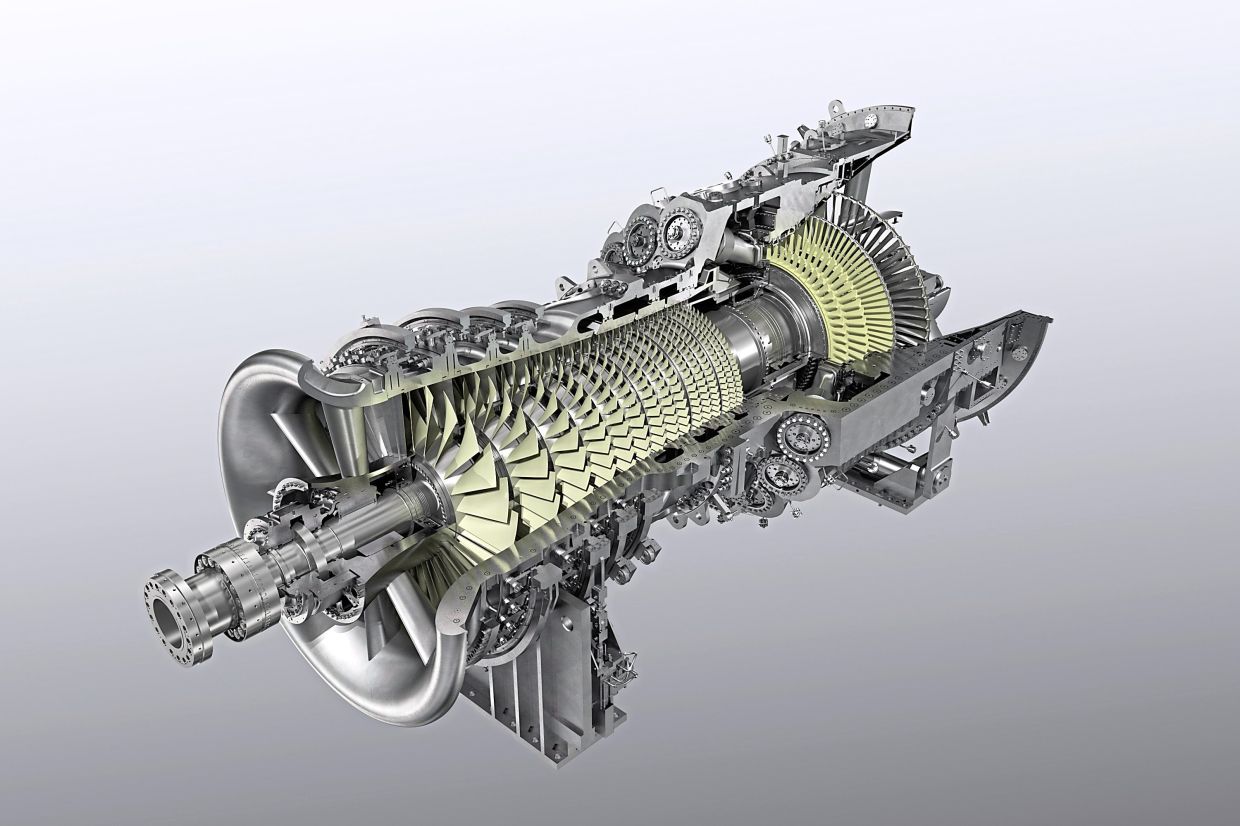
Among these innovations is the gas turbine combined cycle (GTCC) system, which integrates gas and steam turbines to maximise output and minimise emissions. The setup can include Mitsubishi Power’s J-Series Air Cooled (JAC) turbine, one of the world’s most efficient, achieving an industry-leading 64% efficiency rate. Compared to conventional coal-fired power plants, it can reduce CO2 emissions by up to 65%. Incorporating J-Series technologies, the F-Series gas turbine operates at lower temperatures yet offers 62% or more combined cycle efficiency.
Globally, the J-Series fleet has accumulated more than three million operational hours as of June 2025. Mitsubishi Power has already achieved 30% hydrogen co-firing capability with the JAC model and is pursuing a total-hydrogen combustion beyond 2030. These advances will allow Malaysia to transition gradually towards cleaner fuels while maintaining system stability.
Beyond efficiency, Mitsubishi Power leverages digital innovation through its remote monitoring and diagnostics infrastructure. This enables real-time tracking of turbine and plant performance, allowing early detection of anomalies, predictive maintenance and reduced downtime. Such intelligence-driven solutions enhance reliability and align with Malaysia’s push for smarter, data-enabled industries.
Fronting Malaysia’s energy transition
Mitsubishi Power’s technologies are actively powering Malaysia’s clean energy ambitions. The company’s involvement in the Sarawak hydrogen-ready combined cycle power plant for Petroliam Sarawak Bhd (Petros) marks a milestone for the region. The project features a 500 MW-class M701F gas turbine capable of co-firing up to 30% hydrogen—the first of its kind in Malaysia and South-East Asia.
In Peninsular Malaysia, Malakoff, one of the nation’s leading independent power producers, has signed a reservation with Mitsubishi Power for two sets of M701JAC gas turbines and generators. These projects embody the country’s twin goals of decarbonisation and energy security under the NETR.
Mitsubishi Power’s collaboration with Tenaga Nasional Bhd’s generation arm, TNB Genco, further reinforces its role as a trusted technical partner. Together, both organisations are exploring hydrogen and ammonia co-firing, as well as carbon capture technologies, to decarbonise Malaysia’s existing gas infrastructure.
These partnerships extend beyond technology deployment—they symbolise a long-term alliance rooted in trust and shared ambition. By combining global expertise with local implementation, Mitsubishi Power is helping Malaysia diversify its energy mix, enhance grid resilience and position itself as a future exporter of clean electricity within Asean.
At the core of this progress lies the company’s world-class research and development network, exemplified by the Takasago Hydrogen Park in Japan—the world’s first facility to validate production, storage and utilisation equipment for hydrogen under real-world conditions. Insights from this facility are helping shape Malaysia’s hydrogen future, providing practical blueprints for large-scale decarbonisation.
Regional leader in renewable energy
Mitsubishi Power’s regional success underscores its ability to deliver reliable, proven solutions adaptable to Malaysia’s energy transition journey. Across South-East Asia, the company has supported landmark developments that mirror the country’s own energy aspirations.
In Thailand, Mitsubishi Power recently completed a landmark 5,300MW combined cycle project in Rayong and Chonburi for Gulf Group and Mitsui Co Ltd, with eight M701JAC turbines now in operation.
In Singapore, it is playing a leading role in several hydrogen-ready projects, including the 600MW Keppel Sakra Cogeneration Plant—the country’s first hydrogen-ready plant—and the Sembcorp 600MW combined cycle plant. It is also equipping the Meranti Power fast-start open cycle gas turbine facility with M701F turbines capable of 30% hydrogen co-firing. Most recently, it will supply PacificLight Power with an M701 JAC turbine, as part of the country’s first combined-cycle gas turbine (CCGT) unit to be integrated with a large-scale battery energy storage system (BESS).
In Vietnam, Mitsubishi Power supplies two M701JAC gas turbines for the O Mon 4 Power Plant—another first for the country—which supports Vietnam’s Power Development Plan 8 and its 2050 net-zero commitment.
Together, these regional milestones illustrate Mitsubishi Power’s dual mission: to decarbonise, while ensuring energy security. These examples serve as practical blueprints for Malaysia’s own scalable pathways toward clean energy that maintain reliability, affordability and grid stability.
Empowering local expertise, communities
Mitsubishi Power’s contribution to Malaysia extends beyond engineering excellence—it encompasses human development and local empowerment. The company invests in knowledge transfer through on-site technical advisors who work closely with Malaysian engineers to enhance skills and ensure smooth plant operations.
Its long-term maintenance contracts help cultivate local expertise, strengthening Malaysia’s technical capacity to operate advanced power systems independently. This focus on people aligns with the country’s Shared Prosperity Vision 2030, which promotes inclusive growth through technology and capability-building.
However, sustainability also encompasses social and economic impacts, besides just environmental. By nurturing homegrown talent and fostering cross-border collaboration, the company helps Malaysia build a resilient, future-ready workforce equipped to lead the energy transition.
Building trust and innovation
As Malaysia moves toward a cleaner and more connected energy future, Mitsubishi Power remains steadfast in its mission to be a reliable partner. Its legacy in the country reflects a consistent record of trust, performance and technological leadership.
Looking ahead, the company aims to continually ramp up efficiency around gas combustion, scale up hydrogen adoption, advance digital intelligence and modernise legacy infrastructure to meet future demand sustainably. Mitsubishi Power’s enduring partnership with Malaysia is built not just on turbines and technology, but on a shared belief that progress and sustainability must go hand in hand.
With innovation as its compass and partnership as its foundation, Mitsubishi Power continues to power Malaysia’s energy transformation—reliably, responsibly and for generations to come.