NOT all digital transformations begin with towers, servers or big cities.
Over the past decade, while much of Indonesia’s digital development discourse has focused on broadband, 5G and commercial expansion, change has quietly taken root in places often left off the map, including villages, communities and the fringes of the formal economy.
From there, the Common Room Network Foundation ignited a small flame that slowly grew into a bigger movement. Since 2019, Common Room has initiated a community Internet as a living social infrastructure that is managed by citizens and directed toward the public interest.
The movement, born out of an arts practice, stems from the belief that digital technology does not have to come from the central government.
Sometimes, technology grows from the grassroots and from spaces of imagination where culture, creativity and local needs meet.
In the hands of the Common Room, the Internet is more than connectivity. It is a tool for strengthening human relationships, protecting knowledge and driving transformation relevant to the local context.
From art space to public infrastructure
Common Room was not founded as a technology organisation. The group began as an art project in Bandung in 2000. At that time, the Internet was just starting to show its potential as a space for the democratisation of knowledge in Indonesia.
Gustaff H Iskandar and his colleagues, who came from the world of art, literature and culture, saw the Internet as a medium that would change not only how work is created but also how society connects. From there emerged the core vision: creativity, technology and public participation must make room for one another.
Common Room’s collaboration with Tobucil, an independent community book store, in 2004 expanded the meaning of intersections between the online and offline worlds. At this point, they saw that digital technology could not stand alone.
Technology needed social spaces that allowed residents to gather, experiment and build new knowledge.
The transformation of Common Room into a non-profit organisation in 2006 marked a new chapter. At that time, Common Room began engaging in community mapping, creative economy policy and cross-regional projects.
A major shift occurred when Common Room realised the widening gap between urban and rural areas. Field research since 2013 showed that cities were developing rapidly with technological support, while villages lagged behind in information access, infrastructure and digital capacity.
This prompted a new idea: What if the Internet was not only brought to villages, but also owned and managed by them? This question found its answer in Kasepuhan Ciptagelar, Sukabumi, West Java.
Community Internet as an ecology of knowledge
Ciptagelar is no ordinary village. It is an indigenous Sundanese community that has for centuries preserved traditions of rice cultivation, forest conservation and social governance rooted in musyawarah (deliberation) and spirituality.
In 2014, Abah Ugi, the traditional leader, asked Common Room to help build internet access in his village. The request was not about modernisation, but about strengthening networks of knowledge, improving communication and opening access for the younger generation without compromising cultural values.
The process of setting up internet access in Ciptagelar was not easy.
For four years, Common Room studied telecommunications regulations, collaborated with the Ministry of Communication and Digital Affairs and various organisations such as ICT Watch, and attempted to build a radio link connection spanning dozens of kilometres from Bayah, Banten.
The first network only became fully functional in 2018. Despite its very limited capacity, the small step opened a big door: the birth of a community internet model grown through citizen participation.
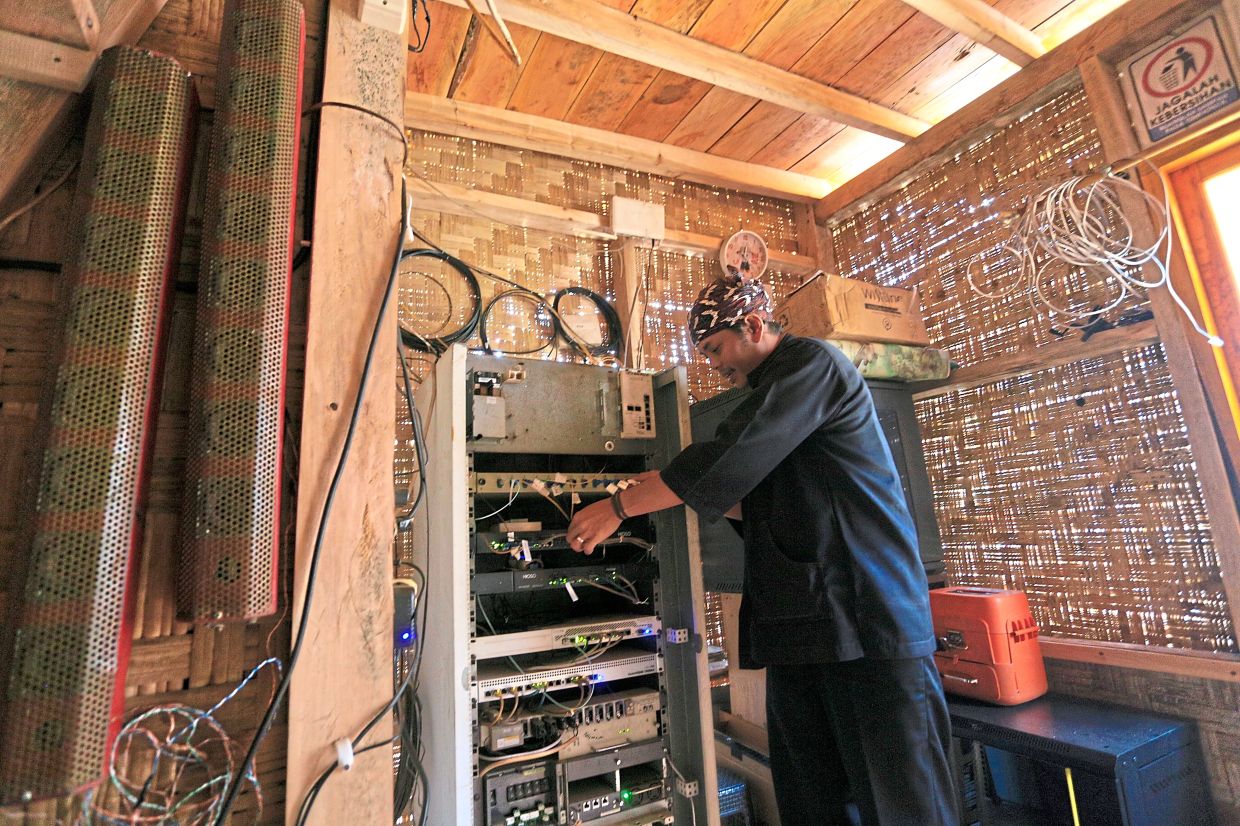
Since 2019, support from the Association for Progressive Communications (APC) has allowed infrastructure expansion. Residents were trained to build towers, set up radio links and manage the network.
They were not just users, but were involved as technicians, administrators and decision-makers. As a result, the community Internet now reaches 45 settlements in 13 villages.
When the Covid-19 pandemic hit, this model became even more relevant. In Ciracap, Sukabumi, an area categorised as a red zone, Common Room helped establish an emergency network, trained health center staff and disseminated health information in Sundanese through comics and local media.
This experience reinforced the belief that the community Internet is not merely infrastructure. It is a public safety tool.
In the past two years, the Ciptagelar network has also been used to collect microclimate data through sensors installed by residents. The data is processed, visualised and used to develop simple artificial intelligence (AI) models for weather forecasting.
With these weather forecasts, farmers can determine planting schedules with greater precision. Communities can also make safety decisions regarding natural disasters. Here, the Internet moves from mere access toward meaningful connectivity.
A just digital transformation
Building a community internet is not without challenges. Cultural adaptation is a key issue. Gustaff and his team strive to introduce technology without eroding local values. For this reason, Common Room always begins a project with social surveys, listening to customary institutions and getting the residents involved in every phase.
In some locations, such as Ngata Toro in Sigi Regency, Central Sulawesi, traditional leaders have even issued customary rules to prevent risks, such as online gambling and illegal loans. This demonstrates that local regulations can sometimes be more responsive than formal mechanisms.
Another challenge is digital literacy. High national internet penetration does not necessarily mean that people understand how to use the Internet safely and productively.
In fact, hoaxes, online fraud and digital violence are increasing. Therefore, Common Room builds a peer-to-peer learning and trainer training approach to ensure that digital skills spread organically through citizen networks.
The Ciptagelar model offers valuable lessons, not just nationally but regionally. Several South-East Asian countries, namely Malaysia, the Philippines and Myanmar, face similar issues in remote areas: large populations, economic inequality and dynamic traditional systems.
Community Internet offers a hybrid model that blends modern technology with local social capacity. This movement shows that digital inclusion is not just about building towers, but about building trust, capacity and social institutions that can keep digital spaces safe and useful.
Common Room’s focus has also shifted from merely building networks to using the Internet for essential services, ranging from education and health to disaster information systems and climate resilience. The climate data initiative in Ciptagelar shows that villages can become centres of global innovation by creating living laboratories that combine data and local wisdom to address contemporary challenges.
From an indigenous village in Sukabumi, Indonesia shows that the most meaningful digital transformations grow from the grassroots.