AS South-East Asia’s economy grows, fuelled by its strategic location and expanding consumer market, the transition from coal to renewable energy (RE) is underway.
Energy security remains a cornerstone of sustainable growth, essential for long-term economic competitiveness and business continuity.

Beyond government-led policies (at both national and state levels), the momentum is also growing in the corporate sector, where businesses are embedding ESG principles into their operations to uphold responsible practices. At the individual level, conscious choices and sustainable habits are gaining traction, demonstrating how collective action can drive meaningful, long-term change.
One of Malaysia’s key initiatives is the National Energy Transition Roadmap, which was launched in 2023. The roadmap sets ambitious targets, including enhancing RE capacity to at least 70% of power generation by 2035, up from about 25%.
Analysts estimate that these targets will entail at least 20GW of new RE until 2050, of which more than 90% is expected to come from solar. This goal is a significant step up from the previous targets of achieving 40% RE capacity by 2035.
Around the region, Indonesia aims for 23% RE in its primary energy supply by 2025 and 31% by 2050, while Vietnam plans for RE to constitute 32.3% of total primary energy consumption by 2030 and 44% by 2050.
Thailand, meanwhile, targets 30% RE in total final energy consumption by 2036.
“Malaysia’s energy sector is evolving rapidly to meet sustainability demands.
“The need to adapt is driven by global shifts in technology, environmental policies and evolving consumer expectations – all of which directly influence Malaysia’s energy trilemma: striking a balance between energy security (ensuring reliable power access), environmental sustainability (minimising greenhouse gas emissions) and affordability (maintaining accessible electricity for all citizens),” Nirinder Singh Johl, founder and chief executive officer of Asia Carbon XChange PLT, says.
He says investors and consumers are increasingly demanding cleaner energy solutions that are competitively priced. Meeting these expectations is crucial; not only to fulfill international commitments but also to build a resilient and inclusive energy ecosystem, he adds.
“The energy sector is gradually becoming more decentralised, shifting away from the traditional model where energy is produced solely by large utilities.
“Individuals, businesses and communities are now becoming ‘prosumers’ – both producing their own electricity, often through renewable sources like solar panels, and selling any excess energy back to the grid.”
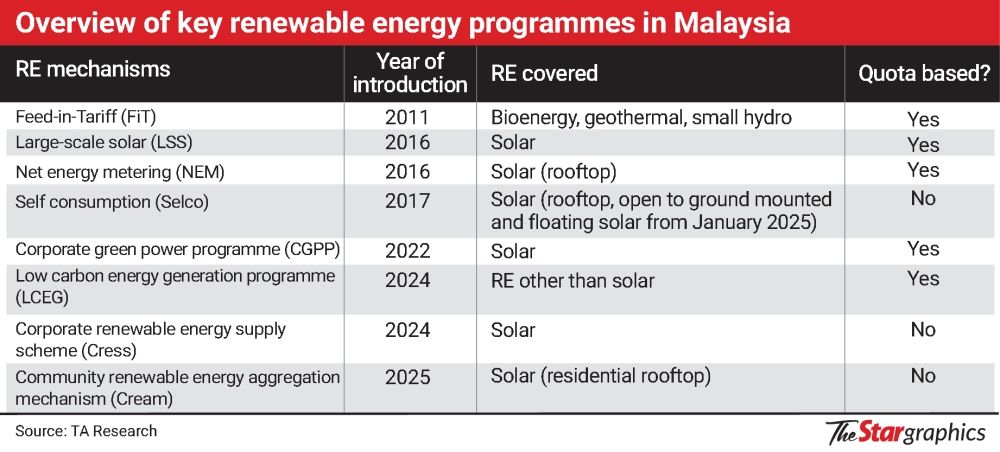
He points to the government’s initiative like the Feed-in Tariff and various Net Energy Metering schemes, which exemplify the shift of allowing consumers to offset electricity bills with RE sources.
“RE prosumers can make meaningful progress towards their broader sustainability goals. For example, a reduced reliance on conventionally-sourced electricity enables them to lower their Scope 2 emissions, which refers to indirect greenhouse gas emissions associated with the consumption of purchased electricity,” says Nirinder.
With the natural retirement of existing plants, the proportion of coal-fired power generation in Malaysia is expected to decline in the coming years.
A complete phase out is targeted by 2045. Natural gas is anticipated to act as a “transitional” fuel as the government accelerates the deployment of RE technologies, particularly solar photovoltaics (PV) and battery energy storage systems (Bess) to increase the share of clean energy in the power mix.
With upcoming tenders for the LSS5, LSS5+ and LSS6 large-scale solar programmes, analysts foresee significant growth in solar PV capacity in Peninsular Malaysia, translating into another round of multi-billion-ringgit job flow opportunities for listed companies. Meanwhile, the bidding round for the installation of Bess to third parties is likely to take place in the third quarter of 2025.
One key milestone in Malaysia’s energy transition journey is enforcement of the Energy Efficiency and Conservation Act on Jan 1, 2025. It mandates that large energy consumers, selected buildings and key energy-using products adhere to minimum energy efficiency (EE) standards and implement robust energy management systems.
CIMB Securities, in a recent report, says the regulatory measure is anticipated to drive significant operational improvements and cost savings.
“With Malaysia poised to increase electricity tariffs as part of subsidy rationalisation programmes, the financial benefits of EE has become even more pronounced.
“Companies that invest in energy-efficient upgrades can effectively mitigate higher operating costs, safeguarding their profitability and positioning themselves for long-term competitive advantages over peers,” CIMB Securities adds.
The research house notes that a significant portion of existing government buildings have been identified as energy inefficient, thus an urgent need for large-scale retrofitting to bring energy use closer to best practice standards.