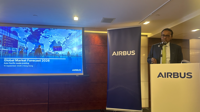
WHEN Malaysia Aviation Group (MAG) hosted a financiers’ meeting more than a decade ago, fewer than 20 people attended.
The confidence in Malaysia Airlines was then at its lowest ebb.
This year, however, the picture was markedly different as over 110 representatives from global banks and aircraft lessors filled the auditorium at the MAG Financiers Summit.
They arrived with one clear purpose — to position themselves early to finance Malaysia Airlines’ next wave of aircraft acquisition.
The strong turnout went beyond symbolic support.
Several financiers were already engaging in detailed discussions around funding structures and timelines, signalling their readiness to support Malaysia Airlines’ fleet renewal programme under its Long-Term Business Plan 3.0 (LTBP 3.0). For the group, this level of proactive interest reflects growing confidence in MAG’s financial discipline, operational stability and long-term growth strategy.
The summit marked a turning point where the conversation shifted from recovery to readiness — with financiers no longer asking whether MAG could execute, but how they could be part of its next phase of expansion.
As Captain Datuk Izham Ismail steps down tomorrow, Malaysia Airlines will close an important chapter in its long and often turbulent history.
His departure invites reflection not just on a man who spent 40 years in the company, beginning in the cockpit as a pilot, but also on how leadership, perseverance and clarity of purpose helped stabilise the national carrier during one of the most challenging periods global aviation has faced.
Many had doubts whether a pilot could take on the job of a corporate man with little management and boardroom experience to navigate the company through the dark clouds.
But he proved the cynics wrong by defining his tenure as group managing director of MAG and chief executive officer of Malaysia Airlines from 2017 onwards.
He assumed leadership at a time when the airline was still grappling with the aftermath of MH370 and MH17 — tragedies that left deep emotional and reputational scars — while facing structural weaknesses that had accumulated over the years.
Soon after, the Covid-19 pandemic brought global aviation to a near standstill, threatening the very survival of many airlines worldwide.
Against this backdrop, Captain Izham led a deliberate and often difficult transformation. Rather than chasing rapid expansion or short-term gains, MAG focused on operational discipline, cost control and a clearer market position.
The decision to refocus Malaysia Airlines as a premium full-service carrier — prioritising yield over volume — marked a return to its traditional strengths of service, network connectivity and brand trust.
The results, while not without setbacks, were tangible. MAG’s return to profitability in recent years signalled that the airline’s restructuring had moved beyond survival and into recovery.
Equally significant was the emphasis on sustainability — financial, operational and organisational — aimed at ensuring the airline would not repeat the cycles of crisis that defined earlier decades.
This is not to suggest that the journey was smooth. Passengers experienced service disruptions, operational constraints and network adjustments that tested public patience.
These challenges served as reminders that rebuilding an airline is a complex process, involving difficult trade-offs and long-term planning rather than quick fixes.
He will be remembered for stabilising operations in a volatile environment, including network rationalisation and activation of initiatives to manage supply chain and fleet constraints.
He delivered a strong financial recovery, in particular achieving an operating profit of RM540mil in 2022 (first full year post-restructuring) and positive net income after tax in subsequent years, including RM54mil in 2024.
He strengthened MAG’s position as a network carrier, with disciplined capacity management, agile revenue strategies and increased contribution from international markets.
Captain Izham also launched new destinations such as the Maldives, Da Nang, Chiang Mai, Paris and Kolkata.
There was also progress in Diversity, Equity & Inclusion, including 50% female representation in senior management
To wrap it up, Malaysia Airlines was named the world’s fastest-growing airline brand in 2025,- Skytrax ranking improved from #51 in 2021 to #27 in 2025 and Malaysia Airlines' cabin crew was ranked among the world’s top 8
As Captain Nasaruddin A. Bakar takes over, he inherits an airline that is more focused, financially steadier and clearer about its identity than it was a decade ago.
That is perhaps Captain Izham’s most enduring contribution: leaving Malaysia Airlines better positioned to take flight.