
WHEN the Budget 2024 speech began just after 4pm last Friday, it was rather a surprise to hear that Datuk Seri Anwar Ibrahim early on in his speech delivering key tax measures.
This include the increase in the sales and service tax (SST) from 6% to 8%, announcement of new legislation that will govern high-value goods tax of between 5% to 10% based on item-price threshold values as well as the introduction of a 10% capital gains tax on the disposal of unlisted shares for companies.
In terms of revenue expectations, the Treasury secretary-general was quoted as saying that the higher service tax rate is expected to generate some RM3bil in revenue, much higher than the projected RM900mil increase that was presented under the Fiscal Outlook and Federal Government Revenue Estimates 2024 Report.
Likely, the RM900mil in the report did not take into consideration the revised service tax rate of 8% as the year-on-year growth for service tax collection for next year is at just 5.4%.
With higher service tax, SST collection next year will likely hit RM37.9bil, RM2.1bil more than the figure presented in the Fiscal Outlook Report, and hit the 85% mark of the total full-year collection under the goods and services tax (GST) regime of RM44.3bil before its demise in 2018.
Of course, had the GST remained, and assuming steady growth of about 5% a year, total GST collections in 2024 would have grown to about RM60bil.
Hence, under the current SST regime, revenue collection remains substantially below what the government would be able to collect under the GST regime.
The initial thought after listening to the changes was that the government is going for a bold and brave move towards economic reforms that would take Malaysia on the right path, in line with the Madani Economy.
However, as the prime minister delivered the budget speech, surprisingly, the tax measures were the only material measures that were announced and even the much talked-about targeted subsidy mechanism was absent, despite recognising the pain Malaysia is going through due to the huge subsidy bill.
Even for diesel subsidies, while the government noted the consequences of subsidising the fuel, no concrete measures were announced as to when Malaysia will move towards market pricing for the sale of diesel, except for announcing that sale of diesel will be rationalised in a phased manner.
Key misses
Budget 2024 was a disappointment in the sense it failed to provide the right timeline as to when exactly subsidies will be removed or reduced. As it is, even the detailed breakdown of subsidies for 2024 sees a total expenditure of some RM52.8bil, which is only RM11.5bil or 17.9% lower than the projected figure for this year of RM64.2bil.
Surprisingly, in the budget speech and even before budget day, the prime minister was quoted as saying that subsidies this year would hit RM81bil, but the Fiscal Outlook Report showed a lower amount.
While one recognises that an abrupt end to subsidies is not possible due to the impact on inflation and cost of living, the government should introduce a timeline for how it intends to roll out the targeted subsidies and whether Malaysia will return to the international norm when it comes to market prices for fuel.
Budget 2024 also failed to present a plan for how the Progressive Wage Model will be implemented while no real moves were made to reduce the number or amount of reliefs granted to individuals or corporations, which could have widened the tax net.
The introduction of a global minimum tax was expected while the introduction of a Flexible Account for Employees Provident Fund (EPF) members, allowing them to withdraw anytime, was unnecessary as it would result in a lower number of members achieving the minimum threshold savings level at the age of 55.
Just above 12%
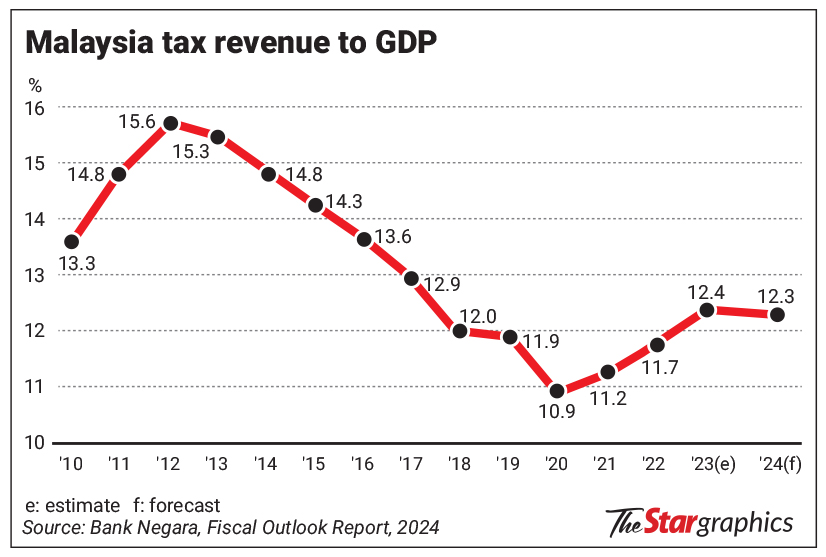
Tax revenue to GDP, one of the key ratios that Malaysia has been harping on as being too low and well below the peer average of almost 19%, is only expected to hit 12.3% in 2024 from the estimated 12.4% this year based on the projections provided in the Fiscal Outlook Report 2024.
As reflected in the accompanying chart, tax revenue to GDP fell to a low 10.9% in 2020, from a high of 15.6% in 2012. It is hoped with Budget 2024 measures, which among others include the introduction of e-invoicing from August 2024 onwards and its full application by July 2025, Malaysia will be able to see greater tax compliance as well as widen the tax net, especially those related to the shadow economy.
Ballooning infrastructure cost
Of the RM90bil in gross development expenditure, the transport sector has been allocated RM19.1bil or 21.3% of the total.
This is followed by training and education with RM14.3bil or 15.9% of the total. Other large recipients include the finance sector, with RM10.4bil allocation or 11.6% of the total, while defence and healthcare were allocated RM7.4bil and RM6.1bil, representing 8.2% and 6.8% of the total allocation, respectively.
While the budget was not about large infrastructure projects, some of the projects that were announced showed mind-boggling figures.
Case in point, the government intends to reinstate five shelved Light Rail Transit 3 (LRT3) stations at a cost of RM4.7bil, equivalent to RM940mil per station.
The additional RM4.7bil is almost 40% of the slashed-down fixed-price contract of RM11.9bil for the line.
With the additional five stations, LRT3’s cost has now increased to RM16.6bil for the 37km line or RM45mil per km.
In addition, the government also proposed to spend RM600mil for the purchase of 150 electric buses and build three new depots. Even assuming that these buses cost RM1.5mil each, do bus depots cost RM125mil each?
Overall, these are huge expenditures but when one looks into the details, the price per kilometre has been rising exponentially and it is hoped that proper budgeting, tendering, and award of contracts is done transparently.
Having reviewed some of the key highlights of Budget 2024, the budget presented at best can only be described as baby steps towards reforms. Next week, this column will take a look at the government’s financial position and where we stand towards fiscal consolidation.
Pankaj C. Kumar is a long-time investment analyst. The views expressed here are the writer’s own.
Already a subscriber? Log in
Get 20% OFF The Star Digital Access
Cancel anytime. Ad-free. Unlimited access with perks.