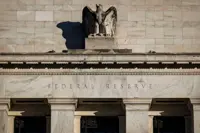
LONDON: A Federal Reserve rate hike on Wednesday will go down like a lead balloon at the White House. But the gap between President Donald Trump's wilder economic pronouncements and his new Fed chair is now so wide that the die may be cast. Trump's promise of US$5,000 checks for every American probably offends Kevin Warsh's monetarist sensibilities most of all.
Most analysts in Washington and on Wall Street think Trump's pledge of a $5,000-per-person dividend if Republicans retake Congress this November is a non-starter.
There's no clear funding source for the total cost of at least $1.2 trillion, tariff revenue projections wouldn't come close to covering it, and the prospect of the U.S. Treasury adding to its debt mountain while struggling to control decades-high borrowing rates is downright alarming.
Even if Republicans surprised and retained both houses of Congress at the midterms, it's not clear that it would get the likely necessary approval. And as it stands, betting markets see more than a 50% chance of a Democratic sweep of both houses in seven weeks' time.
Far from backing away from it, however, Trump and his Treasury Secretary Scott Bessent continued to play up the political ploy this week.
"It's easy if the Republicans win," Trump said on Sunday, adding, "we can easily handle that because we're taking in so much money."
Bessent said on Tuesday that the administration would work with House Speaker Mike Johnson on the payments if a congressional green light was needed.
Yet even if it never happens, the proposal will alarm the Trump-appointed Warsh most of all. The very idea of helicoptering money to households in an economy with stubborn, above-target inflation, accelerating growth, a business investment boom, and a burgeoning government debt problem will rankle a central bank chair with clear monetarist leanings.
The Fed won't take the proposal into account in Wednesday's deliberations, concentrating on hard data rather than Trump's speculative promises.
But there's no doubt that if those checks ever saw the light of day, they would embolden the increasingly hawkish central bank to tighten policy and mop up what Warsh would - or at least should, given his frequently aired views - see as diesel on a smouldering inflation fire.
Warsh made clear in a number of interviews before arriving at the Fed that he saw the central bank's failure to act quickly enough to tamp down a government-funded explosion of the money supply around the pandemic lockdowns as "the greatest mistake in macroeconomic policy in 45 years".
DOES MONEY MATTER?
Arguing in his annual Jackson Hole speech last month that the money supply needed to be brought back onto the Fed's dashboard, Warsh reckons that had more attention been paid to money supply during the massive policy response to the COVID-19 pandemic, officials might better have spotted the huge spike in inflation that emerged.
Congress approved three separate direct payments in March 2020, December 2020, and March 2021 as part of sweeping relief packages to help people weather the pandemic. Those payments - up to $1,200, $600, and $1,400 per adult, respectively - were phased out for higher-income earners. That amounted to 476 million payments totaling $814 billion, according to a congressional oversight committee.
Annual growth in M2, a broad measure of money and bank deposits, hit a record 27% in early 2021, more than a year before the Fed started raising rates when inflation reached 7.2% by the personal consumption expenditures (PCE) measure it uses for its target.
After briefly contracting during a series of rate hikes that ended in 2023, M2's annual growth climbed back above 5% this year for the first time in four years - although it has ebbed slightly since July.
A one-off $1.2 trillion money drop down voters' chimneys, however, would amount to more than 5% of total M2 all on its own.
"Money matters," Warsh likes to say and repeated at Jackson Hole. "It's not fashionable these days, but my view is that money has something important to do with monetary policy."
He may want to communicate that to his president, given reports of regular calls between the two since Warsh took the chair.
At the very least, Trump is not making it easy for his appointee to build a case at the Fed for the sharply lower interest rates the White House routinely demands.
If Warsh votes for a Fed rate rise on Wednesday, he will be truer to his professional convictions than the president who gave him the job. But he may do well to turn off his social media feeds afterwards. Trump's tirades against Jerome Powell for not cutting rates fast enough were vicious - and Powell wasn't even pushing rates in the opposite direction.
Perhaps if the relationship breaks down this week, it'll be easier for the Fed chair to greet any eventual stimulus checks with the monetary policy speed he claimed the central bank lacked in 2021. - Reuters
The opinions expressed here are those of Mike Dolan, a columnist for Reuters.