SHANGHAI: China’s economic growth met the government’s target last year despite a pronounced slowdown in recent months, weathering Donald Trump’s trade war by boosting exports outside the United States.
Gross domestic product rose 5%, according to data released by the National Bureau of Statistics (NBS) yesterday, confirming an estimate given by President Xi Jinping in a speech on New Year’s Eve and matching the expansion in 2024.
Chinese onshore stocks edged up slightly following the data release, while government bonds and the yuan were little changed.
While industrial production fared well in recent months, retail sales and investment worsened.
The world’s second-largest economy expanded 4.5% in the last quarter from a year earlier, in line with forecasts and the slowest pace since the reopening from Covid lockdowns in late 2022.
Nominal economic growth, which is unadjusted for price changes, was 4% in 2025, the slowest since 1976, excluding the pandemic year of 2020.
The nation’s population shrank for the fourth straight year, with the number of babies born in 2025 dropping to a record of fewer than eight million and the birth rate reaching the lowest since 1949.
“The Chinese economy withstood multiple pressures and maintained steady progress in 2025,” the NBS said in a statement.
“But the impact of the external environment is deepening, and the imbalance between strong domestic supply and weak demand is prominent. The economy still faces plenty of old problems and new challenges.”
After months of tariff chaos, China has emerged vindicated about the strength of its export-reliant economy that powered through the challenges thrown up by trade tensions with the United States.
A record US$1.2 trillion goods trade surplus provided breathing room for top officials to seek a fix for vulnerabilities that range from deflationary pressures to a persistent housing crisis.
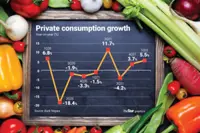
Consumer spending and business investment remain weak, as a weak jobs market and falling home prices weigh on domestic demand.
As a component of household disposable income, wage growth slowed to 5.3% in the fourth quarter from a year earlier, the weakest pace since early 2023.
Deflation has now lasted for three straight years, a record streak since China began transitioning to a market economy in the late 1970s.
Except for Japan, no other major economy has experienced such prolonged price declines since the end of World War II.
But as China navigated tariffs and growing economic protectionism around the world, its manufacturing edge and the resilience of exporters have sustained factories, keeping growth in industrial output at well over 5% for most of last year.
This uneven growth pattern will likely persist in 2026.
While Beijing shows greater willingness to help consumers, it’s unlikely to unleash massive stimulus as it continues to battle risks tied to local government debt.
China’s leadership has pledged to “significantly” boost the share of consumption in its economy in the next five-year plan, which takes effect in 2026, while keeping tech and manufacturing as the top priorities.
Beijing has also vowed to stop the historic drop in investment this year, although it remains to be seen whether local officials will actually ramp up capital expenditure on the ground.
Xi has emphasised efficiency, and the government is moving to stop cutthroat competition among companies, a campaign dubbed “anti-involution”, to curb price wars that erode profits.
Beijing has stuck to a growth target of “around 5%” for the past three years. But global banks, including Goldman Sachs Group Inc and Standard Chartered Plc, increasingly see the government lowering that goal to between 4.5% and 5% for 2026. — Bloomberg