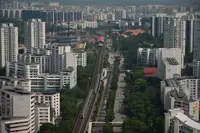
PETALING JAYA: Connectivity will continue to remain a huge factor for real estate developers, particularly as states like Johor step up infrastructure investments and deepen cross-border linkages.
But it isn’t only projects like the Johor Baru-Singapore Rapid Transit System (RTS) that is taking precedence.
Real Estate and Housing Developers Association Malaysia (Rehda) president Datuk Ho Hon Sang said the government’s plan for the elevated Automated Rapid Transit (E-ART) will further propel the state in terms of seamless entry for people and cross-business efforts into the more rural areas.
He added the government is close to finalising plans for the project.
The E-ART system, which will serve three key corridors, namely, Skudai, Tebrau and Iskandar Puteri, is said to be preferred over the light rail transit or LRT because of the length of time taken to build it.
“This system will connect all other parts of Johor. It will be a last mile type of connection and we view it positively. Despite it being in progress, many are already looking forward to it,” he told StarBiz at the Rehda CEO Series 2026 conference here yesterday.
According to Ho, he foresees property adjacent to train stations and depots seeing a tremendous hike in prices.
“There may be some tenants who will be forced to leave and perhaps other parties will come in to take over. But as far as Rehda is concerned, we’ve noticed that these properties are rapidly developed, launched and are doing very well,” he noted.
When launched, Ho said a handful of these properties were unaffordable for Malaysians, but as more were being pushed to the market – prices came down.
“Prices have mellowed, which has resulted in many Malaysians buying these properties, so there is no potential of an oversupply,” he said.
On the RTS, Transport Minister Anthony Loke said the project was running on schedule and a bill to facilitate border control arrangements would be tabled next month in Parliament.
He explained the regulations were necessary to enable the co-location of Customs, Immigration and Quarantine facilities for the RTS Link.
“There will be Singapore immigration officers stationed at Bukit Canggah while our local immigration officers will be at Woodlands. This reflects the strong cooperation between the two countries and that is very important.”
Meanwhile, on a separate note, Rehda Institute chairman Datuk Jeffrey Ng Tiong Lip said home ownership among the country’s middle-income (M40) group had dropped below the rate of the low-income (B40) group.
He said this was because of a development model reliant on cross-subsidisation, which has inflated open-market home prices. Ng said that right now, the responsibility for delivering price-controlled housing and absorbing project-level risks lies almost entirely with developers – causing elevated overall market prices.
“The B40 households continue to struggle to purchase houses, while M40 homeownership dropped to 75.9%, below the B40 rate of 76.3%. The current model is no longer sustainable,” he said.
This has also inevitably led to financial stress, cost pressures for projects and even abandoned home projects. He noted based on previous data and research, challenges proved to be systemic rather than developer-specific.
“The challenge before us, therefore, should not be viewed narrowly as one of housing affordability alone, but as a question of delivery sustainability and ecosystem resilience. It spans land policy, financing structures, infrastructure and utility provision, compliance costs and approval processes,” he said.
With that, Ng said the financial sector needs to play a more reactive role – not only as a lender, but as a partner in delivery.
He said that these included preferential financing for first-time homebuyers, more flexible pricing of risk through longer tenures or income-responsive repayment structures, and targeted risk-sharing mechanisms supported by policy incentives.
“At the same time, utility providers must be part of the solution, through more equitable cost-sharing arrangements for infrastructure provision. State and local governments also play a decisive role, particularly by streamlining approvals and accelerating speed to market.”