PETALING JAYA: The adoption of sustainable aviation fuel (SAF) in Malaysia will have wide-ranging impact on businesses such as domestic airlines, energy and petro-chemical, as well as plantation and agribusiness companies and the institutional investors who allocate capital to them.
While Malaysia has identified SAF as a cornerstone to the country’s pathway of achieving net-zero emissions by 2050 through the Malaysia Aviation Decarbonisation Blueprint (MADB) that was unveiled in September 2024, BIMB Securities said the roadmap laying out the adoption of this fuel lacks binding enforcement mechanisms or interim milestones.
“This absence of clear mandates may delay adoption by domestic airlines, potentially weakening Malaysia’s alignment with global climate policies and undermining its competitiveness in international aviation markets,” it said.
It noted that Singapore had mandated a 1% SAF blending requirement by this year for all departing flights.
Singapore’s requirement would rise from 3% to 5% by 2030, while Japan and South Korea, which have been investing heavily in SAF, have targets of 10% by 2030 and 1% by 2027, respectively.
With SAF integrated into the National Energy Transition Roadmap, the indicative targets for its blending into aviation fuel starts at 1% in the near term to scaling up progressively to 47% by 2050.
Under the MADB, SAF has been projected to contribute to the largest share of carbon reductions, accounting for up to 46% of aviation emission savings by mid-century.
The brokerage pointed out that the primary obstacle to more SAF adoption remains its high cost, as it can be from two to four times more expensive than conventional jet fuel.
Supply, meanwhile, remains another obstacle as global production continues to be limited despite countries such as Malaysia, Singapore, Japan and China expanding production capacity.
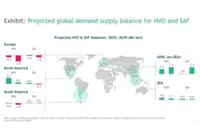
“On the supply side, Malaysia is preparing for significant SAF production capacity by 2027,” it said.
The country’s SAF industry would see two significant producers, Petroliam Nasional Bhd with a 650,000-tonne refinery in Pengerang, Johor, and EcoCeres Inc, a Hong Kong-based renewable fuels company with a 350,000 tonne facility in Pasir Gudang, Johor.
It said while the supply side has gathered momentum, costlier SAF that can be three times higher limits voluntary intake from airlines based in the country, with a comprehensive framework on certification, blending rules and cross-sector coordination still under development, creating uncertainty over market access and demand visibility.
“Malaysia’s policy choices over the next five years will determine whether SAF ambitions align with domestic decarbonisation and regional competitiveness,” it said.
It added that despite production capacity scaling significantly by 2027, domestic consumption may remain limited without robust mandates, subsidies or corporate commitments.
“For investors and corporates, this gap underscores both the risk of stranded assets and the opportunity to influence policy direction, ensuring that Malaysia’s SAF industry supports local demand as well as export markets,” it said.
“The interplay of regulatory clarity, production capacity and adoption costs will shape the trajectory of several sectors, particularly aviation, energy, plantations and infrastructure,” it added.
It suggested that one effective strategy could be collective advocacy through the forming of alliances by stakeholders to present a unified voice to policymakers.
“Such coalitions can demonstrate the commercial readiness of SAF supply chains while highlighting the risks of inaction, such as stranded investments and loss of competitiveness against regional peers,” it said.