
ON-the-ground feedback and various surveys have consistently showed that businesses remain under operational and financial strains in 2024-2025, primarily driven by rising input costs, economic uncertainty, rising wages, supply chain issues, evolving regulatory environments and other structural factors.
ACCCIM M-BECS – the Malaysia’s Business and Economic Conditions Survey, a regular survey by the Associated Chinese Chambers of Commerce and Industry of Malaysia in collaboration with Socio-Economic Research Centre or SERC – has consistently ranked high operating cost as the most dampening factor affecting business performance in 2023-2024.
More than 70% of respondents indicated higher cost of local inputs in the first half of 2025, of which over a quarter (25.6%) have experienced an increase of more than 10%.
Businesses, particularly micro, small and medium enterprises (MSMEs) are facing margin pressures and operational challenges.
Cautious and weak consumers discretionary spending has restrained retailers to adopt selective pass-through of increased costs onto their customers, and hence, their profit margin has narrowed or even declined.
Our tabulation of some listed retailers operating in the mall companies have experienced decreased or slowed net profit margin growth due to weak demand, increased competition, and higher production costs, rising input and labour costs, logistics services and the implementation of the expanded sales and service tax (SST), in particular the 8% service tax on rental.
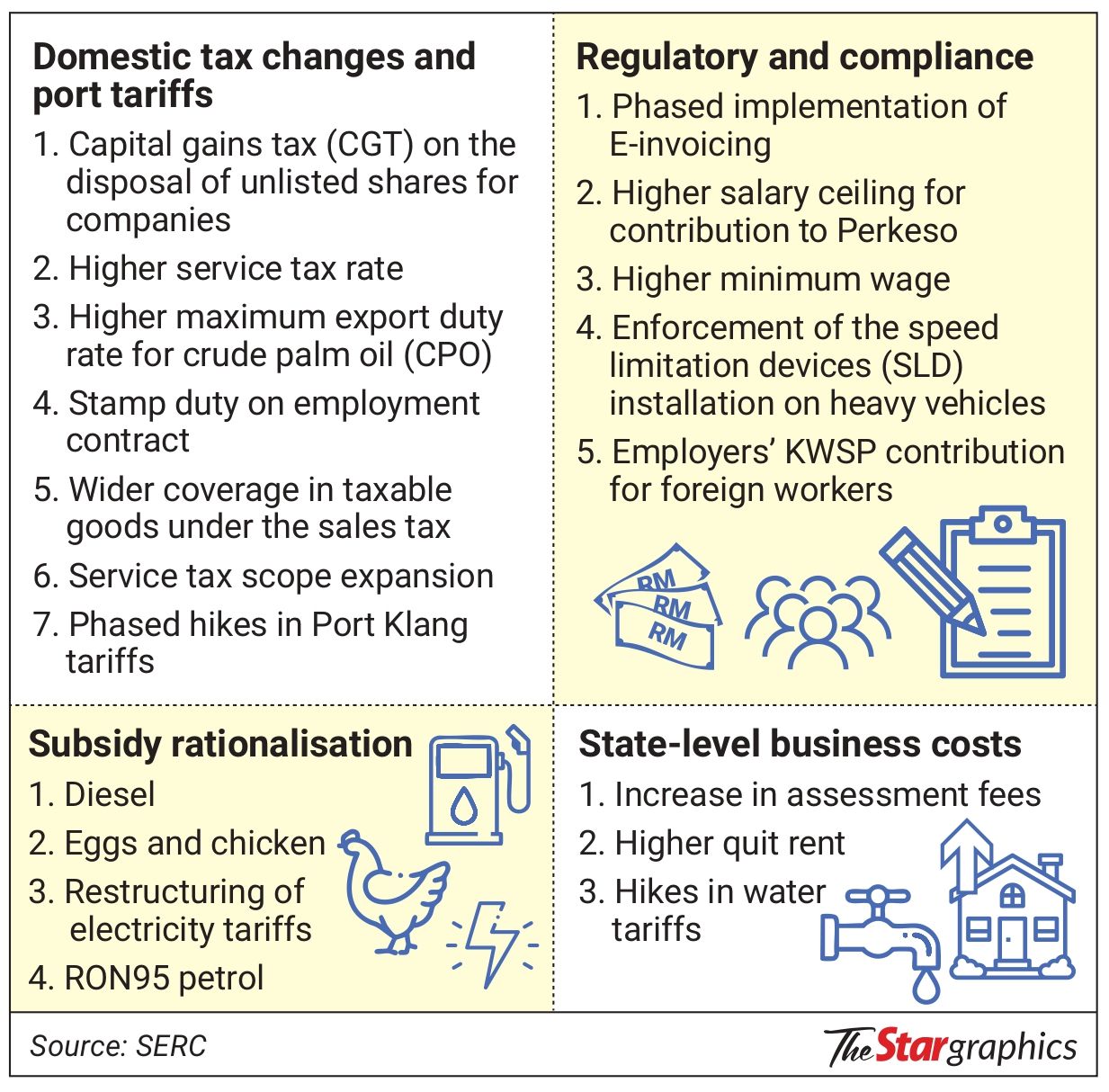
In 2024-2025, businesses have been inundated with cost pressures due to a combination of tax, regulatory and policy changes.
There were seven domestic tax and port tariff adjustments, which amongst these include higher service tax rate and expanded scope of the SST, stamp duty on employment contract, and the capital gains tax (CGT) on the disposal of unlisted shares.
Additionally, there were five mandatory regulatory-related policies, including higher statutory payments (such as higher minimum wage, and employers’ Employees Provident Fund or EPF contributions for foreign workers and higher salary ceiling for contribution to the Social Security Organisation or Perkeso) as well as new compliance cost (phased implementation of e-invoicing); subsidies rationalisation and dismantling of price controls, including eggs, diesel and petrol, as well as restructuring of targeted electricity tariffs (see chart).
At the state level, all states saw an increase in water tariffs between two sen and 10 sen per cubic m in 2024, while most states have experienced steeper hikes in 2025, ranging from 12 sen to RM1.75 per cubic m, exerting considerable pressure on non‑residential users.
Quit rent/parcel rent in Penang has increased by between 29% and 200%, depending on the land category and location (urban vs rural), effective from Jan 1, 2026.
Selangor’s assessment fees have increased by 25%.
The industries exporting to the US market will pay a 19% tariff, adding onto existing tariffs for selected products such as machinery and equipment, optical and scientific instruments, and non-medical gloves as well as furniture.
Products under Section 232 measures, such as automobile parts, copper, steel and aluminium will face a higher tariff of 25% to 50%.
Sectoral tariff risks in the semiconductor, critical minerals and pharmaceutical industries remain a significant and volatile factor in the current global trade environment.
Amid the challenging economic conditions, weak consumer purchasing power and discretionary spending, and in such a competitive trading environment, broad sweeping cost increases have taken a heavy toll on MSMEs.
For example, an increase in the minimum wage and the EPF contribution to foreign workers in 2025 could add an additional 14.1% to personnel cost. Adding on additional measures, overhead costs and operating expenses have increased substantially.
The increase in business costs is compounded by the influx of foreign businesses, which have disrupted the domestic market balance by creating an uneven playing field, whereby local micro and small businesses struggle to compete, potentially leading to their decline in sales, and losses of market share.
Another big concern raised by the industry stakeholders is the sudden, blanket enforcement of the ruling on overloaded commercial vehicles.
While the logistic players, including specific industry and trucking associations supported the principle of enforcing load limits for safeguarding public road safety reasons, they have appealed for a phased implementation or transition period to allow businesses time to adjust their operations.
As the logistics sector contributed between 4% and 5% of total economy, the supply chains disruption caused by the enforcement of load limits has both direct and indirect impact on various industries (such as construction, retail, manufacturing) not only resulting in increased operating costs, higher cost of inputs and materials, but also potentially delay the implementation of projects.
With a myriad of global and local forces putting pressure on business costs, it is vital that the government and local authorities have complete visibility of the implications of domestic tax and regulatory changes, as well as compliance requirements on domestic MSMEs.
In 2024, Malaysia’s 1,130,558 MSMEs, which made up 96.1% of all businesses (67.4% were micro and 27.1% were small), formed an important backbone of Malaysia. All MSMEs have generated RM652.4bil worth of national output or 39.5% of total gross domestic product or GDP; employing 8.1 million employees (48.7% of total employment); and contributed 14.3% of total export of goods and services.
MSMEs are an important driver of domestic direct investment (DDI), with over 80% operating in the services sector encompasses wholesale/retail trade, food and beverages, and transportation. This followed by about 9% in the construction sector, and about 5.4% in the manufacturing sector.
A slowdown in their business activity could result in broader economic effects. When businesses face challenges like reduced consumer demand, higher operating costs, and lower profitability, they often resort to cost-cutting measures, which can lead to job losses and hiring freeze.
A self-perpetuating cycle would ensue – pay or job cuts lower consumer confidence and spending power, which in turn, can slow the economy down even more.
Pragmatism in government’s policies are a crucial factor for achieving stable and sustainable economic and business growth.
It must prioritise and recalibrate policies and measures based on evolving market conditions and changing circumstances, rather than being bounded by rigidities and a dogmatic approach.
Flexibility and adaptability are needed in dynamic environments, with swiftly adjusting policies in response to evolving market conditions and business landscape.
The government’s recalibration measures can be in the form of providing financial support (lower interest loans, and credit guarantees) to help businesses with cash flow and operational costs; implementing temporary tax cuts, deferrals on tax payments, or expanding tax credits to free up capital for businesses; and regulatory flexibility, that is temporarily easing regulations or streamlining bureaucratic processes to reduce the administrative burden on businesses.
The government must promptly recalibrate its measures to ease the burden on MSMEs, primarily focusing on reducing regulatory compliance costs, improving cash flow, and providing a conducive environment for businesses to thrive.
Assessing the collective impact of all regulations and to prevent “behavioral overload” for businesses.
A gradual pace of policy implementation allows businesses to adapt and sufficient industry engagement helps businesses more prepared to respond.
MSMEs have recently “sighed in relief” over an increase in the e-invoice exemption threshold from RM500,000 to RM1mil in 2026; an increase in allocation to RM4bil from RM2bil for tax refunds; two-year moratorium with no enforcement and no penalty on the reporting of jobs vacancies to Perkeso; will consider exempting micro and small enterprises from the duty of reporting job vacancies; and has abolished the proposed RM10,000 penalty for employers who fail to notify Perkeso of job vacancies.
It is widely expected that the government is unlikely to implement policies that would unnecessarily increase operational costs for businesses, especially during times of challenging economic and business uncertainties, heightened rising costs, pressures on businesses’ revenue, and facing tough competition from the influx of foreign businesses.
Some planned measures or implemented measures could be reviewed or recalibrated to further ease cost burden on businesses.
These include reviewing the expanded SST, particularly on the exemption threshold for SMEs, service tax rate on rental services; and increasing the threshold (currently for the first RM150,000) for SMEs enjoying the preferential tax rate of 15%.
The planned carbon tax and multi-tier levy mechanism or MTLM implementation may be put on hold.
Lee Heng Guie is the executive director of the Socio-Economic Research Centre. The views expressed here are the writer’s own.